
3:07 a.m. You know it’s roughly that before you even look. Same as last night, and the night before. The house is quiet, nothing hurts, nothing woke you that you could point to — and yet you’re completely, stubbornly awake.
If that sounds familiar, here’s the first thing worth knowing: the waking itself is almost certainly normal. Everyone surfaces a handful of times a night between sleep cycles. Most people drop straight back under and never remember it. What turns a two-second blip into an hour of staring at the ceiling is usually what happens after you wake. And that part you can change.
Why it’s always the same hour
It feels personal, the way it’s always 3-something. It isn’t. Two things line up in the early hours, and together they make that window the easiest point of the whole night to wake up.
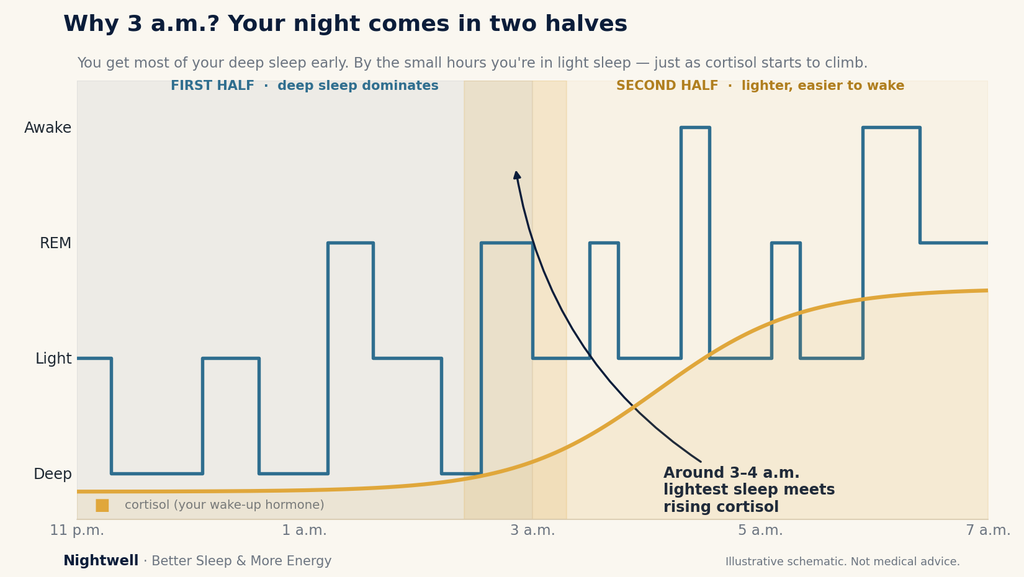
The first is how your sleep is laid out. You cycle through light sleep, deep sleep and REM roughly every 90 minutes, but the cycles aren’t identical. Your body front-loads deep sleep — the heavy, hard-to-wake kind — into the first few hours. By around 3 a.m., most of it is used up. What’s left is lighter sleep and more REM, and you can be pulled out of both by things that wouldn’t have registered at midnight.
The second is cortisol. It has a reputation as the stress hormone, but its day job is getting you up in the morning. It bottoms out in the evening, starts climbing during the second half of the night, and peaks shortly after you wake. So at 3 a.m. you’ve got the lightest sleep of your night meeting a wake-up signal that’s already switching on. Add a stressful week and that signal tends to come in stronger and earlier — which is why a rough patch at work so often shows up as 4 a.m. wakefulness before it shows up as anything else.
One more piece, briefly: age. Sleep gets lighter and more broken as we get older, with less deep sleep and more wake-ups. If your nights have slowly changed over the years, that’s part of the picture — not a sign that something is broken.
Which kind of 3 a.m. waker are you?
“Why do I wake up at 3 a.m.?” has a different answer for different people. Rather than reading through every possible cause, it’s more useful to work out which one is yours. Go through these honestly.
Do you wake up warm, with the duvet half kicked off?
Then heat is the likeliest trigger — and the easiest to fix. Most adults sleep best in a room somewhere around 60–67 °F (roughly 15–19 °C), which is cooler than most people keep their bedroom. Our guide to the best temperature for sleep walks through how to get there without a big energy bill.
Did you have a drink that evening?
Check whether the bad nights line up with the glasses of wine. Alcohol knocks you out quickly, but as your body processes it over the next few hours the effect flips, and the second half of the night turns choppy. If there’s a pattern, you’ve found your answer. Try a few alcohol-free evenings, or finish earlier, and compare.
Is your mind already running the second your eyes open?
Emails, money, a conversation you’re dreading. This is the most common version, and the cortisol rise above is why. The fix here has less to do with the bedroom and more to do with what you do in those first minutes awake — more on that below.
Is there light or noise you’ve stopped noticing?
A standby LED, a gap in the curtains, a street that gets its first delivery van at four. In deep sleep you’d never notice. In light sleep, it’s enough. Blackout curtains or a sleep mask, plus a fan or white-noise source, are cheap, boring fixes that work.
Do you need the toilet?
Also easy to sleep through early in the night and much harder to ignore later. Easing off drinks in the last hour or two before bed often helps. If it’s happening several times a night, mention it to your doctor.
Do you wake up feeling like you barely slept, even on nights without a 3 a.m. wake-up?
That’s a slightly different problem. Have a look at why you’re tired even after eight hours — some of the causes overlap, some don’t.
Plenty of people tick two or three of these. Start with whichever is easiest to change and give it a week before moving on to the next.
The waking isn’t really the problem. Staying awake is.
Here’s the loop most people get stuck in. You wake up. You check the time. Your brain immediately starts doing arithmetic — 3:14, alarm at 6:30, so if I drop off now… — and that little calculation wakes you up a bit more. Ten minutes later you’re annoyed. Twenty minutes later you’re worried about how tomorrow will go. Repeat that for a few weeks and your brain starts linking the bed itself with lying there frustrated.
That’s why “just try harder to sleep” never works. Sleep isn’t something you can push toward. The only real move is to take the pressure off long enough for it to come back by itself.
What to do tonight, when it happens
- Don’t look at the clock. Turn it away from the bed before you go to sleep. Knowing it’s 3:14 gives you nothing except something new to worry about.
- Leave the phone alone. The screen is bright, and whatever you open — messages, news, “just checking” — flips your brain into daytime mode. If your phone is your alarm, put it face-down and out of reach.
- Give your mind something dull to do. Slow breathing with a longer out-breath than in-breath works for a lot of people. So does cognitive shuffling: pick a random word, then think of unrelated things starting with each of its letters — b: bicycle, banana, bridge… It’s just engaging enough to crowd out the worries, and not engaging enough to wake you further.
- If it feels like you’ve been awake about 20 minutes, get up. Don’t check — estimate. Go to another room, keep the light low, and do something quiet and unexciting: a dull book, gentle stretching, calm audio. Go back to bed when you actually feel sleepy. This is called stimulus control, it comes from cognitive behavioral therapy for insomnia, and both the Sleep Foundation and Mayo Clinic recommend it.
Step 4 is the one almost everyone skips, because leaving a warm bed at 3 a.m. feels like giving up. It’s the opposite. It’s the most reliable way to stop your bed from becoming the place where you lie awake.
What to change over the next two weeks
The in-the-moment tricks help you get back to sleep. To make the wake-ups rarer in the first place, a few daytime habits do most of the work.
Keep one wake-up time. The same time every day, including after a bad night and including weekends. It’s the least exciting advice in sleep science and one of the most effective, because it anchors your body clock — including when that cortisol rise kicks in. It helps to know how much sleep you actually need at your age, so you can set a bedtime that fits.
Get daylight early. Ten or fifteen minutes outside within an hour of waking reinforces the same rhythm. An overcast sky still counts.
Move your caffeine earlier. Caffeine hangs around far longer than it feels like it does, and an afternoon coffee can still be thinning out your sleep at 3 a.m. If you want a specific cut-off, here’s what time to stop drinking coffee.
Keep a simple log. Nothing fancy — a note on your phone each morning (not at night) with four things: roughly when you went to bed, whether you drank alcohol, whether the room felt warm, and whether you woke in the night. After two weeks, patterns tend to jump out that you’d never spot from memory. It’s also exactly what a doctor will want to see if you end up going.
What we wouldn’t reach for first: sleeping pills or melatonin. They have their place, but neither fixes whatever is waking you, and the evidence for melatonin is stronger for falling asleep and shifting your body clock than for staying asleep through the night.
When it’s worth seeing a doctor
An occasional 3 a.m. wake-up doesn’t need fixing. But it’s worth talking to a doctor if it’s happening three or more nights a week for several weeks, if it’s dragging down your energy or mood during the day, or if something else comes with it — loud snoring or gasping, restless or twitchy legs, pain, or persistently low mood. Those can point to things like sleep maintenance insomnia, sleep apnea or restless legs, which are worth ruling out properly.
And if it does turn out to be ongoing insomnia, the first-line treatment isn’t a pill. It’s cognitive behavioral therapy for insomnia (CBT-I), a short, structured program whose benefits tend to last after it ends — something medication can’t claim. Several of the techniques above come straight out of it.
So: the 3 a.m. wake-up is mostly your biology doing what it’s built to do. You can’t delete that moment. What you can change is whether it lasts ten seconds or two hours — and for most people, that comes down to a cooler room, a clock turned to the wall, and the discipline to get up instead of lying there fighting it.
General information only, not medical advice. If waking at night is frequent, persistent or affecting your days, please speak to a qualified healthcare professional.
Comments on “Why You Wake Up at 3 a.m. Every Night (and How to Stop)”