
The short answer
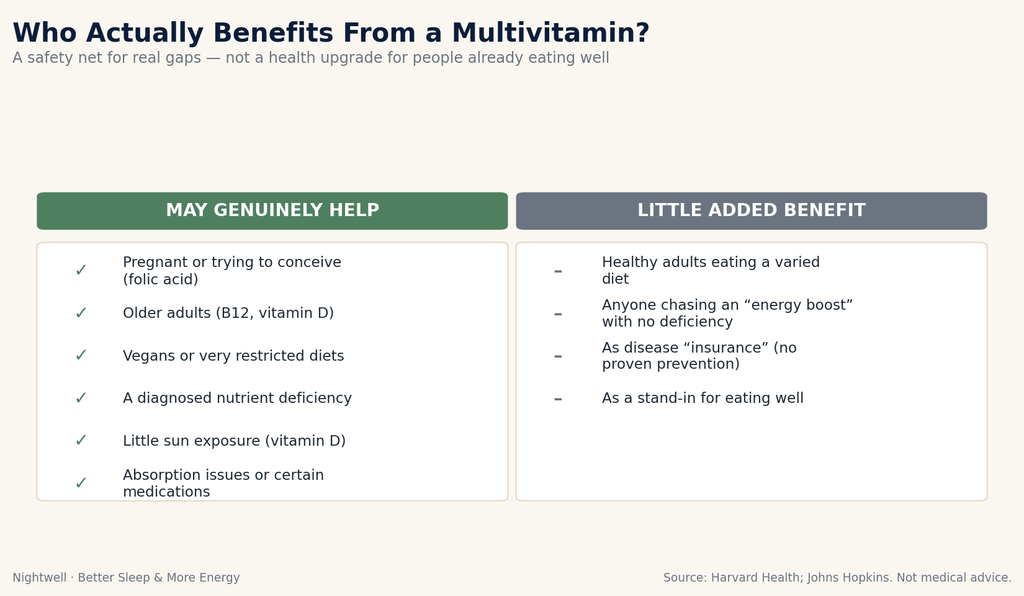
Multivitamins are the most popular supplement on the planet, but the honest verdict is underwhelming. For most healthy people who eat a reasonably varied diet, a daily multivitamin does very little — it won’t give you more energy, and the evidence says it won’t prevent disease. Where it genuinely earns its place is narrower: filling a real gap when you have a diagnosed deficiency or a higher need, such as pregnancy, older age, or a restricted diet. Think of it as a modest safety net, not a health upgrade — and definitely not a substitute for eating well.
What the evidence actually shows
This is one of the most studied questions in nutrition, and the results are remarkably consistent. Large, long-term trials — including the Harvard Physicians’ Health Study and the Women’s Health Initiative — found that multivitamins did not reduce the risk of major outcomes like cancer, heart attack, or stroke in generally healthy people. Reviewing the field, the US Preventive Services Task Force concluded there is insufficient evidence to recommend multivitamins for preventing cardiovascular disease or cancer in healthy, well-nourished adults.
Doctors at Harvard and Johns Hopkins land in the same place: for someone already eating a balanced diet, a multivitamin offers no special health benefit or disease protection. That doesn’t make them dangerous — at sensible doses they’re low-risk — but it does mean the glossy promise on the bottle is mostly marketing. The strongest evidence in nutrition still points to unglamorous basics: a good diet, a healthy weight, and less saturated fat, sodium, and sugar.
But will it give me more energy?
This is the big one for anyone reaching for vitamins to beat afternoon fatigue, so it’s worth being clear. Yes, vitamins — especially the B group — are essential for turning the food you eat into usable energy. But that does not mean topping up beyond what your body needs adds extra energy. If you’re not short on a nutrient, swallowing more of it won’t give you a boost; your body simply processes the excess. The “energy” claim on a multivitamin label trades on a real biological role while quietly implying a benefit that isn’t there for most people.
The one genuine exception is when persistent tiredness is caused by an actual deficiency. Low iron or low vitamin B12, for instance, can cause real fatigue — and correcting that deficiency can make a noticeable difference. But the key word is correcting: the fix is identifying and treating the specific shortfall, ideally confirmed by a doctor, not blanketing the problem with a generic multivitamin and hoping. Our guides on iron and energy and vitamin B12 and energy dig into those specific cases.
Who actually benefits
None of this means multivitamins are useless for everyone. There are well-defined situations where they make real sense, usually because a person’s needs are higher or their diet can’t easily cover the gap.
- Pregnancy or trying to conceive. This is the clearest case. Folic acid before and during early pregnancy helps prevent serious birth defects, which is why prenatal vitamins are widely recommended. Extra iron is often beneficial here too.
- Older adults. The ability to absorb vitamin B12 can decline with age, and many older people get less vitamin D, so a supplement can help bridge the difference.
- Vegans and very restricted diets. Vitamin B12 comes almost entirely from animal foods, so people eating fully plant-based diets generally need a reliable source such as a supplement or fortified foods.
- Diagnosed deficiencies. If a blood test shows you’re low in something, targeted supplementation — guided by a professional — is exactly the right tool.
- Limited sun exposure. Your skin makes vitamin D from sunlight, so people who get little of it may fall short and benefit from a D supplement.
- Absorption issues or certain medications. Some medical conditions and drugs interfere with how you absorb nutrients, which can justify supplementation under medical guidance.
Food first — where nutrients really come from
For nearly everyone else, the better strategy is to get your nutrients the way your body is built to: from food. A diet with plenty of fruit, vegetables, whole grains, decent protein, and healthy fats supplies most of the vitamins and minerals you need, in forms and combinations that work together. Food also brings fibre, protein, and other compounds a pill can’t replicate. Our guide on eating for energy covers this in practice, and a pattern like the Mediterranean diet is a good template.
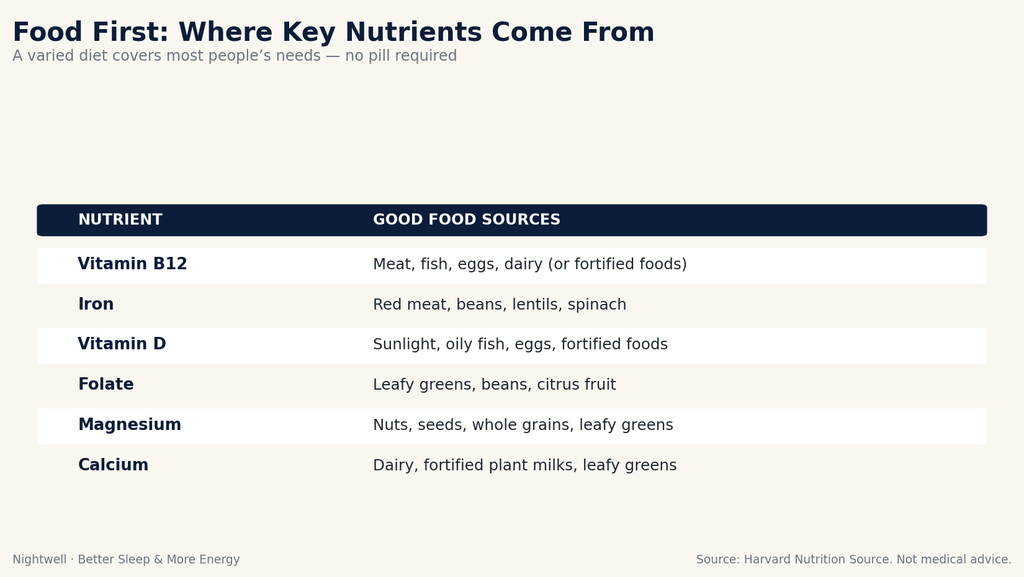
If you look at the table above and realise a couple of those foods rarely make it onto your plate, that’s far more useful information than any supplement. It tells you exactly where to adjust — add some leafy greens, a portion of oily fish, a handful of nuts — and closes the gap at the source rather than papering over it.
Safety: more is not better
Because multivitamins feel harmless, it’s easy to assume that if a little is good, more must be better. That’s not how it works, and with some nutrients it can cause harm. The fat-soluble vitamins — A, D, E, and K — are stored in the body rather than flushed out, so high doses can build up. Large amounts of vitamin A and E in particular have been linked to harm, so megadoses are something to avoid unless a doctor specifically directs them.
A couple of other realities are worth knowing. Supplements are regulated more like food than medicine, so quality and label accuracy can vary between products, and “natural” does not automatically mean safe or necessary. Supplements can also interact with medications. The sensible move — especially if you’re pregnant, managing a health condition, or taking other medicines — is to check with a doctor or pharmacist before starting, rather than assuming a multivitamin is automatically fine.
Gummies, greens powders, and “energy” formulas
The supplement aisle keeps inventing trendier ways to sell the same idea, and most deserve a sceptical eye. A few worth knowing about:
- Gummies. They’re pleasant to take, but that’s part of the problem — they often carry added sugar, can deliver less than the label suggests, and are easy to over-consume because they feel like candy. Convenience, not superiority.
- Greens powders. Marketed as a shortcut to your vegetables, they’re typically expensive and backed by thin evidence, and they are not a replacement for actual produce with its fibre and bulk. If your diet is short on vegetables, adding vegetables is the fix.
- “High-potency” and effervescent energy formulas. These often pack mega-doses of B vitamins. That bright-yellow urine afterwards isn’t a sign it’s “working” — it’s your body excreting the excess riboflavin it couldn’t use. Beyond correcting a deficiency, more does not equal more energy.
The pattern across all of them is the same: a fancier format doesn’t change the underlying science. Whatever the packaging, the honest questions remain “do I have a genuine gap?” and “would food close it better?”
If you do take one, choose sensibly
Maybe your diet is genuinely patchy, or you simply like the reassurance of a safety net. That’s a reasonable personal choice, and at modest doses there’s little downside. If you go that route, a few principles keep it sensible.
- Stick to modest amounts. Look for a multivitamin close to 100% of daily needs rather than mega-dose “high potency” formulas.
- Match it to you. Choose one suited to your age and situation rather than whichever bottle is biggest or trendiest.
- Favour tested brands. Independent, third-party quality testing is a reasonable proxy for a product actually containing what it claims.
- Don’t let it license a poor diet. A multivitamin can’t undo an unbalanced diet, and treating it as permission to eat badly defeats the point.
The bottom line
Multivitamins are cheap, popular, and mostly oversold. For a healthy person eating a varied diet, they won’t boost your energy or protect you from disease — the science on that is clear. Their real value is as a targeted safety net for people with higher needs or genuine gaps: pregnancy, older age, restricted diets, limited sun, or a diagnosed deficiency. If you’re tired and hoping a multivitamin is the answer, the more productive steps are improving your diet and, if fatigue persists, getting checked for a specific deficiency. Build the foundation with food; use a supplement to fill a real gap, not to buy peace of mind. Save your money and attention for the things that genuinely move the needle — what’s on your plate, how well you sleep, and how much you move.
This article is for general information and isn’t medical advice. If you’re persistently tired or think you may have a nutrient deficiency, please see a qualified healthcare professional for proper testing rather than self-diagnosing — and check before taking high-dose supplements, especially during pregnancy or alongside other medications.
Sources: Harvard Health – Is It Okay to Take Multivitamins? · Harvard T.H. Chan Nutrition Source – Should I Take a Daily Multivitamin? · Johns Hopkins Medicine – Is There Really Any Benefit to Multivitamins?
Comments on “Do Multivitamins Actually Work? What the Science”