
The short answer
If you took every principle in this cluster — steady blood sugar, plenty of fibre, whole foods over processed, healthy fats, a happy gut — and rolled them into one way of eating, you’d get something very close to the Mediterranean diet. That’s not a coincidence, and it’s why this is the one eating pattern worth calling a gold standard. It’s been named the world’s best diet for years running, it’s among the most-researched approaches in all of nutrition, and it delivers on energy and long-term health without gimmicks, calorie-counting, or deprivation. Best of all, it isn’t really a “diet” — it’s a sustainable, enjoyable lifestyle.
What it actually is
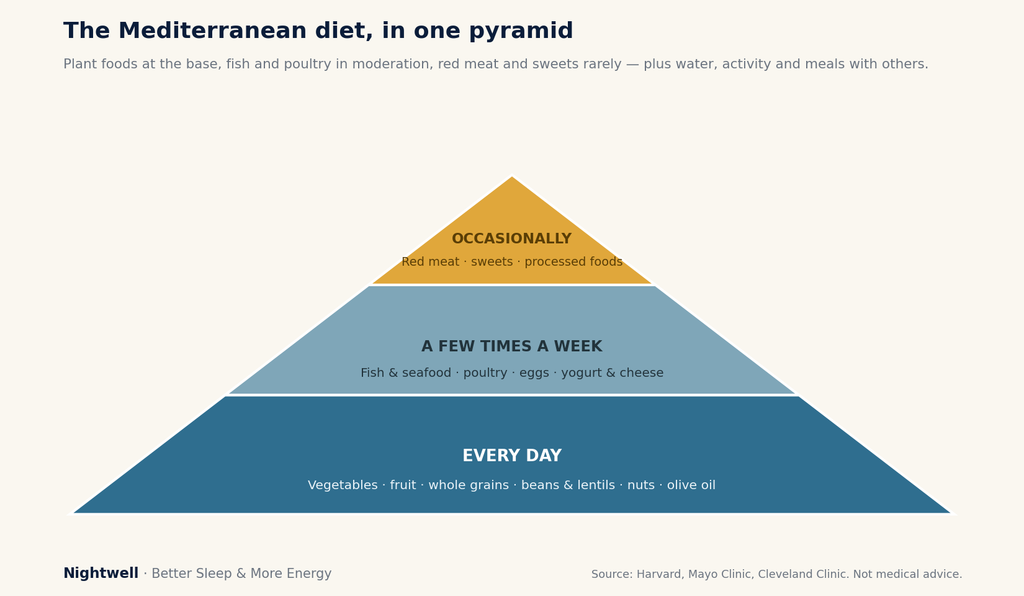
The Mediterranean diet is a plant-forward pattern inspired by the traditional cuisines of countries around the Mediterranean Sea — Greece, Italy, Spain, and beyond. Crucially, the emphasis is on what to eat, not what to cut out. The pyramid above sums it up:
- Every day, at most meals: vegetables, fruit, whole grains, beans and lentils, nuts and seeds, and extra-virgin olive oil as the main fat.
- A few times a week: fish and seafood, poultry, eggs, and moderate dairy — especially yogurt and cheese.
- Only occasionally: red meat, sweets, refined grains, and processed foods.
Roughly speaking, a traditional version lands around 40% carbohydrates, 40% healthy fats, and 20% protein — but you don’t need to count anything. The simplest mental model: make vegetables and whole grains the main event, treat meat as a side rather than the centrepiece, use olive oil generously, and enjoy fruit as dessert.
Why the evidence is so strong
Plenty of diets make big promises; the Mediterranean pattern is unusual in actually having decades of solid research behind it. It’s been ranked the number-one diet by major expert panels for years in a row, and health bodies from the Mayo Clinic to Harvard to the Cleveland Clinic point to a consistent list of benefits:
- Heart health: it lowers LDL (“bad”) cholesterol and blood pressure and is repeatedly linked to lower rates of heart attack and stroke.
- Blood sugar and diabetes: its fibre-rich, low-glycaemic foods improve insulin sensitivity. A major Spanish trial (PREDIMED-Plus) found an energy-reduced Mediterranean diet plus activity cut the risk of developing type 2 diabetes by around 31%.
- Brain health: the antioxidants and omega-3 fats are associated with better memory and focus and a lower risk of cognitive decline.
- Longevity: studies of the world’s longest-living communities consistently feature Mediterranean-style eating.
- Lower inflammation and a healthier gut, both of which underpin the rest.
Why it’s so good for your energy
This is a “More Energy” site, so let’s connect the dots — because almost everything that makes the Mediterranean diet healthy also makes it energising:
It keeps your blood sugar steady. Built on fibre-rich whole grains, legumes, vegetables, and fruit, with protein and healthy fats alongside, it’s the very definition of the slow-release eating we describe in eating for steady energy. No spikes, no crashes — just even fuel through the day.
It’s loaded with fibre. Between the beans, whole grains, vegetables, and nuts, this pattern easily closes the fibre gap most people have — steadying energy and feeding a healthy gut in one move.
It nourishes your gut. The sheer diversity of plants supports a varied, resilient microbiome — exactly the “eat the rainbow” principle from our piece on gut health and energy.
It fights inflammation. Olive oil’s polyphenols and fish-derived omega-3 fats help lower the chronic, low-grade inflammation that quietly saps energy — giving a plausible biological reason behind the decades of population data.
It’s nutrient-dense. Rich in the vitamins and minerals (including iron and B-vitamins) your body needs to turn food into usable energy, while going light on the refined sugar and processed food that drag you down.
It’s more than food
One reason the Mediterranean lifestyle works where strict diets fail is that it’s about how you eat, not just what. In the traditional pattern, meals are unhurried and social — eaten with family and friends rather than alone at a desk — which supports better digestion and lower stress. Regular physical activity is woven into daily life. And there’s room for pleasure: a glass of wine with dinner, good bread, real cheese, in sensible amounts. This is why it’s sustainable. You’re not white-knuckling through deprivation; you’re eating well, and enjoying it, for life.
How to start — without overhauling your life
You don’t need to move to Greece or master unfamiliar recipes. The smartest approach is gradual: shift one meal a day toward the pattern and build from there. Practical first steps:
- Swap your cooking fat to extra-virgin olive oil.
- Add a vegetable (or two) to every meal, and make them the biggest thing on the plate.
- Eat beans or lentils a few times a week — in soups, salads, stews, or as a side.
- Choose whole grains over refined: whole-grain bread and pasta, brown rice, oats.
- Have fish twice a week, and treat red meat as an occasional guest rather than a staple.
- Snack on nuts and fruit, and let fruit be your everyday dessert.
- Use herbs, garlic, lemon, and spices to make simple plant food genuinely delicious — flavour is what makes this sustainable.
Start with foods you already like, and don’t aim for perfection. Every meal shifted in this direction is a win, and over a few weeks the swaps become habits.
An honest word
No eating pattern is a magic cure, and the Mediterranean diet won’t undo poor sleep, chronic stress, or a sedentary life on its own — it works best as part of the whole picture, alongside good sleep and regular movement. It’s also a flexible pattern, not a rigid rulebook, so ignore anyone selling a strict, expensive version of it. But among all the diets competing for your attention, this is the one with the deepest evidence, the fewest downsides, and the most staying power. If you adopt just one framework for eating well, this is the one to choose.
The bottom line
The Mediterranean diet earns its “gold standard” title because it isn’t a fad — it’s a durable, evidence-backed way of eating that steadies your energy, protects your heart and brain, nourishes your gut, and supports a long, healthy life, all while being genuinely enjoyable. Fill your plate with vegetables, whole grains, beans, fruit, nuts, and olive oil; add fish and poultry in moderation; keep red meat and sweets for special occasions; and eat it slowly, ideally in good company. Do that consistently and you’re not on a diet at all — you’re simply living in a way that keeps you energised for the long run.
This article is for general information and education and isn’t medical advice. If you have a health condition or specific dietary needs, please talk to a qualified healthcare professional or registered dietitian.
Sources: Harvard T.H. Chan School of Public Health — Mediterranean Diet Review; Cleveland Clinic — What Is the Mediterranean Diet?; U.S. News — Mediterranean Diet