
The short answer
If there were a single pill that added years to your life, kept your body strong and your mind sharp, protected you from dozens of diseases, and helped you stay independent into old age — you’d take it every day. That pill exists: it’s movement, and it’s free. No lifestyle factor comes close to regular physical activity for aging well. The two most important truths are these: it’s never too late to start — people who begin exercising in their 70s and 80s still gain real benefits — and the goal isn’t to train like an athlete, but to keep moving, sustainably, for life, adapting how you move as the decades pass.
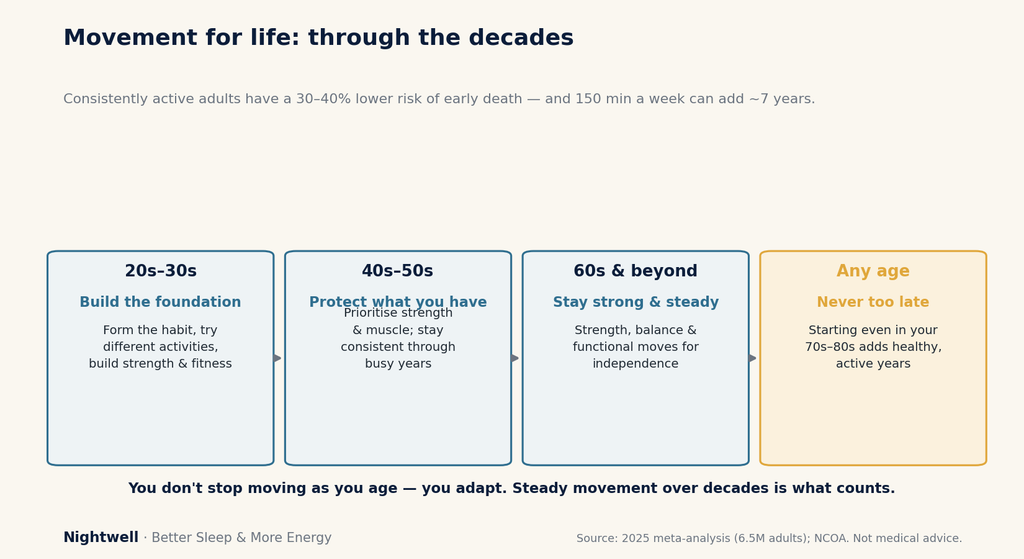
Movement is the closest thing to a longevity drug
The evidence here is overwhelming and consistent. A 2025 meta-analysis pooling 32 studies and over 6.5 million people found that consistently active adults had roughly a 30–40% lower risk of dying from any cause than those who stayed inactive. Other research shows that hitting the standard 150 minutes of moderate activity a week is associated with about seven extra years of life expectancy — and that benefit held regardless of weight, age, sex, or existing health conditions.
But it’s not just about lifespan; it’s about healthspan — the number of years you live free of chronic disease, disability, and decline. As the saying goes, exercise doesn’t just add years to your life; it adds life to your years. It keeps you capable, mobile, and independent, so those extra years are ones worth having.
What movement does deep inside you
The longevity effect isn’t only about avoiding heart disease and diabetes — regular movement changes you at the cellular level, actively slowing aspects of aging. Studies have found that active people have longer telomeres (the protective caps on your chromosomes that shorten as you age), more youthful immune systems, and healthier mitochondria — the tiny power plants in your cells that generate energy and become sluggish with age. Exercise even influences which of your genes are switched on, promoting repair and reducing inflammation. In short, moving your body is one of the most powerful anti-aging tools science has found — and it’s available to everyone.
It’s never too late (and never too early)
Here’s the message that matters most if you think you’ve missed your chance: you haven’t. The research is emphatic that starting later still delivers major benefits. People who became fit in midlife (their 40s and 50s) halved their risk of a deadly stroke. Adults who took up exercise in their 60s, 70s, and even 80s significantly lowered their mortality compared with those who stayed sedentary. Remarkably, the relative benefit of becoming active appears similar no matter what age you start — because your body’s ability to adapt, build fitness, and grow stronger doesn’t disappear with age. If anything, the payoff grows: exercise’s benefits appear to spike after 60, exactly when many people give it up.
So whether you’re 25 or 75, whether you’ve trained for decades or never started, today is a good day to move.
How movement shifts through the decades
Staying active for life doesn’t mean doing the same thing forever — it means adapting the emphasis as your body changes:
- 20s–30s: Build the foundation. This is the time to form the habit, explore different activities you enjoy, and build a base of strength and fitness that will serve you for decades. The routines you establish now set the trajectory.
- 40s–50s: Protect what you have. Muscle mass and aerobic capacity begin their natural decline, so strength training becomes increasingly important, and the challenge shifts to staying consistent through the busiest years of work and family. This is where fitting movement into a packed day earns its keep.
- 60s and beyond: Stay strong and steady. The priorities become preserving muscle and bone, and protecting balance and functional strength so you can keep doing everyday things unaided. Strength, balance, and functional movements take centre stage — they are, quite literally, what independence is made of.
Through every stage, the aerobic base and strength work in how much movement you actually need remain the backbone — you simply dial the emphasis to match your life.
The secret ingredient: sustainability
Here’s the honest truth behind every longevity study: the benefits come from movement done consistently, over years and decades — not from occasional heroic efforts. And the flip side is real too: when you stop, the adaptations fade, with cardiovascular fitness dropping within just two to four weeks of inactivity. But they return the moment you start again. The path to lifelong health, then, depends less on perfection and more on steady effort over time.
That’s why the single most important skill isn’t any particular exercise — it’s making movement a permanent, enjoyable part of who you are. Choose activities you genuinely like, build them into your routine, and forgive the inevitable breaks without abandoning the habit. Everything in building an exercise habit that sticks is really in service of this one goal: a lifetime of moving.
Movement doesn’t stand alone
As you close out this journey, it’s worth remembering that movement is one pillar of a bigger picture. It works hand in hand with the other foundations of feeling and aging well: it deepens your sleep, and good sleep fuels better workouts; it’s one of the most powerful levers for natural energy and a brighter mood; and it’s amplified by eating well. Sleep, nutrition, energy, and movement aren’t separate projects — they’re four sides of the same healthy life, each reinforcing the others. Tend to all of them, and the whole becomes far greater than the sum of its parts.
The bottom line
Movement is the closest thing we have to a fountain of youth — it lengthens your life, protects your healthspan, slows aging at the cellular level, and keeps you strong, sharp, and independent for as long as possible. It is never too late to begin, and it is never too early to invest. The goal isn’t extreme performance or a perfect record; it’s sustainable, enjoyable movement that you carry with you through every decade, adapting as you go. So keep walking, keep lifting, keep stretching, keep playing. Your future self — steady on their feet, clear in their mind, and free to live fully — is built by the choices you make to move today. Start where you are, and never stop.
This article is for general information and education and isn’t medical advice. If you’re older, have a health condition, or have been inactive for a long time, please talk to a qualified healthcare professional before starting or significantly changing your exercise routine.
Sources: Psychology Today — Stay Active, Live Longer; National Council on Aging — How Exercise Helps You Age Well; Allina Health — Exercise Is Key to Living Longer