
The short answer
You’ve heard it a thousand times: drink eight glasses of water a day. It’s one of the most repeated pieces of health advice going — and it isn’t based on solid science. The truth is more freeing: there’s no single magic number, your needs change with your body, activity, and climate, and a lot of your hydration comes from food and other drinks, not just plain water. For most healthy people, you don’t need to count anything at all. Drink when you’re thirsty, keep an eye on the colour of your urine, and you’re doing it right. And it matters for energy more than people realise: even mild dehydration reads as tiredness.
Where the “8 glasses” myth came from
The eight-glasses rule appears to trace back to a 1945 guideline that recommended roughly 2.5 litres of water a day — but that same guideline explicitly said most of this quantity is contained in prepared foods. Over the decades that crucial detail got dropped, and the figure morphed into “drink eight 8-ounce glasses of plain water on top of everything else.” It’s a classic case of a reasonable estimate being flattened into a rigid rule that was never actually the recommendation. There’s no direct clinical evidence that healthy adults need exactly eight glasses.
So how much do you need?
Official bodies do give a ballpark. The U.S. National Academies of Sciences, Engineering, and Medicine put adequate total fluid intake at roughly 3.7 litres (about 125 oz) a day for men and 2.7 litres (about 91 oz) for women. But read that carefully, because two things make it very different from “drink 3.7 litres of water”:
- It’s a figure for the average adult in a temperate climate, before accounting for your own body size, activity, heat, illness, or pregnancy — all of which move the number.
- It includes all fluid from all sources — every drink you have and the water in your food. Roughly a fifth of most people’s fluid comes from food alone.
In other words, the real target is much lower in “glasses of water” terms than it sounds, because coffee, tea, milk, and water-rich foods are all doing part of the job for you.
What actually counts (more than you think)
A few persistent myths inflate how much plain water people think they need:
- Coffee and tea count. Caffeine has a mild diuretic effect, but it’s easily outweighed by the fluid in the drink itself, so your morning coffee is a net positive for hydration — not a dehydrator.
- Food counts. Fruit and vegetables are largely water and come bundled with electrolytes, vitamins, and fiber. A diet rich in produce quietly tops you up all day.
- Milk, juice, and other drinks count too. Plain water is still the best default because it has no sugar or calories, but it isn’t the only path to being hydrated.
The two signals that beat counting glasses
Your body manages fluid remarkably well across a wide range of intakes, which is exactly why chasing a number is unnecessary. Two simple, evidence-supported signals tell you what you need to know.
Thirst. For most healthy adults, thirst is a reliable early cue — when you feel it, drink. The main exception is older adults, whose thirst signal becomes less reliable with age; they’re better off drinking on a light schedule rather than waiting to feel thirsty.
Urine colour. This is the most practical check there is, because colour directly reflects how concentrated your kidneys are making your urine.
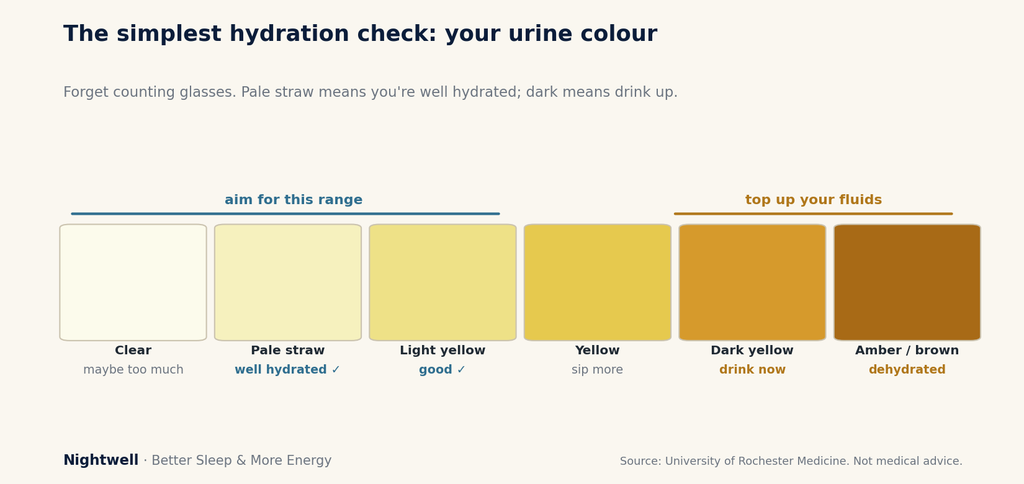
Pale straw yellow means you’re well hydrated. Dark yellow or amber is a nudge to drink more. Completely clear, all the time, can mean you’re actually drinking more than you need. Peeing somewhere around four to eight times a day is a normal benchmark. That’s the whole system — no app, no arithmetic.
Why hydration is really an energy story
Here’s the part that matters most for feeling good day to day. Water makes up about 60% of your body and is involved in nearly everything — digestion, transporting nutrients, regulating temperature. So when you run low, performance drops fast. Studies show that even mild dehydration impairs mood, concentration, and energy: in one well-known study, women experienced headaches, fatigue, and trouble concentrating after losing just over 1% of their body water — a level you can hit without feeling especially thirsty.
This is why hydration is a quiet driver of the afternoon slump. Busy people go hours without drinking, then feel foggy and tired and reach for coffee — when a glass of water would have done more. If your energy sags mid-afternoon, water is one of the first, cheapest things to check, right alongside what you’re eating for steady energy.
Can you drink too much?
Yes, though it’s uncommon. Your kidneys can only process so much water per hour, and drinking far beyond thirst — especially without replacing electrolytes — can in extreme cases dilute your blood sodium dangerously (a condition called hyponatremia). The lesson isn’t to be scared of water; it’s that hydration is about balance, not maximising intake. More isn’t automatically better. For most people, simply drinking to thirst keeps you comfortably in the safe zone.
Practical ways to stay topped up
- Keep a bottle in sight and sip through the day, rather than trying to catch up all at once. Out of sight really is out of mind with water.
- Have a glass with each meal — an easy habit that anchors your intake to things you already do.
- Eat your water. Load up on fruit and vegetables; they hydrate and nourish at the same time.
- Drink more when it’s hot or you’re active. Sweat losses during exercise can run from half a litre to well over a litre an hour, so increase intake accordingly — and for sessions longer than an hour in the heat, include some electrolytes.
- Flavour it if plain water bores you — a slice of lemon, cucumber, or mint makes it easier to drink more without added sugar.
- Front-load earlier in the day. Getting most of your fluid in before the evening keeps you hydrated without waking you for bathroom trips that fragment your sleep — one of the avoidable causes of waking at 3 a.m.
When to check with a doctor
Certain conditions and medications — kidney problems, heart failure, some diuretics — change how much fluid is right for you, sometimes meaning you need more, sometimes less. Pregnancy raises needs too. If you have a health condition that might affect your fluid balance, get a personalised target from your doctor rather than following any general rule. And persistent, unexplained thirst or fatigue that doesn’t improve with normal drinking is itself worth getting checked.
The bottom line
Forget the eight-glasses commandment — it was never real science. Your body is better at managing fluid than any counting app, and it gives you clear feedback: drink when you’re thirsty, aim for pale-straw urine, eat plenty of water-rich food, and drink more when it’s hot or you’re sweating. Get that right and you’ll not only avoid the fog and headaches of mild dehydration — you’ll hand yourself one of the easiest, cheapest energy boosts there is.
This article is for general information and education and isn’t medical advice. If you have a kidney, heart, or other condition affecting fluid balance, or are pregnant, please talk to a qualified healthcare professional about your needs.
Sources: University of Rochester Medicine — How Much Water Should You Drink?; Summa Health — Hydration Myths Debunked