
The short answer
Ever finished a day where you barely moved, yet felt completely drained? That’s often digital overload — the mental exhaustion of a brain bombarded all day by notifications, scrolling, alerts, and constant task-switching. Your phone is a genuine energy drain, and not because of the time it eats but because of what it does to your attention: it keeps your brain in a permanent state of low-grade alert, fragmenting your focus and quietly running down your mental battery. The fix isn’t to throw your phone away — it’s to use it on purpose instead of on reflex.
Why your phone is so draining
It helps to understand the mechanisms, because “just use your phone less” rarely works without knowing what you’re up against.
The dopamine loop. Every notification, like, and new post triggers a small burst of dopamine — your brain’s reward signal. That’s not an accident; apps are engineered to create these loops, which is what makes checking your phone feel compulsive even when it leaves you more drained. You reach for it out of habit, get a tiny hit, and the cycle repeats hundreds of times a day.
Cognitive overload. When your brain is flooded with more information than it can process, the prefrontal cortex — the region responsible for focus, planning, and decision-making — gets overwhelmed. Neuroscientists call this cognitive overload, and it produces exactly the symptoms you’d expect: mental fog, poor concentration, decision fatigue, and a general feeling of being fried.
Constant task-switching. Every time a notification pulls you away, you pay a switching cost, and it takes several minutes to fully regain your concentration. Do that dozens of times an hour and you never reach deep focus at all — you just burn energy bouncing between things, the same tax we cover in deep focus.
The “always-on” alert state. Perhaps the sneakiest one: even when you’re not actively looking at your phone, part of your brain stays primed, subconsciously waiting for the next buzz. That low-level vigilance is a form of chronic stress that quietly drains you all day and keeps your nervous system from ever fully settling.
It’s not just tiredness — it’s mood and sleep too
Digital overload doesn’t stop at mental fatigue. Research links heavy smartphone use with higher anxiety and poorer sleep. Doomscrolling and social comparison chip away at mood, leaving you flat or irritable. And late-night scrolling is a double hit: the content keeps your brain engaged and the bright screen disrupts your sleep, which then wrecks the next day’s energy — part of why it’s worth getting a handle on screens and sleep. Left unchecked, that constant task-switching and pressure can even contribute to burnout, the emotional-exhaustion state we cover in stress, burnout and energy.
The fix: a lighter phone setup
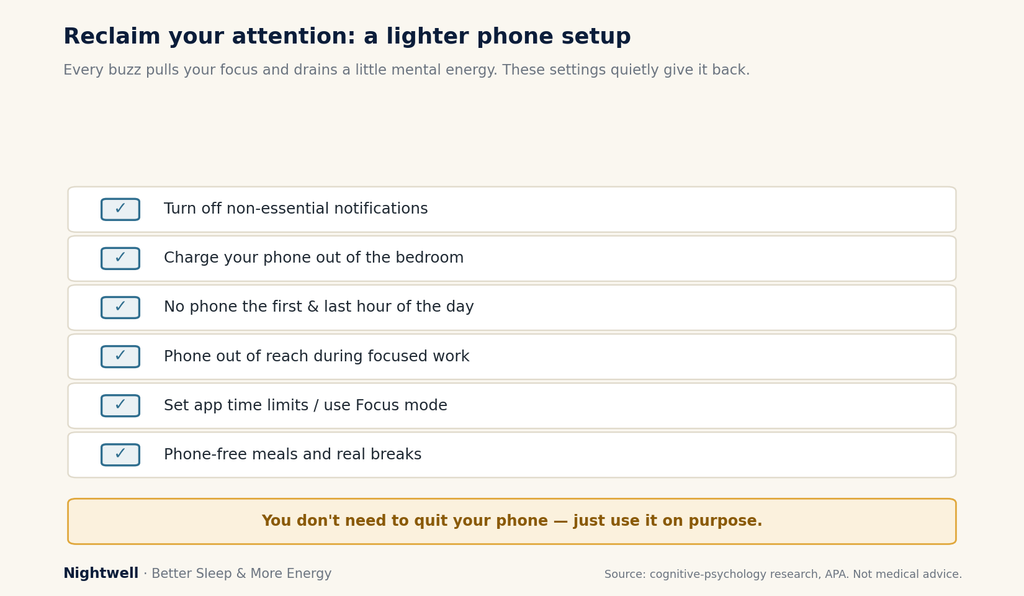
The goal isn’t digital abstinence — phones are genuinely useful, and going cold turkey isn’t realistic for most people. The goal is intentional use: keeping the benefits while cutting the compulsive, draining parts. The settings and habits in the checklist above do most of the work. In more detail:
- Turn off non-essential notifications. This is the single highest-impact change. You don’t need an alert for every app — keep calls and genuinely time-sensitive things, silence the rest. Fewer interruptions means fewer switching costs and less “always-on” tension.
- Charge your phone out of the bedroom. This kills late-night scrolling and stops the phone being the first thing you touch. A cheap alarm clock replaces it easily.
- Protect the first and last hour of your day. Diving into notifications the moment you wake throws you into reactive mode before you’ve set your own agenda — a key part of an energising morning routine. And a screen-free wind-down helps you actually fall asleep.
- Put the phone out of reach during focused work. Not face-down on the desk — in a drawer or another room. Its mere presence drains attention, so distance beats willpower.
- Use your phone’s own tools. Focus/Do Not Disturb modes, app time limits, and the built-in screen-time dashboard turn vague intentions into structure. Seeing how much you actually scroll is often a wake-up call in itself.
- Create phone-free zones and moments. Meals, conversations, the bathroom, the bedroom. Protecting these small pockets of presence adds up to a calmer, less fragmented day.
Give your brain real breaks
Here’s a trap worth naming: “taking a break” by switching from work to scrolling isn’t a break at all — it’s just more digital input, and it leaves you more depleted. Genuine recovery comes from stepping away from screens entirely. Even 10 to 15 minutes of something analog — a walk, some time outdoors, reading a physical page, or just sitting quietly — measurably lowers stress and restores focus. Nature is especially restorative for a fried attention span. Replace some of your reflexive scrolling with these and you’ll feel your mental energy return.
One honest note: if you live with ADHD or an anxiety disorder, your brain is naturally more sensitive to this kind of overstimulation, and the compulsive-checking loops can hit harder. Be extra deliberate about your setup — and if digital overload is fuelling real anxiety or you can’t rein it in despite trying, it’s worth talking to a professional.
Retrain the boredom reflex
The deepest habit to change is reaching for your phone the instant you feel a flicker of boredom — in a queue, in a lift, the moment a task gets hard. Those small empty moments are actually when your mind rests and consolidates, and filling every one with input is part of what leaves you perpetually drained. Try letting yourself just be bored occasionally. It feels uncomfortable at first, then surprisingly restorative — and it slowly loosens the phone’s grip on your attention.
The bottom line
Your phone can quietly be one of the biggest drains on your mental energy — not through screen time alone, but through the endless notifications, task-switching, and “always-on” alertness that overload your brain and fray your focus. The answer isn’t to quit; it’s to take back control. Silence the notifications, get the phone out of your bedroom and out of reach when you need to focus, protect the start and end of your day, and give your brain genuine, screen-free breaks. Use your phone as the tool it is, on purpose — and you’ll reclaim a surprising amount of the mental energy it’s been quietly taking.
This article is for general information and education and isn’t medical advice. If digital overload is contributing to significant anxiety, low mood, or an inability to function, please talk to a qualified healthcare or mental-health professional.
Sources: Nobel Medical Group — How Notifications Impact Your Mental Health; Hunter Psychological Services — Digital Fatigue; Kazmo Brain Center — Coping with Digital Overload
Comments on “Digital Overload: How Your Phone Drains Your Mental Energy”