
The short answer
There’s a free, five-minute habit that boosts your energy in the morning and improves your sleep that night — and most people walk straight past it. It’s simply getting daylight into your eyes soon after you wake up. Morning sunlight is the master signal that starts your body clock: it switches off the sleep hormone, triggers a natural surge of alertness, and sets a timer for good sleep later. No lamp, app, or supplement can replicate it as cheaply or effectively. Step outside for 5 to 20 minutes within the first hour of waking, and you’ll feel the difference.
Why light is your body’s “on” switch
Your body runs on a roughly 24-hour internal clock — the circadian rhythm — and light is the single most powerful cue that keeps it set to the right time. When bright morning light hits special sensors in your eyes, it does two important things at once.
First, it suppresses melatonin, the hormone that makes you sleepy, cutting through that heavy just-woke-up grogginess. Second, it triggers the cortisol awakening response — a natural, healthy rise in cortisol in the first 30 to 45 minutes of your day. Cortisol has a bad reputation as the “stress hormone,” but in the morning it’s better thought of as your timing hormone: a clean, sharp rise tells your body the day has begun, bringing up your alertness, temperature, and focus. Tellingly, research links low morning cortisol with fatigue — so that surge is exactly what you want. You’re not being stimulated like caffeine does; you’re being scheduled.
The part people miss: it fixes tonight’s sleep too
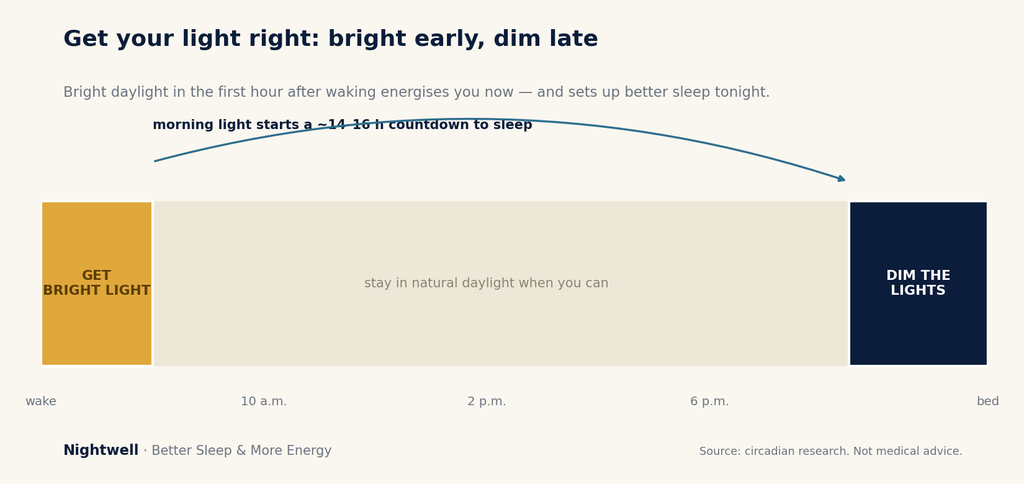
Here’s the genuinely clever bit. That same burst of morning light starts a countdown — roughly 14 to 16 hours — until your body releases melatonin again in the evening. In other words, getting bright light early doesn’t just wake you up now; it tells your body when to get sleepy tonight. Skip it, spend your morning in dim indoor light, and that evening melatonin signal comes later and weaker — which means harder-to-fall-asleep nights and groggier mornings, a loop that quietly feeds daytime tiredness.
This is the flip side of the evening advice in blue light and sleep: bright light early, dim light late. Get both right and your whole day-night rhythm clicks into place — better energy by day, easier sleep at night, and often a softer afternoon slump too.
The other benefits
Morning light does more than set your clock:
- Sharper focus and less brain fog. By signalling “be awake,” it enhances alertness and mental clarity for the hours ahead — a real help if you wake up foggy.
- Better mood. Daylight promotes serotonin, a mood-lifting brain chemical, which is one reason getting outside early tends to make people feel brighter — and why it can ease the low mood many feel in darker months.
- Some vitamin D. When the sun is strong enough, sunlight on skin helps produce vitamin D, important for immune function — a bonus, though not the main event for the morning-light habit.
- Steadier energy overall, because a well-timed body clock underpins consistent sleep, mood, and alertness — the foundation we lay out in how to get more energy naturally.
How to do it right
The habit is simple, but a few details make it far more effective:
- Timing: the first hour after waking, and ideally before about 10 a.m. Your body is most sensitive to light’s clock-setting effect early; miss the window and you enter a long stretch where light does much less to set your rhythm.
- Duration: 5 to 20 minutes, depending on the weather. On a bright, sunny morning 5 to 10 minutes is plenty; on an overcast day aim for 15 to 20. Consistency matters more than hitting an exact number.
- Get outside — don’t rely on a window. This is the big one. Even a cloudy day outdoors delivers far more circadian signal than a bright-seeming indoor room, and glass filters out much of what your clock needs. Actually stepping outside beats sitting by the window.
- No sunglasses for this, so the light can reach your eyes — but never look directly at the sun. You don’t need to; ambient outdoor light is what counts.
- Light before screens and coffee. Get your light first. Piling caffeine on top of an already-rising morning cortisol curve tends to steepen the later crash, so light first, coffee a bit after, is a smarter order.
- Attach it to something you already do. Drink your morning water or coffee on the porch, walk the dog, take a short stroll, or eat breakfast by an open door. Habit-stacking is what makes it stick.
An honest word for dark climates and winter
This habit is easy in summer and much harder if you live far north, work before dawn, or face a run of dark winter mornings when the sun barely rises. It’s not a moral failing if you can’t get real sunlight — the biology just needs bright light, from wherever you can get it. On dark mornings, a light therapy lamp (a bright, daylight-spectrum lamp designed for this) is a well-established substitute: used for 20-30 minutes early in the day, it delivers much of the same clock-setting benefit and is a recognised tool for the winter blues. And on any day, throwing open the curtains and turning on bright indoor lights the moment you wake is better than sitting in the gloom. Do what your latitude and schedule allow — consistency beats perfection.
The bottom line
Morning sunlight is about as close as natural health gets to a free lunch: a few minutes of daylight early in the day sets your body clock, lifts the morning fog with a clean surge of alertness, brightens your mood, and quietly programs better sleep for that night. Step outside within an hour of waking, aim for 5 to 20 minutes depending on the sky, skip the sunglasses, and do it before you reach for your phone or coffee. It costs nothing, takes almost no time, and is one of the most underused energy tools there is. Pair it with dim, screen-light evenings and you’ve got the whole rhythm working for you — which is exactly what steady, all-day energy is built on.
This article is for general information and education and isn’t medical advice. If you have persistent low energy or low mood, or a condition affecting your eyes or skin’s sun sensitivity, please talk to a qualified healthcare professional.
Sources: Oura — The Benefits of Morning Sunlight; SageMED — Morning Sunlight for Mood, Sleep & Immunity; Sunlight and Sleep: How Natural Light Impacts Your Rest