
The short answer
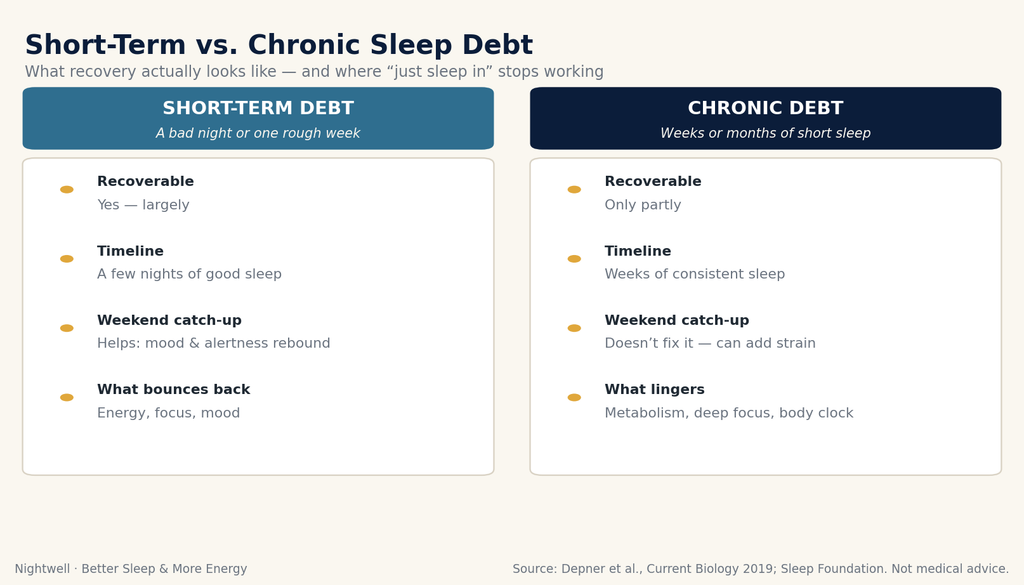
Yes and no — and the distinction matters. You can recover from a bad night or one rough week, but you cannot fully repay chronic sleep debt by sleeping in on the weekend. A couple of solid nights will restore your mood, alertness, and energy after a short-term shortfall. What a weekend lie-in will not do is reverse the deeper effects of weeks or months of undersleeping — the shifts in metabolism, deep focus, and your internal body clock that only steady, sufficient sleep can undo. Catching up helps, but it is not the same as never falling behind.
What sleep debt actually is
Sleep debt is simply the running gap between the sleep your body needs and the sleep it actually gets. Most adults need somewhere between seven and nine hours a night to function well, and the number is fairly stable from person to person. When you regularly fall short — even by 30 or 60 minutes — the shortfall does not vanish at sunrise. It accumulates, quietly, the way a small overdraft grows into a real balance.
The tricky part is that the debt builds from ordinary life, not just dramatic all-nighters. A late work deadline, a long commute, an evening that slips away one episode at a time, a baby who wakes at 3 a.m. — each trims a little off the top. Because the losses are small and familiar, most people underestimate how much they have piled up. By Friday, five nights of “just an hour short” have added up to a full night of missing sleep.
- It compounds. Nightly shortfalls stack across the week, so a modest deficit becomes a large one by the weekend.
- It is easy to miss. You adapt to feeling tired, so your sense of how impaired you are drifts out of line with reality.
- It has a price. Ongoing short sleep is linked to worse concentration, mood dips, stronger appetite, and higher long-term health risks.
Short-term debt: yes, you really can catch up
Here is the encouraging part. If you are not too far behind — a single missed night, or one week of trimmed sleep — your body is remarkably good at bouncing back. A weekend of longer, unrushed sleep will restore how alert you feel, lift your mood, and sharpen your thinking again. You may need more than one long night to feel fully yourself, but the recovery is real, and even a partial catch-up leaves you better off than doing nothing.
So if you had to get up painfully early on Friday and you slept in on Saturday, you have mostly repaid that particular loss. The problem only appears when the “short week, long weekend” pattern becomes your permanent rhythm — because then you are never actually paying the debt down, just refinancing it. For a sense of how much sleep you should be aiming for in the first place, our guide on how much sleep you really need by age is a good place to start.
The weekend catch-up myth
This is where the science gets pointed. In a much-cited 2019 experiment, researchers put healthy adults through exactly the scenario most of us live: short weeknights, a weekend of unrestricted “recovery” sleep, then straight back into another short week. During the weekend, people did sleep longer and ate fewer late-night snacks. But once the next restricted week began, their bodies told a different story. Insulin sensitivity fell, late-night eating and weight crept up, and — strikingly — the weekend-recovery group did no better than people who stayed sleep-deprived the whole time. On some measures they did slightly worse.
Other research points the same way. Studies have found that weekend recovery sleep restores how sleepy you feel without fully restoring measured performance, which stays impaired into the following week. And one analysis found that only about one in four people actually managed to balance their weekly sleep debt with weekend sleep at all. The gap between “I feel caught up” and “I am caught up” is the whole problem.
- Feeling recovered is not the same as being recovered. Subjective sleepiness improves faster than your brain and metabolism actually do.
- Big timing shifts backfire. Sleeping in several hours later on weekends drags your body clock in the wrong direction.
- The cycle resets the damage. Returning to short sleep on Monday undoes much of the weekend’s benefit.
Why sleeping in can quietly make things worse
There is a second cost hiding inside the weekend lie-in: it moves your internal clock. When you go to bed and wake up two or three hours later on Saturday and Sunday, your body experiences something close to flying across time zones without leaving home. Scientists call it “social jet lag,” and it is why Sunday nights are so hard to fall asleep and Monday mornings feel disproportionately brutal. You are asking your body to re-adjust its clock twice every single week.
That constant back-and-forth is its own stressor, separate from the missing hours. It fragments the rhythm that governs your energy, appetite, and alertness through the day — which is part of why chronically short-and-shifting sleep leaves people reaching for caffeine and battling the afternoon slump, then struggling to wind down at night. The fix is not a bigger weekend binge. It is a steadier week.
How long does recovery actually take?
For a small, recent deficit, think in terms of a few good nights rather than a single heroic sleep-in. Recovering from lost sleep is gradual: your body pays it back over several days, not in one shot. As a rough rule of thumb, expect it to take a handful of days of consistent, adequate sleep to feel the effects of even an hour’s chronic shortfall lift.
For a deeper, long-standing debt — months of running on six hours — the timeline stretches to weeks of protecting your sleep before your baseline resets. That sounds slow, but there is an upside: you do not have to do anything dramatic. You simply have to stop adding to the debt and let consistency do the work. If you are technically getting enough hours yet still dragging, our piece on being tired after eight hours of sleep covers the usual culprits.
How to pay it back the right way
The most effective strategy is almost boringly simple: make your sleep more consistent, not just longer on weekends. Anchoring your schedule pays down debt faster than bingeing, and it does it without the circadian whiplash. Here is the approach that works.
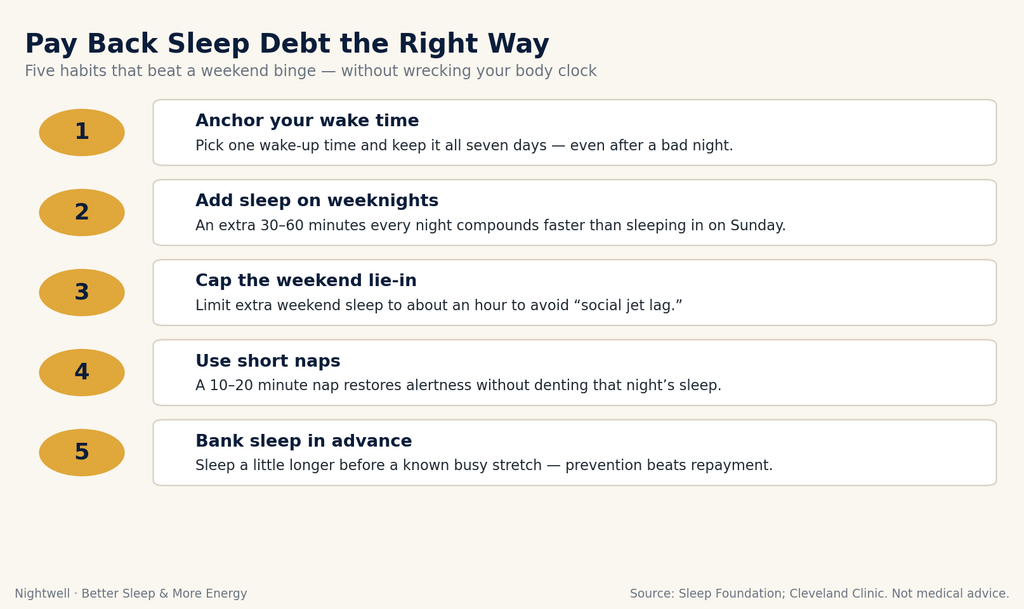
- Anchor your wake time first. Choose one wake-up time you can hold seven days a week — even after a bad night — and build everything else around it. A steady wake time is the single strongest signal your body clock has.
- Add sleep to your weeknights. An extra 30 to 60 minutes every night compounds faster and more safely than a weekend catch-up. Move bedtime earlier rather than trying to sleep later in the morning, which causes more disruption.
- Keep weekend lie-ins modest. An extra hour is fine and even helpful. Three or four extra hours mostly buys you social jet lag.
- Use short naps strategically. A 10–20 minute nap early in the afternoon can restore alertness without stealing from that night’s sleep. Our guide on how long to nap and when has the details.
- Bank sleep before you need it. If you know a demanding stretch is coming, sleep a little longer in the nights beforehand. Prevention is always cheaper than repayment.
When constant tiredness is more than sleep debt
Sometimes the arithmetic does not add up: you are sleeping seven or eight hours, keeping a steady schedule, and still feel exhausted. When good sleep habits do not fix persistent fatigue, it is worth looking past sleep debt. Ongoing tiredness can be a signal of something else — conditions such as sleep apnea, thyroid problems, iron deficiency, or depression can all masquerade as “just being tired,” and none of them are things to guess at on your own.
If you have genuinely protected your sleep for a few weeks and the fatigue will not budge, that is a good reason to talk to a doctor rather than simply chasing more hours. Building steadier energy across the day helps too; you will find practical, everyday tactics in our guide on how to get more energy naturally.
The bottom line
You can catch up on sleep — up to a point. A weekend of rest genuinely repairs a short-term shortfall and will leave you feeling and performing better. But it cannot cancel out a chronic pattern of undersleeping, and large weekend sleep-ins carry their own hidden cost by unsettling your body clock. The honest takeaway is that recovery works best as prevention: a consistent wake time, a little more sleep on ordinary weeknights, and modest weekends beat any heroic Saturday lie-in. Do not bank on catching up. Bank on not falling behind.
This article is for general information and isn’t medical advice. Persistent fatigue or sleep problems can have underlying causes, so if tiredness continues despite good sleep habits, please see a qualified healthcare professional.
Sources: Sleep Foundation – Sleep Debt and Catch-Up Sleep · Depner et al., Current Biology (2019) – Weekend Recovery Sleep & Metabolic Dysregulation · Cleveland Clinic – Can You Make Up for Lost Sleep on Weekends?