
The short answer
Have you noticed that on days you feel low, you also feel drained — and on days you feel energised, your mood lifts too? That’s not a coincidence. Energy and mood are deeply intertwined, each one feeding the other in a loop. Low mood saps your energy and makes you withdraw, which lowers your mood further; but the same cycle can turn the other way. The encouraging news is that the very habits that boost your physical energy — movement, sleep, daylight, good food, connection — also lift your mood, so working on one helps the other. And there’s a powerful, evidence-based trick for turning the loop upward when you feel stuck: act first, and let the feeling follow.
Why energy and mood move together
Your physical energy and your emotional state aren’t separate systems — they run on much of the same machinery. Poor sleep leaves you both tired and irritable. Blood-sugar crashes bring fatigue and low mood. Chronic stress drains your body and flattens your spirits. So when one dips, the other tends to follow.
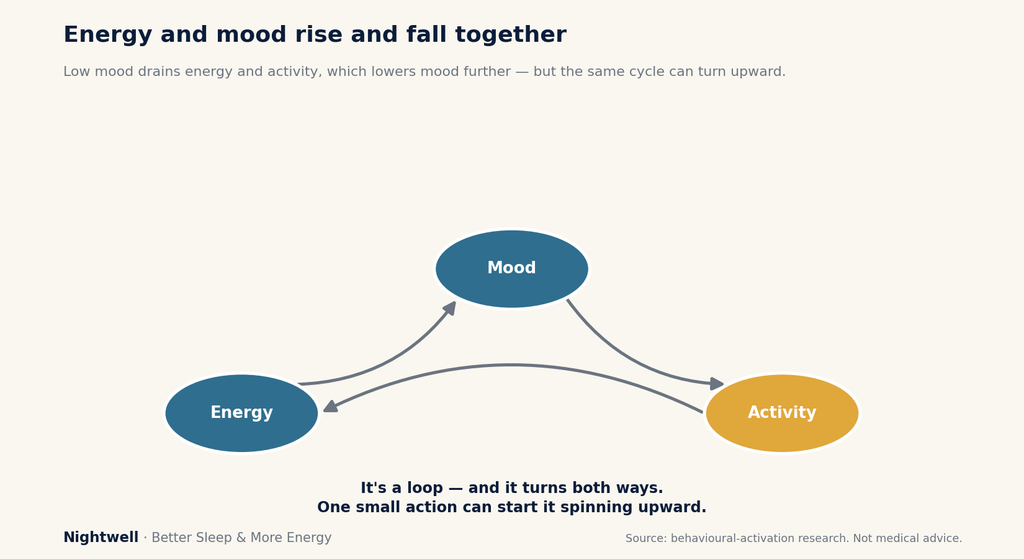
This becomes a self-reinforcing cycle, as the graphic shows. When your mood drops, everything feels harder, so you do less — you skip the walk, cancel plans, stay in. That withdrawal removes the very sources of energy and positive feeling (movement, sunlight, connection) that would have helped, so your mood and energy sink further, making you even less likely to act. It’s a downward spiral that can feel impossible to escape from the inside. The crucial insight is that the loop is reversible: the same connections that spin you down can spin you up.
The same habits lift both
Here’s what makes this genuinely hopeful: you don’t need separate strategies for energy and for mood. The core habits do double duty:
- Movement. Exercise releases mood-lifting endorphins and boosts energy at the same time — and it’s one of the best-evidenced natural antidepressants there is, with meta-analyses showing aerobic and strength exercise significantly reduce depressive symptoms. Even a 10-minute walk shifts both your energy and your outlook, part of why it tops the list in getting more energy naturally.
- Sleep. Quality sleep is essential for both emotional regulation and physical energy — poor sleep and low mood feed each other viciously, so protecting your sleep protects both.
- Food. Steady blood sugar from whole foods keeps your energy and your mood level, while sugar-and-caffeine rollercoasters destabilise both.
- Daylight and nature. Morning light lifts alertness and mood, and time in green space lowers stress while boosting vitality — the double benefit we cover in morning sunlight and nature and energy.
- Connection. Time with people who restore you lifts mood and, indirectly, energy — while isolation drags both down.
- Managing stress. Calming your nervous system frees up the energy that chronic stress silently burns, as we explore in stress, burnout and energy.
Pick any one of these and you’re pulling on a lever that moves both your energy and your mood at once. That’s a remarkably efficient return on effort.
The action-first trick: behavioral activation
But what do you do when you’re caught in the downward spiral — when you know a walk would help, but you have zero energy or desire to take one? This is the cruel catch of low mood: the very things that would lift you feel impossible.
Psychologists have a well-established, evidence-based answer called behavioral activation, a core part of cognitive behavioral therapy that research has found can relieve depressive symptoms about as effectively as talking therapy or medication in some studies. Its central principle is exactly the reversal we met in motivation vs discipline: action comes before motivation, not after. Rather than waiting to feel better before you engage with life, you deliberately do a small, meaningful, or pleasant activity regardless of how you feel — and doing it gradually lifts your mood and energy.
The key is to start tiny and specific. Not “exercise” but “walk to the end of the street.” Not “see friends” but “text one person I’m comfortable with.” Not “get on top of everything” but “do the dishes for two minutes.” You schedule the small action, do it even without motivation, and notice what happens to your mood afterward. Each little success creates a flicker of accomplishment or pleasure that begins to counteract the downward pull — and one small turn of the wheel is often enough to start it spinning the other way.
When it’s more than a rough patch
This is the most important part, so please read it carefully. Everything above helps with the ordinary ebb and flow of energy and mood — the low days, the flat weeks, the general slumps we all get. But persistent low energy and low mood can also be signs of depression or another condition, and those need proper support, not just lifestyle tweaks. Fatigue is one of the most common symptoms of depression, and low mood and exhaustion that don’t lift are a genuine reason to reach out.
Please talk to a doctor or mental-health professional if your low mood or fatigue is persistent (lasting more than a couple of weeks), severe, or interfering with your daily life — or if you’ve lost interest in things you used to enjoy, feel hopeless, or aren’t functioning as usual. That isn’t a failure or an overreaction; it’s the same sensible step you’d take for any persistent physical symptom, and effective help exists. Lifestyle habits and behavioral activation are powerful and can work alongside professional treatment, but they are not a substitute for it when something more is going on. And if you ever have thoughts of harming yourself, reach out to a crisis line or emergency services straight away — you deserve support.
The bottom line
Energy and mood are two ends of the same seesaw — tied together, rising and falling as one. When you’re low, that link can pull you into a downward spiral of doing less and feeling worse. But it works in reverse too: because the same habits fuel both, every walk, good night’s sleep, sunlit morning, and real conversation lifts your energy and your spirits. And when motivation is nowhere to be found, remember that action leads and the feeling follows — one tiny step can start the loop turning upward. Most of all, be kind to yourself, and know when a rough patch has become something worth taking to a professional. Looking after your energy and looking after your mood are, in the end, the same project.
This article is for general information and education and isn’t medical advice. If you’re experiencing persistent low mood, fatigue, hopelessness, or loss of interest in life, please talk to a qualified healthcare or mental-health professional. If you’re in crisis or thinking of harming yourself, contact your local emergency services or a crisis helpline immediately.
Sources: Psych Central — Low Energy Due to Depression; Behavioral Activation: How Small Actions Create Big Changes; Understanding the Connection Between Mood and Energy