
Advertising disclosure: This article contains affiliate links. If you buy through one, Nightwell may earn a small commission at no extra cost to you. We only recommend products we believe genuinely fit the advice on this page.
The short answer
The best mattress isn’t the most expensive one or the one with the biggest advert — it’s the one that matches how you sleep. Your sleep position, your body weight, and whether you run hot or cold matter far more than the brand name on the label. In this guide we explain the main types of mattress, how to choose the right feel, how to tell when your old one is finished, and then give our two current picks: one for people who sleep hot or want firmer support, and one for side sleepers who want a plush, pressure-relieving feel.
The main types of mattress, quickly
Almost every mattress on sale falls into one of four families, and knowing the difference cuts through most of the marketing noise:
- Memory foam. Dense foam that moulds to your body, giving excellent pressure relief and near-silent motion isolation — good if you share a bed with a restless partner. The downside is heat: traditional foam traps it, so look for gel-infused or open-cell versions if you sleep warm.
- Hybrid. A pocket-spring core topped with foam or latex comfort layers. Hybrids are the popular all-rounder because the springs give support and airflow while the foam cushions your joints — cooler than all-foam, kinder to your back than a bare spring bed. Both of our picks below are hybrids.
- Innerspring. The traditional coil mattress. Bouncy, breathable, and usually the cheapest, but it offers less pressure relief and transfers more movement across the bed.
- Latex. Responsive and very durable, with a naturally cooler, springier feel than memory foam. It tends to be firmer and more expensive, and appeals to people who want a natural material.
How to choose the right feel
Ignore the marketing for a minute. A handful of factors decide whether a mattress actually suits you:
- Your sleep position. Side sleepers generally want a softer surface that cushions the hips and shoulders; back and stomach sleepers usually want firmer, more even support to keep the spine level. It’s the same logic behind choosing the right pillow for your sleep position — the whole aim is a neutral spine.
- Your body weight. This shifts how firm a mattress feels to you. Lighter sleepers (under about 60 kg) press in less, so a medium can feel firm and they often prefer medium-soft. Heavier sleepers (over about 90 kg) sink in more and usually need a firmer, more supportive build to stop the hips dropping out of line.
- Whether you sleep hot. All-foam mattresses trap heat; hybrids and latex sleep cooler because air moves through them. If you wake up sweaty, this is the single biggest factor — and it works hand in hand with keeping the bedroom cool.
- The trial period. You cannot judge a mattress in a showroom in five minutes. A proper home trial of several weeks matters more than any spec sheet, because your body needs time to adapt — so always buy where you can return it.
If you take one thing from this section: medium-firm suits the largest number of people, which is why it’s the most common recommendation. Start there unless your position or weight clearly pulls you softer or firmer.
Signs your mattress is past it
A new mattress is a real expense, so it’s worth being honest about whether you actually need one. If your current bed is only a few years old and still comfortable, keep it. But these are the genuine signs it’s time to replace:
- It’s seven to ten years old — roughly the point where most mattresses lose support.
- You can see or feel sagging, dips, or lumps, especially a valley where you sleep.
- You wake up stiff or sore and it eases as the day goes on.
- You sleep noticeably better in a hotel or a spare bed than at home.
- Your allergies or asthma have quietly worsened — old mattresses accumulate dust mites.
That last cluster matters because a worn-out surface is a hidden cause of broken, unrefreshing nights. If you’re tired even after eight hours and ticking several of these boxes, the mattress is a prime suspect.
Our two picks
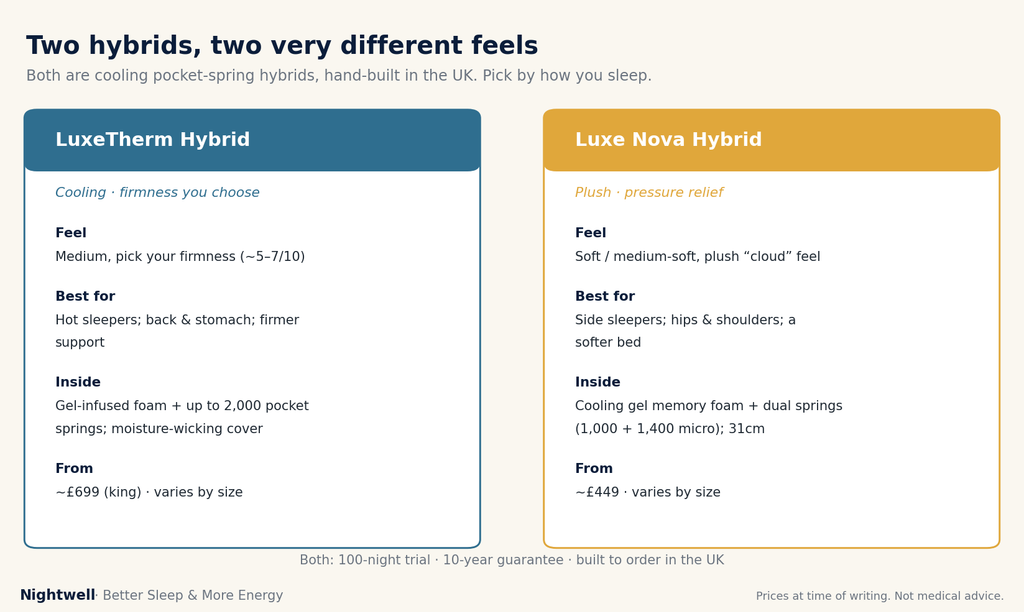
Both of the mattresses below are cooling pocket-spring hybrids, hand-built in the UK, and both come with a 100-night trial and a 10-year guarantee. The difference is the feel — and that’s where your sleep style decides for you.
Best if you sleep hot or want firmer support: LuxeTherm Hybrid
A cooling pocket-spring hybrid built around gel-infused foam and up to 2,000 springs, with a moisture-wicking cover that pulls heat away — the reason to choose it is temperature. If you wake up sweaty or find memory foam too warm, this is the one to look at. You pick the firmness (roughly a 5 to 7 out of 10), so it works for back and stomach sleepers who want a supportive, level surface. It’s hand-built to order in the UK and starts around £699 for a king. Check the LuxeTherm Hybrid →
Best for side sleepers who want a plush feel: Luxe Nova Hybrid
A softer, 31cm hybrid with cooling gel memory foam over a dual spring system — the top foam layers cushion your hips and shoulders while the springs keep your spine level. That plush, medium-soft feel is exactly what most side sleepers want, and it’s the more affordable of the two, starting around £449. If you like sinking in a little rather than lying on top, this is your pick. Check the Luxe Nova Hybrid →
A quick word on price: the figures above are starting prices at the time of writing and change with size and seasonal sales, so check the live price on each product page before you decide. And if neither feels right, the principles in this guide apply to any brand — we’ll add more picks here as we test them.
Don’t overlook the rest of your sleep setup
A mattress doesn’t work in isolation, and fixing the cheaper parts around it sometimes solves the problem without a new bed at all:
- Your pillow. The wrong height throws your neck out of line no matter how good the mattress is. Match it to your position — our pillow guide covers this.
- A topper. If a mattress is a touch too firm, or you want to squeeze another year or two out of a slightly tired one, a good topper can adjust the feel for a fraction of the cost of replacing the bed.
- The base. A sagging divan or slats spaced too far apart will undermine even a brand-new mattress — and using the wrong base can void the warranty. Check the maker’s requirements before you buy.
Common mattress-buying mistakes
Most buyer’s remorse comes from a few avoidable traps:
- Judging it in the shop. Two minutes lying down in a showroom tells you almost nothing. The home trial is the real test — use all of it.
- Assuming soft equals comfortable. A very soft mattress can feel lovely for five minutes and leave your back aching by morning because your spine isn’t supported. Comfort and support are not the same thing.
- Buying on brand or price alone. Heavy marketing is baked into some big-name prices; a lesser-known maker with the right feel and a proper trial is often better value.
- Forgetting motion transfer. If you share the bed and either of you moves a lot, pocket springs or memory foam will isolate movement far better than a traditional coil unit.
How long until a new mattress feels right?
Give a new mattress time before you judge it. There’s a genuine break-in period — usually two to four weeks — while the comfort layers settle and your body adjusts to a different surface, so it’s completely normal for a new bed to feel oddly firm or unfamiliar for the first few nights. That’s exactly why the early nights of a home trial aren’t a fair test, and why you should use the full trial window rather than deciding in the first weekend. Once it’s yours, a little care keeps it going: rotate the mattress head-to-foot every month or two (unless it’s a one-sided design), keep it on a supportive base, and use a washable protector to guard against dust mites, sweat, and spills. Do that and a good hybrid should hold its shape and comfort for the better part of a decade.
The bottom line
Buy for your body, not the billboard. Work out your position and whether you run hot, aim for medium-firm unless you have a clear reason to go softer or firmer, and only replace a mattress that’s genuinely worn out. If you sleep hot or want a firmer, more supportive surface, the LuxeTherm Hybrid is the one to look at; if you’re a side sleeper who wants a plush, pressure-relieving feel for less, the Luxe Nova Hybrid is the better match. Whichever you choose, use the full home trial — that’s how you actually find out if a mattress is right for you.
This article is for general information and education and isn’t medical advice. If you wake with persistent back, neck, or joint pain, please talk to a qualified healthcare professional rather than assuming a new mattress will fix it.
Sources: Sleep Foundation — Mattress Information & How to Choose. Product specifications are drawn from each manufacturer’s product pages and are correct to the best of our knowledge at the time of writing.