
Advertising disclosure: This article contains affiliate links. If you buy through one, Nightwell may earn a small commission at no extra cost to you. We only link to products we believe genuinely fit the advice on this page.
The short answer
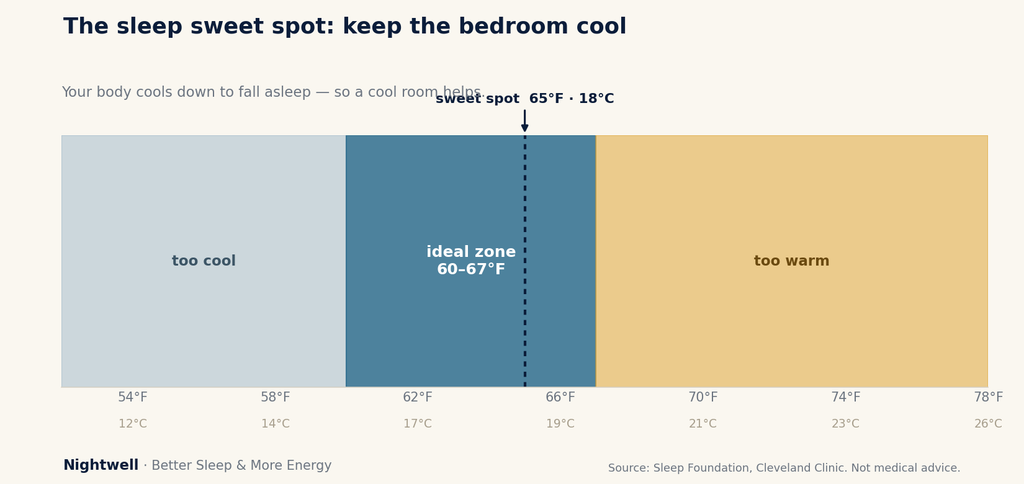
Most adults sleep best in a bedroom kept between 60 and 67 °F (about 15.5 to 19.5 °C), with roughly 65 °F (18 °C) as the commonly cited sweet spot. If that sounds cooler than you’d expect, you’re not alone — most people keep their bedroom warmer than is ideal for sleep. And if you have to err one way, sleep scientists agree: slightly too cool beats too warm.
Why cool wins
Your body doesn’t stay one temperature all day. As bedtime approaches, your core temperature naturally begins to fall — and that drop is part of the signal that tells your brain it’s time to sleep. A cool room works with this process, helping your body shed heat and settle into deep sleep. A warm room works against it: your body has to fight to cool itself, which can delay how long you take to fall asleep and cause more awakenings once you’re there. This is exactly why an overheated bedroom is one of the classic reasons people stir awake in the small hours, when sleep is already at its lightest.
Finding your own number
Sixty-five degrees is a starting point, not a law. Within that 60–67 °F band, personal preference matters — some people settle at 62, others at 67, depending on their metabolism, bedding, and sleepwear. A few things shift the ideal:
- Bedding and pyjamas. Heavy blankets and thick sleepwear effectively raise your personal temperature, so a cooler room compensates.
- Age. Babies and young children generally do better a touch warmer, since they can’t regulate their temperature as well as adults.
- Hormones. Menopausal night sweats or a fever can make a normally comfortable room feel stifling.
The test isn’t the thermostat reading, it’s how you sleep. If you wake up sweaty or kick the covers off, go cooler. If you wake up shivering or with cold feet, nudge it up a degree or two.
How to cool the room without a big bill
You don’t need an expensive cooling system. In rough order from free to fancy:
- Open a window for a crack of airflow, or run a fan — moving air makes a room feel several degrees cooler by helping sweat evaporate.
- Close the curtains during the day in warm weather to block solar heat, so the room starts the evening cooler.
- Switch to breathable bedding and sleepwear — cotton, linen, or bamboo wick heat and moisture far better than synthetics or heat-trapping memory foam.
- Lose a layer. Many people simply overdress for bed; a single lighter blanket often solves an overheating problem on its own.
- Try a warm shower 90 minutes before bed. Counterintuitive, but it works: the warmth brings blood to your skin, and the drop-off afterward helps your core temperature fall — a trick worth folding into an evening wind-down routine.
A note if you’re considering a mattress topper
A topper is a cheap way to refresh a tired, lumpy mattress without replacing it — but classic memory foam is exactly the heat-trapping material mentioned above, so if you sleep warm, choose one with a breathable or cooling cover. If that’s the route you want, the one we’d point to is Luxe’s memory foam topper. Treat it as a comfort upgrade, not a cooling fix — pair it with the cool-room basics above rather than expecting foam alone to keep you cool.
The bottom line
Temperature is one of the most powerful and most overlooked levers for good sleep, and it’s almost entirely in your control. Aim for a cool bedroom in the low-to-mid 60s Fahrenheit (mid-to-high teens Celsius), let how you actually sleep fine-tune the exact number, and remember that cooler usually beats warmer. It pairs well with the other basics — a dark, quiet room, and getting the right amount of sleep for your age — to give you deeper, more restorative nights.
This article is for general information and education and isn’t medical advice. If you regularly sleep poorly or have night sweats, snoring, or daytime fatigue that concern you, please talk to a qualified healthcare professional.
Sources: Sleep Foundation — The Best Temperature for Sleep; Cleveland Clinic — Ideal Sleeping Temperature
Comments on “The Best Temperature for Sleep”