
The short answer
Everyone quotes “eight hours,” but that number is really just the middle of a range — and the range shifts with age. If you’re an adult, the target backed by sleep scientists is seven to nine hours a night. A teenager needs more, a toddler far more, and an older adult sits at the lower end. The famous eight-hour figure isn’t wrong, it’s just incomplete.
Here’s the full picture across every stage of life, based on the consensus guidelines from the National Sleep Foundation — the most widely referenced sleep recommendations, developed by a panel of sleep scientists and reaffirmed after a decade of review.
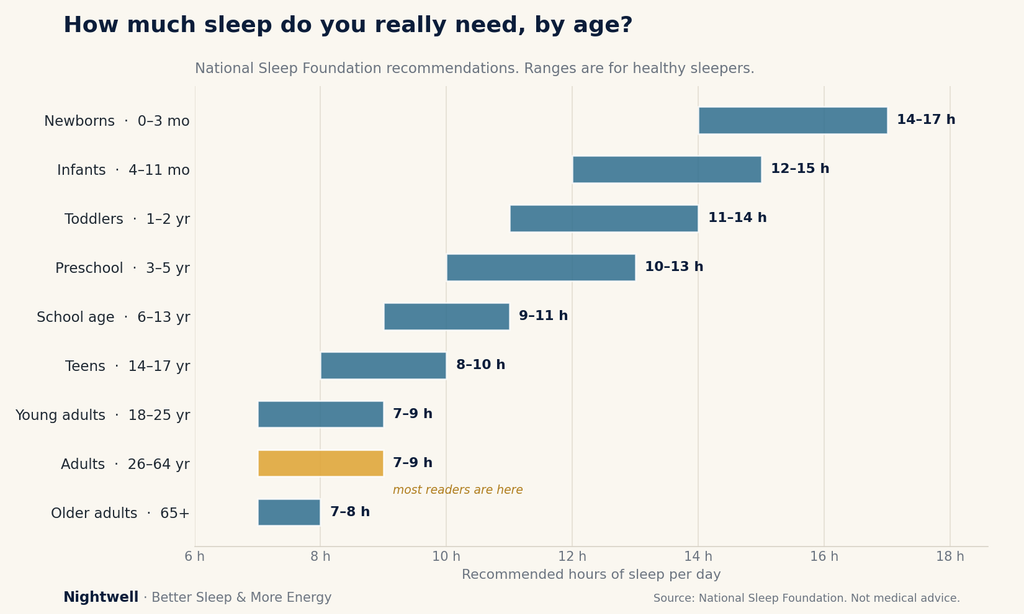
Sleep needs by age, in plain numbers
Reading the chart from youngest to oldest:
- Newborns (0–3 months): 14–17 hours, spread across the whole day in short bursts.
- Infants (4–11 months): 12–15 hours, including naps.
- Toddlers (1–2 years): 11–14 hours.
- Preschoolers (3–5 years): 10–13 hours.
- School-age children (6–13 years): 9–11 hours.
- Teenagers (14–17 years): 8–10 hours.
- Young adults (18–25 years): 7–9 hours.
- Adults (26–64 years): 7–9 hours.
- Older adults (65+): 7–8 hours.
Why the number falls as we grow
Sleep isn’t idle downtime — it’s when the body does its heaviest maintenance. In the early years, that workload is enormous: a newborn’s brain is wiring itself at a furious pace, and children and teenagers produce most of their growth hormone during deep sleep. More building work means more sleep. As the body finishes growing and settles into adulthood, the nightly requirement levels off into that steady seven-to-nine-hour band and stays there for decades.
The older-adult myth worth clearing up
A common belief is that older people simply need less sleep. That’s mostly a misunderstanding. The need barely drops — older adults still require around seven to eight hours. What changes is the ability to get it in one solid block. With age, the brain’s internal clock weakens, deep sleep declines, and nights become lighter and more broken, with earlier wake times and more frequent awakenings. So an older adult who sleeps six hours and naps isn’t proof that the need shrank — it’s a sign the body has become less efficient at producing consolidated sleep, even though it still wants roughly the same amount.
Do you need seven or nine?
Notice that the adult recommendation is a range, not a single figure — and that’s deliberate. Where you land inside it depends on your genetics, activity level, health, and sleep quality. The reliable way to find your personal number isn’t a formula; it’s how you feel. Ask yourself:
- Do you wake up most mornings feeling reasonably refreshed, without an alarm dragging you out of deep sleep?
- Do you stay alert through the day without needing caffeine just to function or fighting an afternoon crash?
- On free days, do you sleep roughly the same length as on work days — or dramatically longer? (Sleeping in for hours every weekend is a classic sign you’re running a sleep debt during the week.)
If you feel good and alert on seven hours, seven is your number. If you’re dragging until you get closer to nine, that’s your body telling you the truth. One caveat worth naming: genuinely needing only five or six hours is extremely rare — the “short sleeper” trait exists but is found in a tiny fraction of people. Most who insist they thrive on five hours are simply adapted to feeling tired.
Hours in bed aren’t hours asleep
One more reason the raw number can mislead: time in bed and time actually asleep are not the same. If you’re in bed for eight hours but spend forty minutes falling asleep and surface a few times in the night, your real sleep total is well under eight. This is why “quality” matters as much as “quantity” — and why hitting the recommended range depends on protecting your sleep, not just scheduling enough time for it. Keeping the room cool and dark, having a consistent wake time, and cutting caffeine and alcohol earlier in the day all help close the gap between time in bed and time genuinely restored.
Signs you’re not getting enough
Beyond obvious grogginess, chronic short sleep tends to show up as trouble concentrating, low mood or irritability, stronger cravings and appetite, getting sick more easily, and relying on caffeine to get through the day. Occasional short nights are completely normal and nothing to worry about. It’s the steady, week-after-week shortfall that’s linked to longer-term effects on weight, heart health, immunity, and focus — which is exactly why the age-based ranges are worth taking seriously as a target.
The bottom line
“How much sleep do I need?” has one honest answer: it depends on your age, and then on you. For most adults, aim for seven to nine hours, treat that as a target rather than a nice-to-have, and let how you feel during the day fine-tune where you land in the range. Getting the amount right for your stage of life is one of the simplest, highest-return things you can do for your energy, mood, and long-term health.
This article is for general information and education and isn’t medical advice. If you regularly struggle to get enough sleep or feel unrested despite enough hours in bed, please talk to a qualified healthcare professional.
Sources: National Sleep Foundation — How Much Sleep Do You Really Need?; National Sleep Foundation duration recommendations (final report); CDC — About Sleep
Comments on “How Much Sleep Do You Really Need by Age?”