
The short answer
Sleep hygiene is the set of everyday habits and bedroom conditions that make good sleep more likely — things like a steady schedule, a cool dark room, and an unhurried wind-down. For most people, it is the single most useful foundation for better sleep, but it is a foundation, not a cure. Solid habits will noticeably improve ordinary, garden-variety poor sleep. What they cannot reliably do on their own is fix a genuine sleep disorder like chronic insomnia. Knowing the difference is what keeps you from either neglecting the basics or blaming yourself when the basics are not enough.
What “sleep hygiene” actually means
The phrase sounds clinical, and it started that way — it was originally developed to help treat mild insomnia. Today it is used more broadly to describe the behavioural and environmental practices that support healthy sleep for the general public. Strip away the jargon and it comes down to two ideas: send your body consistent signals about when to sleep, and remove the obstacles that get in the way.
Your sleep is governed largely by two systems — a build-up of “sleep pressure” across your waking hours, and an internal 24-hour clock that decides when you should feel alert or drowsy. Almost every sleep hygiene tip is really about keeping those two systems working with you instead of against you. A regular schedule steadies the clock. A dark, quiet room removes signals that say “stay awake.” A wind-down routine gives the transition from busy day to sleep a runway instead of a cliff edge.
The pillars that actually matter
You do not need a 30-step checklist. A handful of high-impact habits carry most of the benefit, and public-health bodies like the CDC and clinicians at Harvard broadly agree on them.
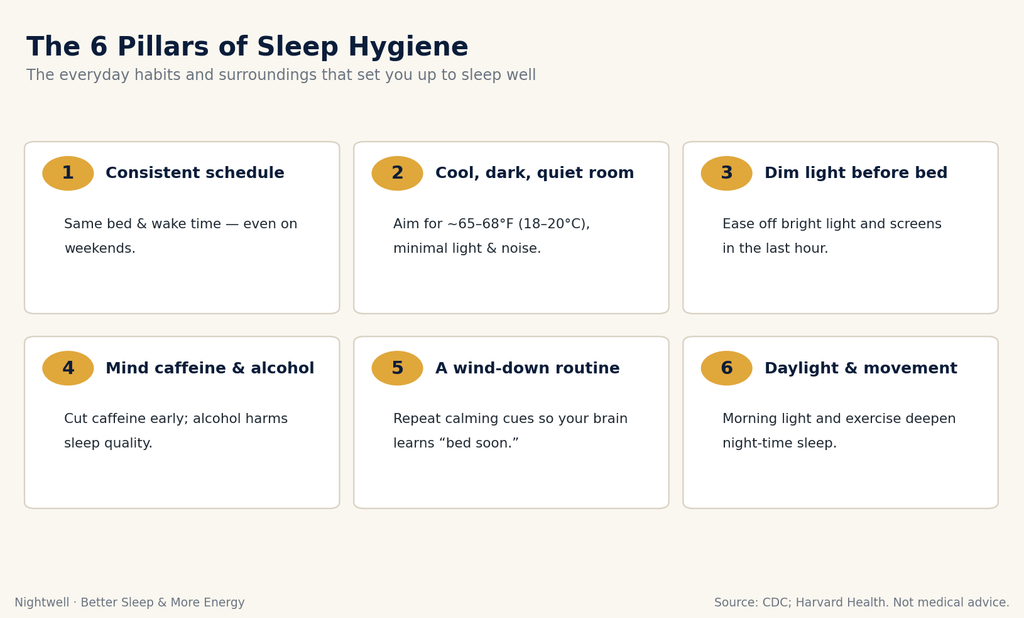
- Keep a consistent schedule. Going to bed and, more importantly, getting up at the same time every day — weekends included — is the most powerful lever you have. It anchors your body clock so sleepiness arrives on schedule.
- Make the bedroom cool, dark, and quiet. Most people sleep best in a slightly cool room, roughly 65–68°F (about 18–20°C). Block outside light and mask noise if you need to. Our guide on the best temperature for sleep goes deeper on this.
- Dim light and screens before bed. Bright light in the evening tells your brain it is still daytime. Easing off overhead lights and devices in the last hour helps — see blue light and sleep for the nuance on what actually matters here.
- Watch caffeine and alcohol timing. Caffeine lingers far longer than most people expect, and alcohol fragments sleep even when it helps you doze off. Timing is everything — our piece on when to stop drinking coffee has specifics.
- Get daytime light and movement. Morning light and regular exercise both deepen night-time sleep. They are “sleep habits” even though they happen nowhere near your bed.
Notice what these have in common: none of them is a gadget or a supplement. Sleep hygiene is mostly about timing and consistency, which is good news — it means the highest-impact changes are free.
Build a wind-down routine
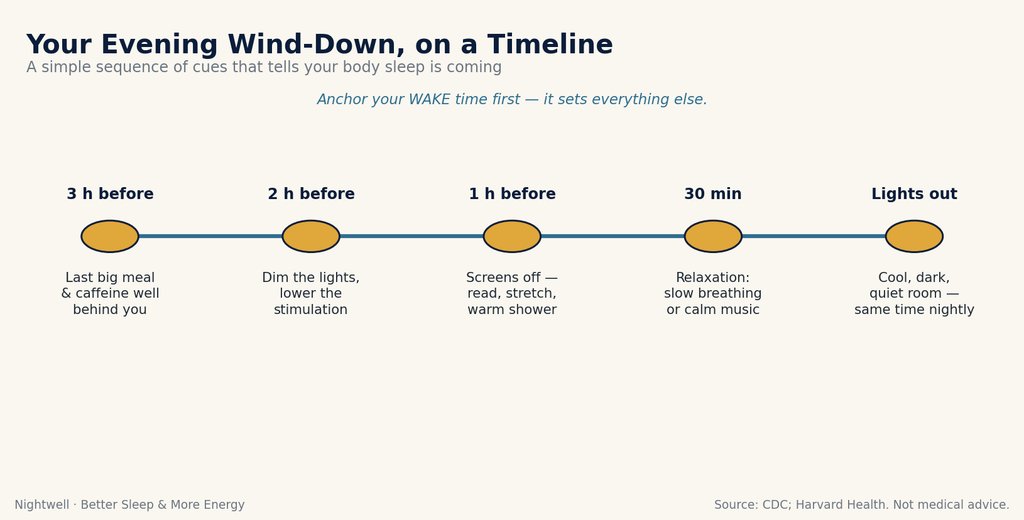
The hour before bed matters more than almost anything else you do, because that is when you either help your nervous system downshift or keep it revved. A wind-down routine is just a repeatable sequence of calming cues, done in roughly the same order each night, until your brain learns to read them as “sleep is coming.” It does not need to be elaborate; it needs to be consistent.
One rule is worth singling out because it is counter-intuitive: if you cannot fall asleep after about 20 minutes, get out of bed. Do something quiet and boring in dim light, and only return when you feel sleepy. Lying awake and frustrated teaches your brain to associate the bed with wakefulness, which is exactly the opposite of what you want. For more tactics on the drift-off itself, see our guide on how to fall asleep faster.
And anchor the whole thing to your wake time, not your bedtime. You have far more control over when your alarm goes off than over when sleep arrives, and a fixed morning start gradually pulls your natural sleep timing into line. Pairing it with early morning sunlight makes the signal even stronger.
What sleep hygiene can’t do — the honest part
Here is where a lot of well-meaning advice quietly oversells. Sleep hygiene is genuinely helpful for everyday sleep trouble, but the evidence that it works as a stand-alone treatment for chronic insomnia is weak. Sleep specialists are clear on this point: for a real, persistent sleep disorder, hygiene tips alone are not considered an effective therapy. The first-line treatment for chronic insomnia is a structured programme called cognitive behavioural therapy for insomnia (CBT-I), not a longer list of bedtime rules.
It is also worth knowing that not every popular tip is equally well supported. The research is strongest for things like avoiding a noisy environment, keeping alcohol away from bedtime, and not doing mentally demanding or anxiety-provoking tasks in bed. Some other familiar suggestions have surprisingly thin evidence behind them. So if you have been doing everything “right” and still struggle, the problem is probably not your discipline — it may be that you need a different tool.
- Good for: ordinary poor sleep, jet lag, shift-adjustment, undoing bad habits.
- Not enough for: chronic insomnia, sleep apnea, restless legs, or other diagnosable disorders.
- The tell: if weeks of consistent, solid habits do not help, it is time to see a professional rather than trying harder.
Common mistakes that quietly sabotage good habits
Sometimes the problem is not a missing habit but a hidden one working against you. A few patterns are so common they deserve calling out, because fixing them often does more than adding yet another rule.
- Using the bed as an office and cinema. Working, scrolling, or watching TV in bed teaches your brain that the bed is a place for being alert. Try to keep the bed for sleep, so lying down becomes a cue to switch off.
- Going to bed too early to “catch up.” Climbing in before you are sleepy usually means lying awake, which breeds frustration and clock-watching. Go to bed when you are actually drowsy, not when the clock says you should.
- Weekend schedule whiplash. Sleeping in for hours on Saturday shifts your body clock and makes Monday brutal — a mini jet lag you inflict on yourself every week.
- Clock-watching. Checking the time when you wake feeds anxiety and makes it harder to drift off again. Turn the clock away.
- Relying on a nightcap. Alcohol is a sedative, not a sleep aid; it helps you fall asleep but wrecks the second half of the night.
- Over-napping. Long or late naps steal from your night-time sleep pressure. If you nap, keep it short and early.
You do not have to fix all of these at once. Pick the one that most describes you and change it first — it is often the fastest win available.
How long until it works?
Sleep hygiene is cumulative, not instant. A single well-run evening might help a little, but the real gains come from repetition, because you are retraining a body clock and a set of associations that took weeks to drift. Give any change a couple of weeks of genuine consistency before you judge it. The most common reason people conclude “sleep hygiene doesn’t work” is that they tried it for three nights, saw no miracle, and quit — right before it would have started to pay off.
Consistency also beats intensity. One steady, modest routine practised every night will outperform an elaborate ritual you keep only on your good days. Pick the two or three pillars that fit your life, do them reliably, and add more once they stick.
The bottom line
Sleep hygiene is the foundation almost everyone benefits from: a consistent schedule anchored to your wake time, a cool dark quiet room, sensible caffeine and light timing, and a calm wind-down. For everyday sleep trouble, these habits are the highest-value, lowest-cost thing you can do, and they are worth protecting. Just hold them in proper perspective — they set the stage for good sleep rather than guaranteeing it, and they are not a substitute for treatment when something more serious is going on. Build the foundation first. If sleep still will not come after a fair, consistent try, that is your cue to get help, not to add another rule.
This article is for general information and isn’t medical advice. If poor sleep persists despite good habits, or you notice signs of a sleep disorder such as loud snoring, gasping, or daytime exhaustion, please speak with a qualified healthcare professional.
Sources: CDC – Tips for Better Sleep · Harvard Health – Sleep Hygiene: Simple Practices for Better Rest · Irish et al., NIH/PMC – The Role of Sleep Hygiene in Promoting Public Health