
The short answer
Blue light does affect your sleep — but not as dramatically as the glasses, filters, and “night mode” marketing would have you believe. The honest version: any bright light in the evening can delay the sleep hormone melatonin, and blue wavelengths do it a little more efficiently than others. But how bright the light is and how long you’re exposed matter far more than its colour. The good news is that the fixes that actually work are free.
Why blue light gets the blame
Your body clock takes its main cue from light. Special cells in your eyes — separate from the ones you see with — detect brightness and tell your brain’s master clock whether it’s day or night. These cells happen to be most sensitive to blue wavelengths (around 460–480 nanometres), the kind well represented in daylight and in the white light of LED screens. When they sense that light in the evening, your brain reads it as “still daytime” and holds back melatonin, the hormone that makes you feel sleepy. That’s the real, legitimate science behind the concern.
Where the panic gets overblown
Here’s the part the product ads leave out. The effective blue-light dose you get from a phone or laptop is tiny compared to daylight — on the order of a few percent of what the sun delivers. The famous study everyone cites, where reading on an iPad delayed melatonin by about an hour and a half, involved people staring at a bright screen up close for four continuous hours — far more than a typical evening scroll. Quick checks to set an alarm won’t wreck your night; it’s sustained, bright, close-up exposure in the hour or so before bed that does the measurable damage.
And two popular “solutions” are weaker than you’d hope. Studies on Apple’s Night Shift found that shifting the screen to warmer colours didn’t reliably reduce melatonin suppression on its own — because it’s the brightness that does most of the work, not the colour. Blue-light-blocking glasses come off worse still: a large Cochrane review found no significant benefit for sleep or eye strain. The takeaway isn’t “blue light is a myth” — it’s “you’ve probably been sold the wrong fix.”
What actually helps
Ranked roughly by how much difference they make:
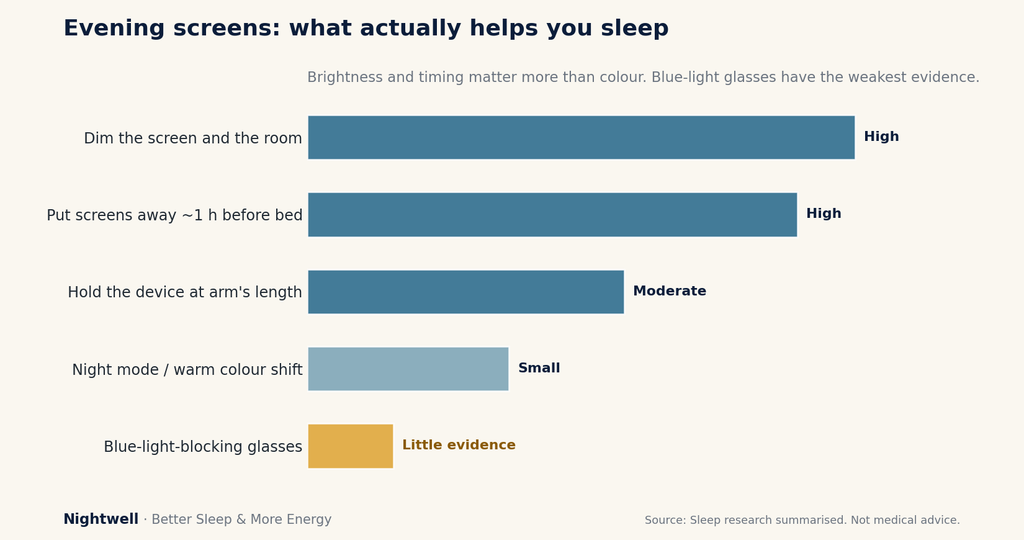
- Dim everything. Turn your screen brightness down to half or lower in the last couple of hours, and dim the room lights too — overhead lights off, low lamps on. Reducing overall brightness is the single most effective, and cheapest, move.
- Put screens away about an hour before bed. This solves the light and the other half of the problem: engaging content keeps your brain switched on regardless of wavelength. It’s the habit most people find hardest and most worth doing.
- Increase the distance. Light intensity drops sharply with distance, so holding your phone at arm’s length rather than against your face genuinely reduces exposure.
- Use night mode — but for its dimming, not its colour. It’s a small help, mostly because it tends to lower brightness. Don’t expect the warm tint alone to save you.
- Don’t bank on blue-light glasses. The evidence just isn’t there. If you like how they feel, fine — but they’re not a substitute for dimming and disconnecting.
The bottom line
Blue light is real, but it’s not a monster — and the gadgets sold to block it are mostly the least effective option. What genuinely protects your sleep is turning the brightness down and stepping away from screens before bed. Fold that into an evening wind-down routine, keep the bedroom cool and dark, and you remove one of the most common reasons people lie awake — including those who find themselves wide awake at 3 a.m. after a late-night scroll.
This article is for general information and education and isn’t medical advice. If you regularly struggle to fall or stay asleep, please talk to a qualified healthcare professional.
Sources: TIME — What You Think You Know About Blue Light and Sleep; Cochrane review — blue-light-filtering lenses; Nemours KidsHealth — Screens and Sleep
Comment on “How Blue Light Really Affects Your Sleep”