
The short answer
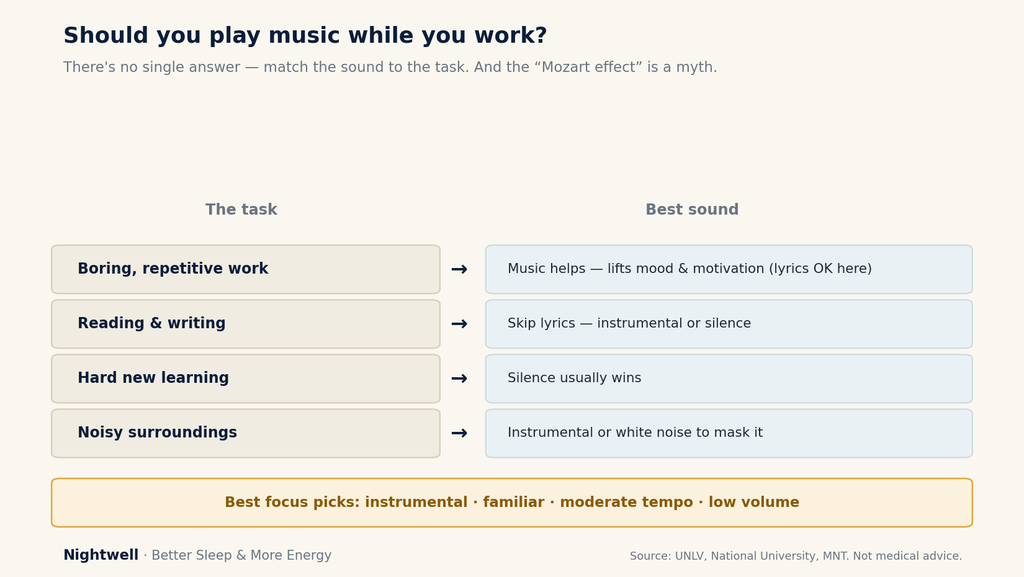
Does music help you concentrate? The honest answer is: it depends — on the task, the music, and you. There’s no universal yes, and the popular idea that classical music makes you smarter is a myth. What the research actually shows is more useful: instrumental music at low volume can help with boring, repetitive work and lift your mood, but lyrics and loud or complex music tend to hurt reading, writing, and hard thinking. The trick is to match your sound to the task rather than pressing play on the same playlist for everything.
Why there’s no single answer
Your brain has limited “working memory” — the mental space where you juggle information in the moment. Music uses up some of that space. Whether that’s a problem depends entirely on how much the task itself demands. For an easy, repetitive job, you’ve got spare capacity, and music fills the gap pleasantly, keeping you engaged and motivated. For a demanding task that’s already maxing out your working memory, that same music competes for resources you can’t spare — and your performance drops. This is why researchers keep landing on the same conclusion: the relationship between music and focus is genuinely complex, and it hinges on task demands, the type of music, and individual differences.
The lyrics problem
Here’s the single most practical finding. Reading and writing rely heavily on your brain’s language-processing system — and so do song lyrics. When you try to read or write while listening to words, the two compete for the same channel, and focus suffers. That’s why lyric-heavy music is a poor choice for anything involving text.
The fix is simple: for language-heavy work, go instrumental — classical, lo-fi beats, ambient, soft jazz, acoustic, or film and video-game scores all sidestep the lyric problem. Interestingly, one study found that the students who set up their study space best deliberately chose instrumental over lyrical music, often to drown out background noise. For a task where lyrics don’t matter — a boring, repetitive one — a fired-up playlist with vocals is fine and can even help you push through.
When silence wins
For your hardest, most cognitively demanding work — learning genuinely new material, dense reading, complex problem-solving — silence is often the best “soundtrack” of all. When every bit of working memory is needed, even instrumental music can be one input too many. So don’t feel you must have something playing; for deep, analytical tasks, quiet is a legitimate and often superior choice. Reserve music for the parts of your work that don’t need every ounce of concentration.
The Mozart-effect myth
You’ve probably heard that listening to Mozart makes you smarter. It doesn’t. The “Mozart effect” comes from a 1993 study where people did slightly better on a spatial-reasoning task right after listening to Mozart — but the boost was tiny, temporary, and specific to that one type of task, and it hasn’t held up as a route to higher intelligence or better focus in general. Most researchers now think any small benefit came from music briefly improving mood and alertness, not from the music rewiring your brain. So by all means enjoy classical music while you work — just for the right reasons, not because it’ll raise your IQ.
Getting the details right
If you do use music to focus, a few settings make it far more likely to help than hurt:
- Instrumental over lyrical for anything involving words.
- Low volume. Soft background music is far less distracting than loud — loud music, whether fast or slow, tends to harm concentration.
- Moderate, steady tempo. Avoid tracks with sudden jumps in volume or tempo, which yank your attention away. A consistent rhythm fades into the background.
- Familiar and emotionally neutral. Your favourite emotional songs are distracting — they pull up memories and feelings. Pick music you like but aren’t deeply attached to, so it doesn’t hijack your attention.
What about white noise?
Sometimes the real enemy isn’t silence versus music — it’s a noisy environment. In a loud café, open-plan office, or busy home, the point of putting something in your ears is to mask unpredictable, distracting sounds. Here, steady instrumental music or plain white (or brown) noise works well: it creates a consistent audio backdrop that drowns out the disruptive stuff without competing for your language processing. If a chatty environment keeps breaking your concentration, this is often more effective than music with any melody at all — and it’s a close cousin of the distraction-removal principles in deep focus.
Know yourself — and experiment
Individual differences are real. Some people focus beautifully with a lo-fi playlist; others find any sound intrusive and do best in silence. How you naturally process information, how easily you’re distracted, and even your mood on the day all play a part. So treat it like a small experiment: notice whether you actually get more done, and how you feel, with music versus without on different kinds of tasks. Let results, not habit, decide.
One more honest use for music: as a tool to start. If the hardest part is getting going, an upbeat track can lift your mood and motivation enough to begin — and once you’re in flow on a demanding task, you can turn it down or off. Just make sure the music is helping you work, not helping you procrastinate over choosing the perfect playlist. And remember it’s one small lever among the bigger ones — sleep, movement, and managing digital distraction — that really determine your focus, as we lay out in getting more energy naturally.
And binaural beats?
You’ll see apps and playlists promising “binaural beats” or special “focus frequencies” that supposedly tune your brainwaves for concentration. Be a little sceptical here: the evidence is thin and mixed, and any benefit some people report may come as much from having a steady, calming background sound (and the expectation that it’ll help) as from the frequencies themselves. There’s no harm in trying them — if a particular focus track helps you settle in, use it — but don’t pay a premium believing they’re a scientifically proven concentration switch. A simple instrumental playlist or plain white noise does the same practical job for free.
The bottom line
Music can genuinely help you focus — or quietly sabotage you — and which one it does comes down to matching the sound to the task. Use instrumental, low-volume, familiar music for repetitive or moderately demanding work; skip lyrics for anything involving reading or writing; reach for silence or white noise when the task is hard or the room is loud; and don’t buy the Mozart-makes-you-smarter myth. Experiment to learn your own preferences, use music to get started and to hold your mood, and let it be a helpful backdrop rather than another thing competing for your attention.
This article is for general information and education. Preferences vary from person to person, so treat these as starting points and find what genuinely helps you concentrate.
Sources: UNLV — Does Music Help You Study?; Medical News Today — Can Music Improve Focus?; National University — Can Music Help You Study and Focus?