
Let’s follow one ordinary night, hour by hour. Lights out at 11 p.m., alarm at 7. Nothing special happens — no nightmares, no 3 a.m. crisis. And yet your brain goes through something like five complete cycles, switching between states that are about as different from each other as sleeping is from being awake.
Understanding that journey explains a surprising amount: why an alarm sometimes feels brutal and sometimes fine, why a late night and an early morning damage you in different ways, and why “eight hours” doesn’t always feel like eight hours.
11:05 p.m. — The doorway (N1)
Your eyes are closed, your muscles loosen, your thoughts start going slightly strange. This is N1, the lightest stage, and it only lasts a few minutes. It’s also where that sudden jolt of “falling” tends to happen. If your partner says something now, you might answer and insist you weren’t asleep. You were, just barely.
11:15 p.m. — Real sleep begins (N2)
Your heart rate and breathing slow down, your body temperature drops, and your brain starts producing short bursts of activity called sleep spindles. They seem to help protect your sleep from noise and play a role in storing memories.
N2 doesn’t get much attention, but it’s the backbone of the night. You’ll spend around half of your total sleep here, returning to it again and again between the other stages.
11:40 p.m. — The deep end (N3)
Now you’re in slow-wave sleep: deep, heavy and very hard to wake from. Brain activity slows into large, rolling waves. This is when your body does much of its physical maintenance — tissue repair, growth hormone release, immune housekeeping. If someone manages to wake you now, you’ll feel confused and groggy for a while, which is known as sleep inertia.
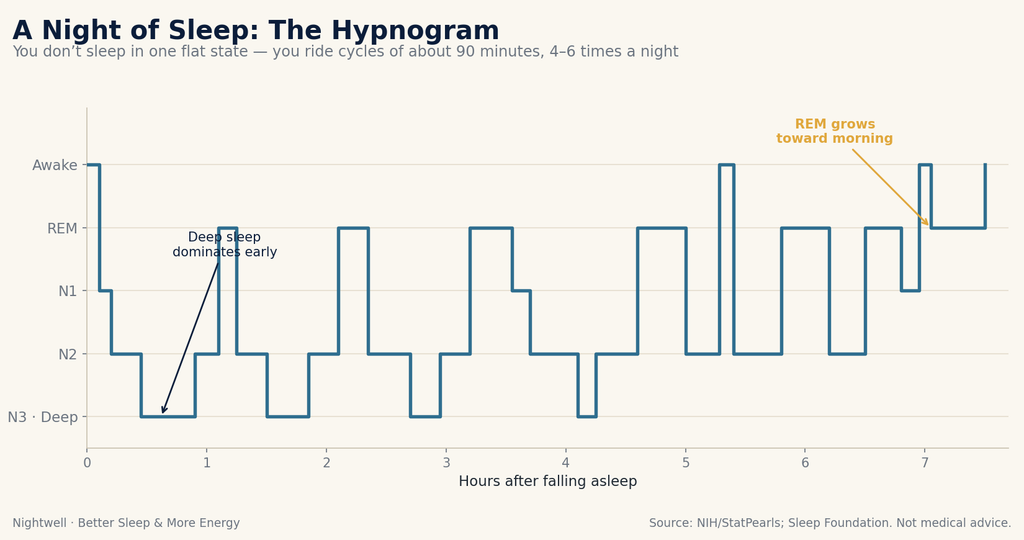
The key detail: deep sleep is front-loaded. Your first two cycles contain the longest, deepest stretches. By the second half of the night there’s very little left.
12:45 a.m. — The first dream (REM)
After deep sleep you drift back up through N2 and then into your first REM period. Your brain lights up to almost waking levels, your eyes flick back and forth behind your eyelids, and most of your muscles are temporarily switched off so you don’t act out your dreams.
This first REM period is short, often just a few minutes. That’s the other key detail: REM gets longer with every cycle. The biggest blocks come in the early morning.
That’s one full cycle, roughly 90 minutes. Then it starts again.
3:00 a.m. — The halfway shift
By the middle of the night, the mix has changed. Most of your deep sleep is done. The cycles now consist mostly of N2 and increasingly long REM periods. Your sleep is lighter overall, which means it’s easier to wake up briefly — a noise, a warm room, a full bladder. Most of those brief wake-ups you’ll never remember. If you tend to wake at 3 a.m. and struggle to get back to sleep, this change in sleep structure is a big part of the reason.
5:30–7:00 a.m. — REM territory
The last couple of cycles are dominated by REM. Some of these periods can last half an hour or more, and this is when you have your longest, most vivid and most memorable dreams. REM appears to be heavily involved in consolidating memories and processing emotions from the day.
Which is why cutting your night short in the morning matters so much. Set your alarm for 5:30 instead of 7:00, and you don’t lose “an hour and a half of sleep” evenly. You lose a big share of that night’s REM.
Deep sleep vs REM, side by side
| Deep sleep (N3) | REM sleep | |
|---|---|---|
| When it happens | Mostly in the first 3–4 hours | Mostly in the last 3–4 hours |
| Share of the night | Roughly 15–25% | Roughly 20–25% |
| Main job | Physical repair, immune function, feeling rested | Memory, learning, emotional processing |
| What your brain looks like | Slow, large waves — very quiet | Busy, almost like being awake |
| Your body | Relaxed, hard to wake | Major muscles temporarily paralysed |
| Short on it, you feel… | Heavy, achy, unrefreshed | Irritable, foggy, more emotional |
| Stolen by… | Going to bed very late, late caffeine, a warm room | Waking too early, alcohol, broken mornings |
People often ask which of the two is more important. Honestly, it’s the wrong question. They do different jobs, and your body treats both as essential. After a period of bad sleep, it usually catches up on deep sleep first, then pays back REM over the next few nights — which is why the first night after a rough week often feels like a heavy, dreamless crash, and the vivid dreams come back a night or two later.
Why eight hours doesn’t always feel like eight hours
Because the stages are spread so unevenly, how you get your hours matters, not just how many. Two people can both log eight hours and feel completely different in the morning.
If your sleep is broken up by frequent waking, you may keep resetting into lighter stages and never get long uninterrupted stretches of deep sleep or REM. If your bed and wake times shift a lot from day to day, your cycles never settle into a steady pattern. And if your alarm happens to land in the middle of deep sleep, you’ll wake up feeling worse than if it had gone off 20 minutes later in a lighter stage. All of these help explain why so many people feel tired even after eight hours.
What quietly reshapes your night
Alcohol is probably the biggest everyday culprit. It can help you fall asleep, but it suppresses REM early in the night and breaks up the second half — more on that in alcohol and sleep.
Late caffeine can reduce deep sleep even if you fall asleep without trouble.
A warm bedroom pushes you toward lighter, more broken sleep. Deep sleep in particular benefits from a cool room — see the best temperature for sleep.
Age changes things too. Deep sleep naturally shrinks as we get older, and lighter sleep takes up more of the night. That’s normal, not a sign that something is wrong.
Can you boost a specific stage?
Not really, whatever some apps and gadgets suggest. Sleep trackers can give you a rough picture, but their stage estimates are just that — estimates, and often not very accurate ones. We wouldn’t lose sleep over what your watch says about your REM.
What does work is boring but reliable: enough total time in bed, a consistent wake-up time, a cool, dark room, daylight and movement during the day, and keeping alcohol and late caffeine under control. The fundamentals of good sleep hygiene, in other words. Protect the whole night, and your brain will arrange the stages on its own. If you’ve fallen behind, our guide on whether you can catch up on sleep covers what recovery really looks like — and why getting it right is one of the best cures for daytime brain fog.
Tonight, as you drift off, you’ll start that same journey again. You won’t notice any of it. That’s rather the point.
General information only, not medical advice. If you regularly wake unrefreshed, snore loudly, stop breathing during sleep, or feel exhausted during the day despite enough time in bed, talk to a healthcare professional about a possible sleep disorder.
Sources: NIH/StatPearls — Physiology, Sleep Stages · Sleep Foundation — Stages of Sleep · Medical News Today — Sleep cycle stages
Comment on “Sleep Stages Explained: REM vs Deep Sleep”