
The short answer
Cardio and strength get all the attention, but there are two overlooked pillars of fitness that quietly determine how well you’ll age: balance and flexibility. They’re what let you stay steady on your feet, move freely, and remain independent for decades — and their decline is what leads to the falls that are a leading cause of injury in older adults. The best news? Both are trainable at any age, with simple moves you can do at home in a few minutes. Investing a little in balance and flexibility now is one of the smartest things you can do for your future self.
Why balance matters more than you think
Balance rarely crosses your mind — until you slip. But it’s doing constant, invisible work every time you walk, climb stairs, turn around, or stand up. And it’s more than “strong legs”: staying steady is a complex team effort involving your vision, your inner ear, your muscle strength, your joint flexibility, and your brain’s coordination. When any of these weakens, your balance suffers.
The stakes rise with age. Roughly one in three adults over 65 falls each year, and falls are a leading cause of injury and loss of independence in older people. There’s also a vicious cycle: a fall (or the fear of one) makes people move less, which weakens the muscles and balance systems further, making the next fall more likely. Breaking that cycle — or better, never entering it — is what balance training is all about.
Why it declines — and why that’s not inevitable
Several age-related changes chip away at balance: muscle mass and strength drop by around 3–8% per decade after 30, joint flexibility and range of motion diminish, reaction times slow, and the inner-ear systems that sense your position become less reliable. Left unchecked, these add up to a wobblier, stiffer, less confident body.
But here’s the crucial point: this decline is not inevitable, and it’s reversible. Balance is a skill, and like any skill it responds to practice at any age. The evidence is genuinely impressive — structured balance exercise reduces fall risk by roughly 23–24%, and tai chi has cut falls by anywhere from 30% to over 50% in trials. You are not stuck with the balance you have.
Flexibility: the quieter partner
Flexibility works alongside balance. It’s the range of motion in your joints and muscles that lets you reach, bend, turn, and move through daily life without strain — putting on shoes, looking over your shoulder while driving, getting up off the floor. Like balance, it declines with age and with too much sitting, and like balance, it improves with regular gentle work. We cover the how of it in stretching and mobility — the key is consistent, gentle range-of-motion practice rather than occasional heroic stretching.
Simple balance exercises you can start today
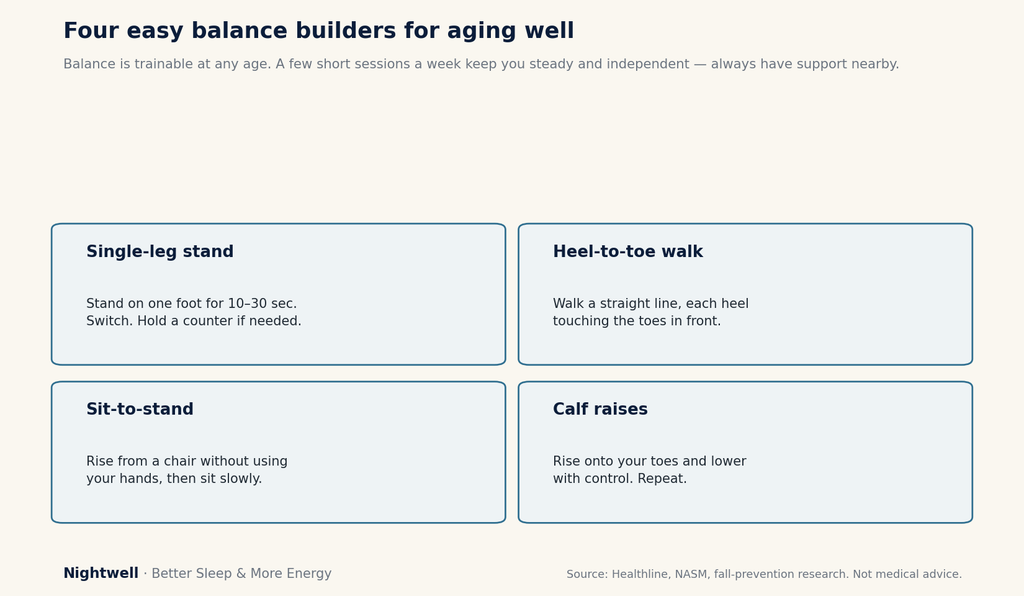
You don’t need equipment or a class — just a few minutes and something sturdy to hold onto for safety. The graphic above shows four of the best:
- Single-leg stand: stand on one foot for 10 to 30 seconds, then switch. Hold a counter or chair at first, and progress to hands-free as you improve.
- Heel-to-toe walk: walk slowly in a straight line, placing the heel of one foot directly in front of the toes of the other, as if on a tightrope.
- Sit-to-stand: rise from a chair without using your hands, then lower back down slowly. This one is special — it’s a core test of leg strength, dynamic balance, and functional independence all at once, and practising it directly protects your ability to get up unaided.
- Calf raises: rise onto your toes and lower with control, holding support if needed. This strengthens the lower-leg muscles that keep you stable.
Aim for around three short sessions a week, 15 to 20 minutes each, mixing steady holds with movement. Always have a wall, counter, or sturdy chair within reach when you start — safety first builds confidence, which is half the battle.
Tai chi: the balance superstar
If you want one activity that trains balance beautifully, it’s tai chi — the gentle, flowing Chinese practice sometimes called “meditation in motion.” It’s one of the most evidence-backed exercises for fall prevention, with studies showing large reductions in falls, because it simultaneously trains strength, balance, flexibility, coordination, and the ability to control your centre of gravity — all while being calming and low-impact. It’s especially popular with older adults for good reason, and it’s a perfect example of the joint-friendly training we cover in low-impact exercise.
Strength is balance’s foundation
You can’t separate balance from strength — strong muscles, especially in your legs, hips, and core, are what physically hold you steady and catch you when you stumble. That’s why the most effective approach is multicomponent: combining balance work with strength, flexibility, and aerobic exercise. The beginner strength routine we outline directly supports better balance, and together these elements make up the full picture in how much movement you actually need. Health guidelines specifically recommend that older adults include balance and functional training on three or more days a week, on top of their strength and aerobic activity.
Start now, whatever your age
Here’s the mindset shift: balance and flexibility aren’t only “old person” concerns. The best time to build them is before you need them — the balance and range of motion you develop now is the buffer that keeps you steady and mobile later. And if you’re already older, it is never too late; improvements come at every age. Weave small doses into daily life: stand on one leg while you brush your teeth, do a few calf raises while the kettle boils, take the stairs, practise rising from your chair without hands. These tiny habits compound into a body that stays capable, confident, and independent.
The bottom line
Balance and flexibility are the unsung heroes of fitness — the pillars that keep you steady, mobile, and independent as the years go by, and your best protection against the falls that can rob older adults of their freedom. Both decline with age, but neither has to: they respond to simple, regular practice at any age. Spend a few minutes a few times a week on balance moves like single-leg stands and sit-to-stands, keep your joints supple with gentle stretching, lean on tai chi if you enjoy it, and back it all with strength training. It’s a small, easy investment now — and it pays out in decades of staying steady on your feet.
This article is for general information and education and isn’t medical advice. If you have balance problems, a history of falls, dizziness, or a health condition, please talk to a qualified healthcare professional or physiotherapist, and always exercise near support to prevent falls.
Sources: Healthline — Balance Exercises for Older Adults; NASM — Balance Training and Fall Prevention; Tai Chi for Fall Prevention: Systematic Review and Meta-Analysis (NIH)