
The short answer
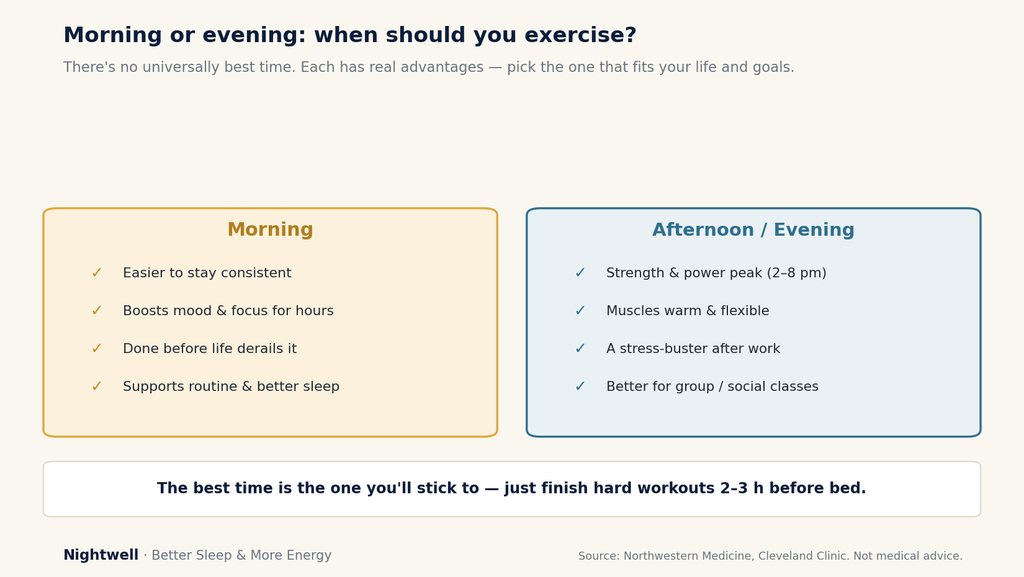
When’s the best time to exercise — morning or evening? The honest answer is that there’s no universally best time; the best time is the one you’ll actually stick to. That said, the science does show real differences: your body is physically strongest in the late afternoon and early evening, while morning workouts tend to win on consistency, mood, and building a routine. So the ideal choice comes down to your goals, your schedule, and your natural rhythm — with one simple rule: finish hard workouts a few hours before bed so they don’t wreck your sleep.
Why your body has a “peak” time
Your strength, flexibility, and performance aren’t constant through the day — they follow your circadian rhythm. The key driver is your core body temperature, which is lowest in the early morning and climbs to its highest point roughly between 4 and 8 p.m. Warmer muscles contract more efficiently, connective tissue is more elastic, and your nervous system fires faster — so your maximal strength and power are genuinely higher later in the day. Research consistently finds handgrip, bench press, and squat performance measurably better in the evening, with day-to-day differences of anywhere from about 3% to 15% between a morning and an evening session.
This is why, purely on physiology, late afternoon is often called the optimal window for strength and power training. But — and this is the important part — physiology isn’t the only thing that matters.
The case for morning workouts
Morning exercise gives up a little peak performance but offers advantages that matter more for most people’s actual lives:
- Consistency. This is the big one. A morning workout happens before the day’s demands, meetings, and tiredness can derail it. If your evenings are unpredictable and workouts keep getting skipped, training in the morning is almost always the better bet — the consistency advantage easily outweighs the small performance dip.
- Mood and focus. A morning session floods your brain with endorphins and boosts blood flow, sharpening your focus and lifting your mood for hours afterward — a great start to a productive day, and a natural fit for an energising morning routine.
- Routine and sleep. Morning exercise, especially outdoors, helps anchor your circadian rhythm, and finishing your workout early leaves no risk of it interfering with sleep.
The one caveat: because you’re cooler and stiffer first thing, morning workouts need a slightly longer, more thorough warm-up to reduce injury risk — a proper dynamic warm-up matters even more, as we cover in stretching and mobility.
The case for afternoon and evening workouts
If your schedule allows and you’ll stick to it, training later has genuine perks:
- Peak strength and power. You’re at your physical best, so you may lift a little heavier, maintain better form, and perform complex movements more effectively.
- Warm, ready muscles. A full day of moving around has already partly warmed you up, so you need less warm-up time and may feel looser.
- A stress release. An evening workout is a superb way to burn off the tension of a demanding day — one of the best natural stress-relievers there is.
- Social options. Group classes and workout partners are often easier to find in the evening.
The one real catch: evening exercise and sleep
There’s a genuine downside to training too late, and it’s about sleep. Vigorous exercise raises your heart rate, body temperature, and adrenaline — the opposite of what your body needs to wind down. A study in Nature Communications found that exercising within about four hours of bedtime was linked to falling asleep later, getting less total sleep, and poorer sleep quality, with a resting heart rate that stayed elevated. So if you train in the evening, the guidance is simple: finish vigorous workouts at least two to three hours before bed.
The important nuance is that this mainly applies to intense exercise. Gentler evening movement — a leisurely walk, some yoga, light stretching, or easy mobility work — is fine close to bedtime and can even help you relax. We go deeper on this balance in exercise and sleep.
What about morning “fasted” workouts and fat loss?
You may have heard that exercising before breakfast burns more fat. There’s a grain of truth — training fasted can increase fat use during and just after the workout — but it isn’t essential, and it doesn’t clearly lead to greater overall fat loss, which is driven far more by your total diet and activity. If working out fasted leaves you light-headed or low on energy, just eat something small first; you’ll train better. Don’t force a fasted morning workout if it doesn’t suit you.
Consistency beats timing — and your body adapts
Here’s the finding that ties it all together and should take the pressure off: consistency matters far more than the specific hour. Any minor physiological edge from evening training is easily outweighed by simply showing up regularly. Even better, your body adapts to whatever time you train — work out consistently at the same time and your muscles’ internal clocks gradually shift to perform their best then, largely neutralising the “optimal window.” So don’t let indecision about timing stop you: the perfect time on paper is worthless if you skip it.
Two more personal factors help you choose. Your chronotype — whether you’re a natural morning lark or night owl — strongly shapes when you’ll have the energy and motivation to train, so work with it rather than against it. And you can mix and match: some people do easy cardio in the morning and save strength work for the evening when they’re stronger. Experiment, notice when you feel best and are most likely to follow through, and build your habit around that — the core of building an exercise habit that sticks.
The bottom line
Your body is physically strongest in the late afternoon and early evening, so that’s the theoretical sweet spot for peak performance — but morning workouts win on consistency, mood, and routine, and that usually matters more in real life. There’s no single right answer: pick the time that fits your schedule, suits your natural rhythm, and, above all, that you’ll actually keep doing. Just remember to warm up well if you train early, and to finish intense workouts a couple of hours before bed if you train late. Nail the consistency, and the exact time on the clock barely matters — your body will adapt to whenever you show up.
This article is for general information and education and isn’t medical advice. If you have a health condition, please talk to a qualified healthcare professional about the exercise routine that’s right for you.
Sources: Northwestern Medicine — Best Time of Day to Exercise; Cleveland Clinic — Best Time of Day to Work Out; ScienceInsights — Morning or Evening Workouts (Nature Communications study)