
The short answer
Stretching is one of the most misunderstood parts of fitness — wrapped in gym myths that turn out to be wrong. The big one: the classic habit of holding long static stretches before a workout does not prevent injury, and can actually reduce your strength and power for the session. What the evidence now supports is simple: do dynamic stretching (moving through your range) before you exercise, and static stretching (holding a stretch) afterward or as its own session. And the deeper goal isn’t just being bendy — it’s mobility: usable, controlled range of motion that keeps you moving well for life.
The myths worth dropping
Let’s clear these up first, because they trip up almost everyone.
Myth 1: Stretching before exercise prevents injury. The latest international expert consensus is clear that stretching doesn’t reliably reduce overall injury risk — and static stretching beforehand can even backfire. What actually protects you is a proper warm-up that raises your body temperature and blood flow, not holding a hamstring stretch on cold muscles.
Myth 2: More flexibility means fewer injuries. The link is far weaker than gym lore suggests. Being able to touch your toes doesn’t automatically protect you; controlled strength through a range of motion matters more.
Myth 3: Stretching cures muscle soreness. The evidence that stretching prevents or relieves next-day soreness (DOMS) is mixed at best — don’t rely on it for that.
None of this means stretching is useless — it just means doing the right type at the right time.
Dynamic vs static: the key distinction
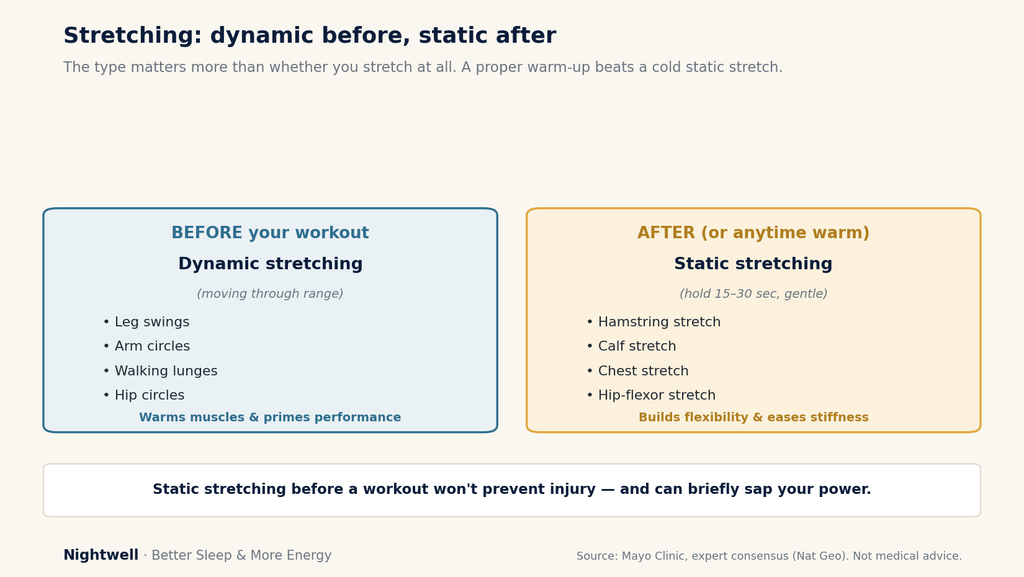
Dynamic stretching means moving a joint through its full range in a smooth, controlled, repeated way — leg swings, arm circles, walking lunges, hip circles. It raises muscle temperature, blood flow, and neural activation, priming your body to perform. This is what belongs before a workout, as part of a 5-to-10-minute warm-up. Far from hurting performance, a dynamic warm-up tends to improve it — studies have found small but real boosts to sprint speed, jump height, and agility compared with static stretching or no warm-up.
Static stretching means easing into a stretch and holding it — a hamstring stretch, a calf stretch, a chest opener. This is the one to save for after your workout (or as a standalone session), when your muscles are warm and pliable. Held static stretches gradually improve flexibility and ease stiffness. The catch is timing: done on cold muscles before training, prolonged static stretching can temporarily reduce your strength — one well-known meta-analysis found drops of around 10% — which is exactly why it’s the wrong warm-up.
So the rule of thumb is easy: dynamic before, static after.
Flexibility vs mobility — and why mobility wins
People use these words interchangeably, but they’re different. Flexibility is how far a muscle can passively lengthen — how far someone could push your leg into a stretch. Mobility is how well you can actively move a joint through its range with control and strength. Mobility is the more useful goal, because it’s what lets you squat deeply, reach overhead, and move freely in real life — not just hold an impressive stretch. That’s why combining stretching with strength work (which builds control through range) matters more than chasing extreme flexibility for its own sake, and it dovetails with the routine in strength training for beginners.
Who actually needs dedicated stretching?
Here’s the honest hierarchy: for general health, regular cardio and strength training matter more than stretching. Stretching is a valuable supporting player, not the main event. But some people benefit from dedicated mobility work beyond a warm-up and cool-down:
- Desk workers, whose hips, chest, and hamstrings tighten from hours of sitting — a great counter to the stiffness we describe in why sitting all day drains you.
- Older adults, for whom maintaining range of motion supports balance, posture, and everyday function.
- Anyone with specific tightness or restrictions, such as tight hip flexors or hamstrings.
For these groups, a short daily mobility routine — or something like yoga, which builds mobility, strength, and body awareness at once — pays real dividends in how you move and feel.
How to stretch well
Whether dynamic or static, a few principles keep stretching safe and effective:
- Warm up first for static stretching. Stretch when muscles are warm (after activity or a light warm-up), never deeply on cold ones.
- Ease to gentle tension, never pain. You should feel a mild pull, not discomfort. Pushing into pain risks strain and is counterproductive.
- Hold, don’t bounce. For static stretches, hold steadily for about 15 to 30 seconds (up to 60), and repeat two or three times. Avoid ballistic bouncing, which can cause injury.
- Breathe. Relax and breathe through the stretch rather than holding your breath — it helps the muscle release.
- Be consistent. Flexibility and mobility improve gradually with regular practice over weeks, not from one heroic session. A little, often, beats a lot, rarely.
A simple approach that fits any workout
Put it all together and your routine looks like this: begin with 5 to 10 minutes of dynamic movement — a brisk walk building to leg swings, arm circles, and walking lunges — to warm up and prime your body. Do your walk, workout, or activity of choice. Then, while you’re still warm, spend a few minutes on static stretches for the muscles you used, easing into each and breathing. If you sit a lot or want better mobility, add a short dedicated session a few times a week. That’s genuinely all most people need.
The bottom line
Forget the old ritual of bouncing through static stretches on cold muscles before a workout — it won’t prevent injury and can leave you weaker for the session. Instead, warm up with dynamic movement before you train, and save static stretching for afterward or its own time, when your muscles are warm. Aim for mobility — usable, controlled range — rather than just flexibility, and remember that stretching supports your cardio and strength work rather than replacing it. Do it gently, consistently, and at the right time, and you’ll move better, feel looser, and keep your body working well for years to come.
This article is for general information and education and isn’t medical advice. If you have an injury, joint problem, or a condition affecting your movement, please talk to a qualified healthcare professional or physiotherapist before starting a stretching routine.
Sources: National Geographic — What the Science Says About Stretching; Mayo Clinic — Does Stretching Prevent Injuries?; University of Utah Health — 4 Stretching Myths Exposed
Comment on “Stretching and Mobility: What You Really Need”