
The short answer
Ever ended a day where you didn’t get much done, yet felt completely mentally drained? Your to-do list may be the culprit. A long, vague list quietly exhausts you in two ways: every unfinished task nags at your brain like an open browser tab, and every glance at the list forces another round of “what should I do first?” — burning through your limited daily supply of decision-making energy. The fix isn’t a fancier app or more willpower. It’s to get everything out of your head, pick a tiny few things that matter, and make them concrete. Do that and your list starts giving you energy instead of draining it.
Why a to-do list drains you
Two well-documented psychological effects are working against you.
The Zeigarnik effect: open loops. In the 1920s, psychologist Bluma Zeigarnik noticed that waiters could remember complex unpaid orders perfectly — then forgot them the instant the bill was settled. She’d discovered that our brains hold onto unfinished tasks far more tightly than completed ones. Every incomplete task becomes an “open loop” your brain keeps partly loaded, periodically resurfacing it so you don’t forget. A handful is manageable; dozens of open loops create constant background noise, low-level anxiety, and real mental fatigue. It’s why you can feel wiped out even on a day you barely finished anything — your brain was busy juggling reminders the whole time.
Decision fatigue. Your capacity for decisions and willpower is finite — think of it as a daily mental-energy budget. Every choice makes a small withdrawal. A long, unstructured list is a decision-fatigue machine: each time you look at it, you re-run the whole calculation — What’s most important? Can this wait? Where do I even start? That constant re-evaluation drains the very resources you need for your best work, leaving you depleted before you’ve truly begun.
Underlying both is a hard limit: your working memory can only juggle a few things at once — research suggests around four. Push a to-do list well past that and your brain simply can’t hold it, so it resorts to that exhausting cycling-through instead.
The key insight: closure, not completion
Here’s the liberating part. Your brain doesn’t actually need a task finished to quiet the open loop — it just needs to trust that it’s captured somewhere reliable. Writing a task down does much the same thing for your mind as completing it: it signals “you can stop holding this now, it’s recorded.” The loop closes, and the mental energy it was consuming is freed up for actual thinking. This is the principle behind David Allen’s well-known Getting Things Done method — your head is for having ideas, not storing them. So the goal isn’t to do more; it’s to offload more.
How to fix it
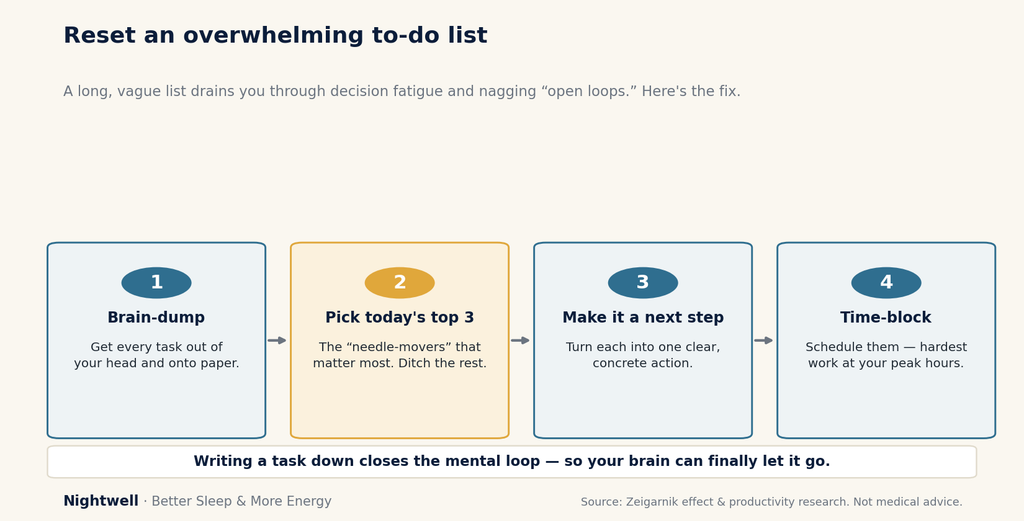
The four steps in the graphic above turn a draining list into a calm, workable plan.
1. Brain-dump everything
Set a timer for 10 to 15 minutes and write down every task and open loop swirling in your head — work, home, personal, the lot. Don’t filter, rank, or judge; the only goal is to get it all out of your working memory and into external storage. This single act often brings immediate relief, because your brain finally stops trying to hold it all. It’s also a brilliant thing to do before bed: a bedtime brain-dump stops those open loops resurfacing the moment your head hits the pillow, which is a common cause of lying awake — one more reason it pairs with falling asleep faster.
2. Pick today’s top three
Now the crucial move: don’t try to do the whole list. Choose just one to three “needle-movers” — the tasks that, if you did nothing else today, would matter most. An endless to-do list is like fighting a hydra: finish one item and two more appear, because there’s always more you could do. A short, chosen list of what truly counts protects you from that trap and gives your day a clear shape. Everything else stays captured on the master list, out of your head but not forgotten.
3. Turn each into a clear next step
Vague tasks are procrastination magnets, because your brain doesn’t know where to start with “sort out the finances” or “work on the project.” Rewrite each priority as one specific, concrete action: “open a spreadsheet and list this month’s bills,” or “draft the first paragraph.” A clear next step is easy to begin — and beginning is usually the hardest part.
4. Time-block, and work with your energy
Finally, give your top tasks a home on your calendar rather than leaving them floating. Assigning a specific time turns intentions into commitments and removes yet another in-the-moment decision. And schedule wisely: put your most demanding task in your natural peak window (for many people, late morning) and leave the low-effort stuff for your energy dip, as we cover in the afternoon slump. Doing hard work when you’re sharpest is far more efficient than grinding against your own biology.
Two bonus habits that close loops
- Decide, don’t defer. Unmade decisions are especially draining loops — your brain rehearses the options over and over. Whenever you can, make the call, even imperfectly, to stop the drain. “Maybe later” keeps the tab open; a decision closes it.
- Close small loops for quick relief. When you feel overwhelmed, knock out two or three tiny tasks (reply to that message, book that appointment). Each completion frees a sliver of mental capacity, and the momentum makes the bigger work feel lighter.
When it’s more than a messy list
These strategies quiet the ordinary mental clutter most of us carry. But if writing things down and scheduling them doesn’t ease the noise — if your mind keeps churning regardless — that can point to something beyond everyday task overload, such as anxiety-driven rumination or the executive-function challenges of ADHD, where everything feels equally urgent and unfinished at once. If that sounds familiar and it’s affecting your daily life, it’s worth talking to a professional. And chronic overwhelm that never lets up is closely tied to the exhaustion we cover in stress, burnout and energy.
The bottom line
Your to-do list isn’t supposed to exhaust you — but a long, vague one does exactly that, through nagging open loops and relentless decision fatigue. The antidote is simple and backed by how your brain actually works: dump everything out of your head so it stops cycling, choose the one-to-three tasks that genuinely matter, turn them into concrete next steps, and time-block them around your energy. Capture calms the mind; focus does the rest. Get this right and you’ll end more days feeling accomplished rather than merely frazzled — and it’s one of the most underrated moves in protecting your mental energy.
This article is for general information and education and isn’t medical advice. If persistent overwhelm, rumination, or difficulty organising tasks is affecting your daily life, please talk to a qualified healthcare or mental-health professional.
Sources: Brain Dumping: Clearing Working Memory (Zeigarnik effect); Psychology Today — Why You Feel Overwhelmed; The Science of a “Top 3” Priority List (decision fatigue)