
The short answer
That 2 or 3 p.m. wall — where your focus fades, your eyelids get heavy, and the biscuit tin starts calling — is real, and it’s not a sign you’re lazy or unfit. Part of it is simply your biology: your internal body clock programs a dip in alertness in the early afternoon, and it happens even after a good night’s sleep. The rest is in your control. A heavy lunch, dehydration, poor sleep, and sitting still for hours all deepen the dip. Fix those, work with your body clock instead of against it, and the slump shrinks from a daily crash into a mild, manageable lull.
Why it happens: the part you can’t change
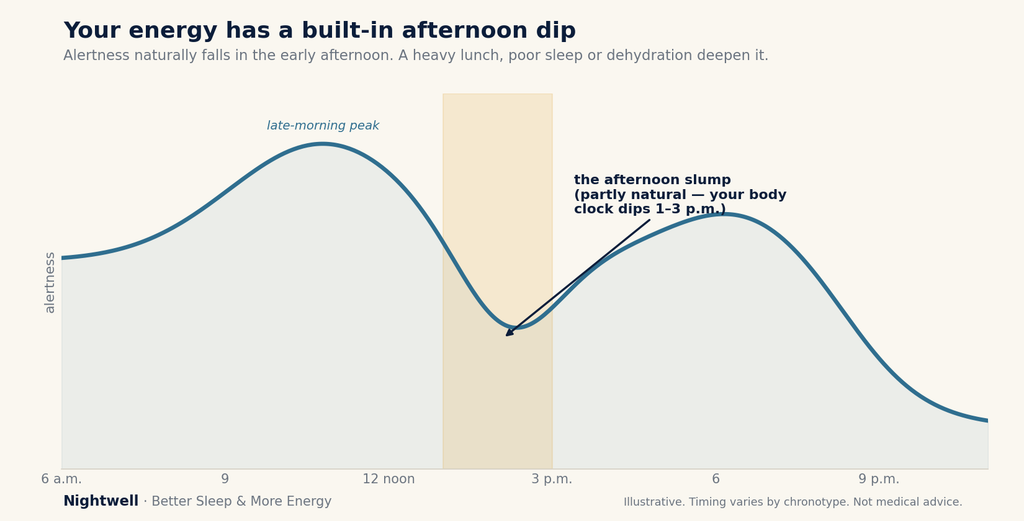
Your energy isn’t flat across the day — it rises and falls on a schedule set by your circadian rhythm, the internal clock that also governs sleep. That clock builds in a natural dip in alertness in the early-to-mid afternoon, usually between about 1 and 3 p.m. This is sometimes called the post-lunch dip, but the name is a little misleading: it happens largely because of your body clock, not just because you ate. In fact, the dip shows up even if you skip lunch entirely. Some researchers think it’s an evolved rhythm that once nudged our ancestors to rest in the heat of the day.
Because it’s tied to your clock, the timing shifts with your chronotype — whether you’re a morning lark or a night owl. If you’re up at 5 a.m., your dip may hit before noon; if you rise at 10, it may land later in the afternoon. Either way, it usually lasts only a couple of hours, which is why most people get a “second wind” and regain their focus by late afternoon or early evening. The graph above shows the pattern: a late-morning peak, the afternoon trough, and an evening recovery.
The useful takeaway from all this: the dip is partly non-negotiable, so the smartest move isn’t to fight it head-on but to schedule around it. Do your hardest, most demanding thinking during your late-morning peak, and save the low-effort, routine tasks — admin, email, tidying — for the trough.
Why it happens: the part you can change
Here’s the good news. While the dip itself is natural, most people turn a mild lull into a full crash through four very fixable habits.
1. A heavy, high-carb lunch. This is the biggest culprit. A lunch built on refined carbs — white bread, pasta, a big sandwich, chips, something sugary after — spikes your blood sugar and then drops it an hour or two later, landing the crash right on top of your natural circadian dip. The two effects stack, and that’s when the slump feels unbearable. (It’s the same blood-sugar mechanism we cover in what to eat for steady, all-day energy.)
2. Dehydration. Even mild dehydration registers as tiredness and poor concentration. By mid-afternoon many people simply haven’t drunk enough, and they mistake thirst for fatigue — then reach for coffee, which does nothing for the underlying dehydration.
3. Sitting still. Hours at a desk without moving slows circulation and leaves you feeling foggy. Your body reads stillness as a cue to wind down.
4. Poor sleep the night before. A natural dip on top of a sleep debt is a brutal combination. If you’re tired even after a full night in bed, the afternoon will hit especially hard.
How to beat it: what actually works
You don’t need all of these — pick the two or three that fit your day.
- Eat a lighter, balanced lunch. Build it around protein, fiber, and healthy fat rather than a pile of refined carbs — think chicken or chickpeas with salad and whole grains, not a white-bread sandwich and crisps. You’ll digest it without the blood-sugar crash. The same protein-anchoring principle that fixes the mid-morning breakfast crash applies at lunch.
- Move for 10–30 minutes. This is one of the most effective fixes. A brisk walk boosts circulation, mood, and attention — and researchers note that a 30-minute walk can deliver cognitive benefits comparable to a short nap, without disrupting your body clock. Even a few minutes of stretching or a lap around the building helps.
- Get natural light and change your scene. Step outside, or at least move to a brighter spot or a different room. Daylight is a direct signal to your brain to feel more awake, and a change of environment refreshes a tired mind.
- Drink water. Keep a bottle on your desk and sip through the day rather than trying to catch up at 3 p.m. It’s the cheapest energy fix there is.
- Take a real power nap — if you can. A 10–20 minute nap in the early afternoon is genuinely restorative. Just keep it short and not too late, so it doesn’t wreck your night; the how and when are in our guide to napping without wrecking your sleep.
- Time your caffeine, don’t overdo it. A coffee at the start of the dip can help, but more caffeine isn’t better — and drinking it too late backfires on your sleep, feeding tomorrow’s slump. Know when to stop drinking coffee.
The snack question
The afternoon is when cravings for a quick sugar hit peak — and giving in guarantees another spike-and-crash. If you need a snack, reach for something slow-release that pairs carbohydrate with protein or fat: a handful of nuts, cheese with wholegrain crackers, Greek yogurt, or apple slices with nut butter. These steady your blood sugar instead of sending it on another rollercoaster, and they keep you full until dinner.
When it’s more than a slump
An everyday afternoon dip is normal. But if your fatigue is severe, constant, or unexplained — if you’re exhausted all day rather than just after lunch, or no amount of sleep, food, or water helps — it’s worth seeing a doctor. Persistent tiredness can be a sign of an underlying issue such as iron-deficiency anemia, an underactive thyroid, sleep apnea, or depression, all of which are treatable once identified. Lifestyle tweaks fix a normal slump; they won’t fix a medical cause, so don’t just push through month after month.
The bottom line
The afternoon slump is part biology, part habit. You can’t switch off your body clock’s early-afternoon dip — so plan your demanding work for the morning and go easy on yourself in the trough. But you can stop making it worse: eat a lighter, protein-anchored lunch, move your body, get some daylight, stay hydrated, and use caffeine and naps strategically rather than desperately. Do that and 3 p.m. stops being the moment your day falls apart — and becomes just a gentle dip you barely notice.
This article is for general information and education and isn’t medical advice. If daytime fatigue is persistent, severe, or unexplained, please talk to a qualified healthcare professional.
Sources: RWJBarnabas Health — Why You’re So Tired at 3 p.m.; BBC Science Focus — Beat the Afternoon Slump; Calm — The 3 p.m. Slump Explained
Comments on “The Afternoon Slump: Why It Happens and How to Beat It”