
The short answer
Whether it was an injury, an illness, a busy stretch of life, or simply lost motivation, taking a long break from exercise happens to almost everyone — and getting back into it can feel daunting. The good news: you can absolutely restart, and your body is on your side. The single most important rule is to start where you are today, not where you were before. Ease in at roughly half your old intensity, build up gradually, and prioritise consistency over pushing hard. Do that and you’ll rebuild safely — and thanks to “muscle memory,” you’ll regain fitness faster than someone starting from scratch.
The one mistake to avoid
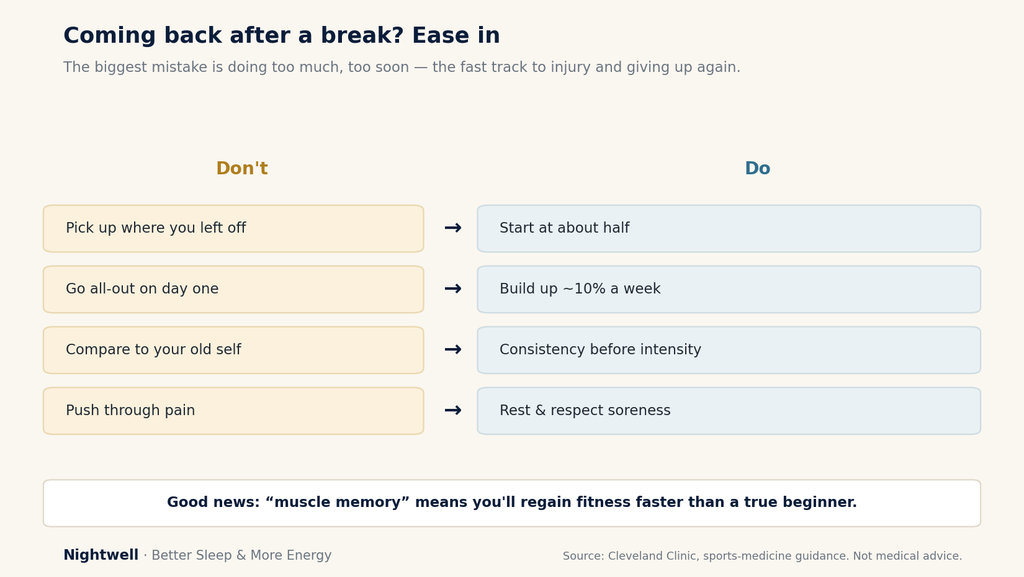
Almost everyone makes the same error when they come back: they try to pick up exactly where they left off. You remember running 5k comfortably or lifting a certain weight, so you attempt it on day one — and your body, which has quietly lost some conditioning, isn’t ready. The result is muscle strains, tendonitis, or stress fractures that sideline you all over again, plus the demoralising soreness that makes you want to quit. As one sports-medicine surgeon puts it, it’s far better to start as minimal as possible and build up than to do too much, too soon.
This matters because of a hidden detail: even when your strength comes back quickly, your connective tissues — tendons and ligaments — adapt more slowly than your muscles. So you might feel capable of more than your joints are ready for, which is exactly how the eager returner gets injured. Respect the ramp-up, and you protect yourself.
Muscle memory is real — and it’s on your side
Here’s the encouraging science. If you’ve trained before, your body remembers. During your previous training, your muscles gained extra cell nuclei and your nervous system learned to coordinate movements efficiently — and much of that persists through a break. This “muscle memory” means a previously fit person regains strength and fitness noticeably faster than a true beginner. After a short break you might see improvements within a couple of weeks; after a longer one, it may take six to eight weeks to feel strong again, and a few months to reach a good overall level — but you’re rebuilding, not starting from zero. That’s a genuine reason for optimism, and a reason to be patient rather than discouraged in the early, harder weeks.
How to restart, step by step
1. Start at about half. Whatever you used to do, begin at roughly 50–60% of it — lighter weights, a slower pace, shorter sessions, fewer reps. This isn’t a sign of weakness; it’s the smart way to let your muscles, joints, and heart re-adapt safely while you rebuild confidence.
2. Build up gradually. Once the starting level feels comfortable, increase slowly — a common guideline is adding no more than about 10% to your time, distance, or load each week. Small, steady increases are your best defence against overuse injury, and they compound quickly.
3. Make consistency the goal, not performance. For the first few weeks, success isn’t hitting old numbers — it’s simply showing up regularly and rebuilding the habit. A solid foundation of consistent movement matters far more than any single hard session, and it’s the whole point of building an exercise habit that sticks. Set small, achievable goals — even “add 1,000 steps a day this week” is a real win.
4. Focus on form. Restarting is actually the perfect time to perfect your technique. Move slowly and deliberately, relearning good form before you add intensity — it protects your joints and gets you more from every rep.
5. Warm up and do mobility work. After time off you’ll feel stiffer, so gentle stretching and controlled movement to prepare your muscles and joints is more important than ever — see stretching and mobility for how to warm up well.
6. Respect recovery. Your body rebuilds during rest, so don’t train hard every day when you’re just back — build in rest days and listen for signs you need one, as we cover in rest days and recovery. And remember: “no pain, no gain” is a myth. Ordinary next-day muscle soreness is normal and fades; sharp or joint pain is a signal to stop and scale back.
The easiest way back in
If the thought of a full workout feels overwhelming, don’t start there. The gentlest, most reliable on-ramp is simply walking. It’s low-impact, requires nothing, and rebuilds your cardiovascular base while you find your feet — and, as we cover in walking benefits, it delivers real health gains on its own. Build up your daily steps, add a flight of stairs, take the dog a little further — movement doesn’t have to feel like “working out” to count. Once walking feels easy, layer in some gentle strength work, then gradually work toward the balance in how much movement you actually need. Choosing something you genuinely enjoy — dancing, hiking, swimming, a sport — makes it far more likely to stick this time.
Set yourself up to succeed
A few extra strategies smooth the return:
- Make a simple plan. A little structure removes guesswork and decision fatigue — even just “walk Monday, Wednesday, Friday” is enough to start.
- Find a buddy or group. Accountability and company make workouts easier to show up for, especially on low-motivation days.
- Be kind to yourself. There’s no shame in having stopped — life happens to everyone. Restarting is a genuinely positive decision for your body and mind. Treat setbacks as normal, not as failure.
When to check with a doctor first
For most people, easing back into gentle movement is safe. But it’s wise to check with a healthcare professional before restarting if you’re returning after an injury, illness, or surgery; if you have a chronic condition such as heart disease or diabetes; if you’ve been completely inactive for a very long time; if you’re pregnant or recently gave birth; or if you’re older and unsure where to begin. A quick conversation ensures your comeback fits your situation and starts you off safely.
The bottom line
Coming back to exercise after a long break is one of the best things you can do for yourself — and it’s entirely doable if you resist the urge to jump straight back to your old level. Start at about half, build up by small increments, focus on consistency and good form, warm up, and respect recovery. Lean on the fact that muscle memory will speed your progress, begin with something as simple as walking if you need to, and be patient and kind with yourself through the effortful early weeks. Show up regularly, and before long you’ll be back — often stronger, and with a habit built to last this time.
This article is for general information and education and isn’t medical advice. If you’re returning after an injury, illness, or surgery, have a chronic condition, are pregnant, or have been inactive for a long time, please talk to a qualified healthcare professional before restarting exercise.
Sources: Cleveland Clinic — How to Get Back to Exercising After a Long Break; GoodRx / Ohio State — 6 Tips for Starting Exercise Again; Pontchartrain Orthopedics — Safely Returning to Fitness
Comment on “How to Start Exercising Again After a Long Break”