
The short answer
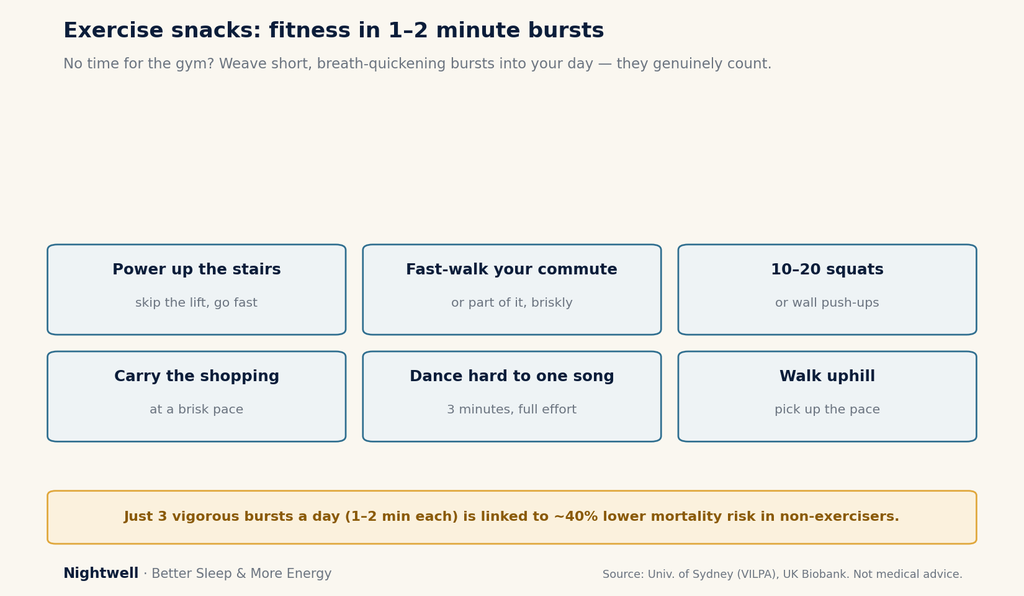
“I don’t have time to exercise” is the most common reason people give for not moving — and exciting new research has quietly dismantled it. You don’t need an hour, a gym, or even a spare 30 minutes. You need “exercise snacks”: brief, breath-quickening bursts of activity — one or two minutes at a time — woven into your ordinary day. Powering up the stairs, fast-walking to the bus, carrying the shopping briskly. Astonishingly, in people who don’t otherwise exercise, just three of these short vigorous bursts a day is linked to around 40% lower mortality risk. Movement doesn’t have to look like a workout to transform your health.
What are exercise snacks?
An “exercise snack” is exactly what it sounds like — a small, standalone portion of exercise, typically lasting from about 20 seconds to a couple of minutes, done on its own rather than as part of a longer session. Researchers at the University of Sydney gave the everyday version of this a name: Vigorous Intermittent Lifestyle Physical Activity, or VILPA. It refers to those brief bursts of vigorous effort that are already embedded in daily life — climbing stairs, walking uphill, carrying heavy bags, hurrying for a train, playing energetically with kids — if you simply do them with a bit more intensity.
“Vigorous” here just means anything that raises your heartbeat, makes you breathe harder, or works up a light sweat. You don’t need special clothes, equipment, or preparation. You’re not “going to exercise” — you’re intensifying things you already do.
The research that changes everything
This isn’t a wellness fad — the evidence is genuinely striking. A large study tracked over 25,000 adults who described themselves as non-exercisers, using wearable devices to capture their tiny bursts of activity. The findings: compared with people who did none, those who managed just three short bouts of vigorous activity a day — one to two minutes each — had roughly 38–40% lower risk of dying from any cause or from cancer, and nearly 50% lower risk of dying from cardiovascular disease. The benefit rose in a near-linear way, meaning more bouts brought more protection. Other research has found that just 3 to 9 minutes of these vigorous snacks a day is associated with a 40–50% lower risk of cardiovascular disease and death — benefits comparable to people doing far more formal exercise.
Let that sink in: a handful of minutes of huffing and puffing, scattered through an otherwise sedentary day, is associated with living significantly longer. For the 70–80% of adults who don’t do structured exercise, this is one of the most hopeful findings in modern health science.
Why short and vigorous works so well
Two things make exercise snacks punch so far above their weight. First, intensity is time-efficient. A minute of vigorous effort delivers a much stronger stimulus than a minute of gentle movement, so you get a lot of benefit from very little time. In fact, researchers increasingly think vigorous activity has been undervalued by traditional guidelines. Second, your body responds fast. These bursts rapidly improve your cardiorespiratory fitness — your VO₂ max — which is one of the strongest predictors of health and longevity there is, and they improve how your body handles blood sugar and inflammation.
Crucially, the old rule that exercise had to come in blocks of at least 10 minutes has been officially dropped — the evidence now shows that all movement counts toward your health, no matter how short the bout.
Your exercise snack menu
The beauty of this approach is that the opportunities are already in your day — you just add effort. The graphic above shows a menu; here’s how to find your moments:
- Take the stairs — fast. Skip the lift or escalator and climb with purpose. Stair climbing is the classic exercise snack.
- Fast-walk part of your commute. Walk to the next bus stop, or pick up the pace for the last few minutes to your destination.
- Do a quick set. Ten to twenty squats, wall push-ups, or calf raises while the kettle boils or between tasks.
- Carry things briskly. Hauling the shopping or a heavy bag at a quick pace turns a chore into a workout.
- Walk uphill whenever your route offers a slope, and lean into it.
- Dance to one song, full effort. Three minutes of energetic dancing is a genuine cardio hit — and fun.
- Play actively with kids or pets — chase, run, and don’t hold back.
How to build the habit
Aiming for something like four to sixteen minutes of vigorous intermittent activity a day, in short bursts, is a great target. To make it stick:
- Spot your opportunities. Look at your daily routine and identify the natural moments — stairs, walks, chores — where you can add intensity.
- Attach snacks to existing habits. “Every time I climb these stairs, I go fast.” “Whenever the kettle’s on, I do squats.” Linking bursts to things you already do makes them automatic, the core of building an exercise habit that sticks.
- Start where you are. “Vigorous” is relative to your fitness — for someone unfit, even brisk walking can raise the heart rate enough to count. Push to the point of breathing harder, safely, and build from there.
- Track it if it motivates you. Noticing your bursts adds up and keeps you going.
Snacks and full meals: how it fits together
Exercise snacks are brilliant, but let’s be clear about their place. They’re a fantastic way to get real health benefits when structured exercise isn’t happening — and for the majority of people who “never have time,” they may be the single most practical thing to start with. They also pair naturally with breaking up long periods of sitting, which tackles a different but related problem. That said, if you can build up to the fuller picture — the balance of cardio and strength in how much movement you actually need — that remains the gold standard. Think of exercise snacks as either your starting point or a powerful top-up: an easy on-ramp that requires no time you don’t already have, and a way to make sure a busy day is never a completely inactive one.
The bottom line
The “no time to exercise” excuse is officially retired. You don’t need a gym, a plan, or a free half-hour — you need to inject a few short, vigorous bursts into the day you’re already living. Climb the stairs fast, walk briskly, carry things with purpose, dance to a song. Just three one-to-two-minute bursts a day is linked to dramatically lower mortality risk, and your fitness starts improving quickly. Exercise snacks prove that when it comes to movement, something — even a tiny, breathless something — is enormously better than nothing. Start snacking today.
This article is for general information and education and isn’t medical advice. If you have a heart condition or another health concern, please talk to a qualified healthcare professional before adding vigorous activity to your routine.
Sources: VILPA and mortality — UK Biobank study (Nature Medicine / NIH); BBC Science Focus — How Little Exercise You Actually Need; World Cancer Research Fund — The Science Behind Exercise Snacking