
The short answer
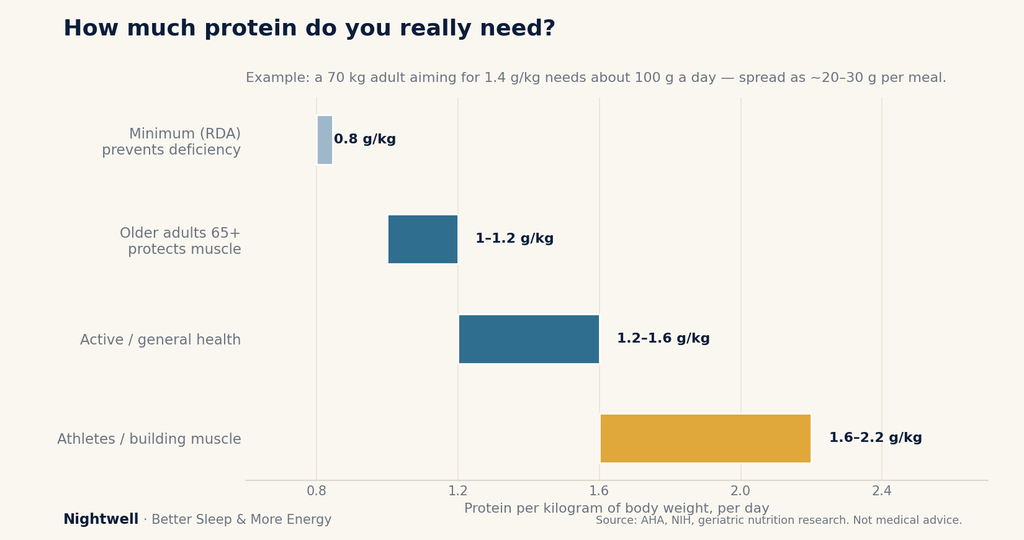
Protein is the nutrient that keeps your energy steady, your hunger in check, and your muscles intact as you age — and most people, especially older adults, don’t get quite enough of it or spread it out well. The official minimum is 0.8 grams per kilogram of body weight a day, but that’s a floor to prevent deficiency, not a target for feeling your best. For steady energy, staying full, and protecting muscle, somewhere around 1.2 to 1.6 grams per kilogram suits most active adults, and it matters just as much when you eat it: spread across the day in roughly 20–30 gram portions rather than piled into one meal.
Why protein matters for energy, not just muscle
Protein’s reputation is all about building muscle, but its role in your day-to-day energy is just as important — and more relevant to most people.
First, satiety. Protein is the most filling of the three macronutrients. It triggers the hormones that tell your brain you’re satisfied, so a protein-containing meal or snack keeps hunger away for hours and cuts the cravings that drive sugary, crash-inducing snacking.
Second, blood-sugar control. Protein digests slowly and blunts the spike you’d get from carbohydrates eaten alone. That’s the whole reason “anchor your carbs with protein” runs through everything from a good breakfast to smart snacks — it flattens the blood-sugar rollercoaster that leaves you tired an hour later.
Third, muscle — which is an energy story too. Muscle is metabolically active tissue; maintaining it keeps your metabolism healthier and your body more capable. As we age we naturally lose muscle (a process called sarcopenia), and that loss is linked to weakness, falls, and fractures. Enough protein, paired with some resistance exercise, is the single best defence.
How much do you actually need?
Here’s where the official number misleads people. The Recommended Dietary Allowance is 0.8 g/kg per day for adults — but this figure was set as the minimum to avoid deficiency in a healthy young person, not the amount for thriving. A growing body of research suggests it’s too low for optimal health, particularly for two groups.
Active people. If you exercise, and especially if you do any strength training, you need more protein to repair and build tissue. Most guidance lands around 1.2 to 1.6 g/kg per day for general health and activity, rising toward 1.6–2.2 g/kg for athletes or those deliberately building muscle.
Older adults. This is the counterintuitive one: your protein needs go up with age, not down. Older bodies develop “anabolic resistance,” meaning they extract less benefit from the same amount of protein, so they need more to maintain muscle. Expert groups recommend around 1.0 to 1.2 g/kg per day for people over 65 — and some research points higher. Combined with strength work, this is what preserves independence and mobility into later life.
To make it concrete: a 70 kg (154 lb) adult aiming for 1.4 g/kg would target about 100 grams of protein a day. You don’t have to weigh and log everything — the American Heart Association points out that most people meet their needs by simply eating a variety of protein sources — but knowing the ballpark helps you spot where you’re falling short, which for most people is breakfast.
Timing: spread it out
This part surprises people, and it’s genuinely important. Your body can only use so much protein for muscle-building at once — research suggests roughly 20 to 30 grams per meal maximizes the muscle-building response, or about 0.4 g/kg per meal. Beyond that in a single sitting, the extra isn’t wasted exactly, but it’s not put toward building muscle as efficiently.
The practical takeaway: three meals each with 25–30 grams of protein beats a tiny breakfast, a modest lunch, and a huge protein dinner. A study in older adults found that those who spread their protein evenly across the day had more muscle than those who packed it into one meal, even at the same daily total. Since most people already get plenty at dinner, the easiest win is adding protein to breakfast — the meal where a pastry or bowl of cereal typically delivers almost none.
The best sources
Food first, and variety is your friend. High-quality “complete” proteins — those with the full set of essential amino acids — come readily from animal sources: eggs, dairy (Greek yogurt and cottage cheese are protein-dense), fish, poultry, and lean meat. Plant sources — beans, lentils, chickpeas, tofu, tempeh, edamame, nuts, seeds, and whole grains — are excellent too, and the heart-health guidance actually encourages leaning on plants like beans, lentils, soy, nuts, and seeds, adding fish, and keeping meat leaner and smaller in portion.
If you eat mostly or entirely plant-based, you can absolutely hit your protein needs — just eat a range of sources across the day so you cover all the amino acids, rather than relying on one. Protein powders (whey or plant-based) are a convenient top-up if you struggle to reach your target through food, especially around workouts, but treat them as a supplement to real food, not a replacement.
Common protein myths, cleared up
- “High protein damages your kidneys.” For people with healthy kidneys, there’s no good evidence that higher protein intakes cause harm. The caution applies specifically to those with existing kidney disease, who should follow their doctor’s guidance.
- “More protein = more energy.” Protein supports steady energy through satiety and blood-sugar control, but eating far beyond your needs won’t supercharge you — excess is simply burned for energy or stored, like any other calories.
- “You need a shake right after training.” The “anabolic window” is far more forgiving than supplement marketing suggests. Hitting your total daily protein, spread across meals, matters far more than the exact minute you consume it.
Simple ways to get enough
- Fix breakfast first. Swap the cereal-or-pastry habit for eggs, Greek yogurt, or a protein-topped bowl of oats — the single highest-impact change for most people.
- Add a protein to every snack. Nuts, cheese, yogurt, or hummus turn a carb snack into a steady one.
- Anchor each meal with a palm-sized portion of a protein source before you build the rest of the plate.
- Pair protein with strength training a couple of times a week — the two together do far more for muscle and metabolism than either alone, a link we explore in exercise and sleep.
The bottom line
Protein is quietly one of the most important levers for steady energy and long-term health — and the official minimum sells most people short. Aim for roughly 1.2 to 1.6 grams per kilogram of body weight if you’re active, a little more if you’re older or building muscle, and spread it across the day in 20–30 gram portions rather than saving it all for dinner. Build a protein source into every meal and snack, favour whole foods and variety, and you’ll feel the difference where it counts: fewer cravings, steadier energy, and a body that stays strong as the years go by. It works hand in hand with the rest of the picture — balanced meals for steady energy, good sleep, and regular movement.
This article is for general information and education and isn’t medical advice. If you have kidney disease or another health condition, please talk to a qualified healthcare professional or registered dietitian before significantly changing your protein intake.
Sources: American Heart Association — Protein: What’s Enough?; Stanford Lifestyle Medicine — Protein Needs for Adults 50+; Protein Requirements During Aging (NIH)
Comment on “Protein 101: How Much You Really Need and Why It Matters for Energy”