
Advertising disclosure: This article contains affiliate links. If you buy through one, Nightwell may earn a small commission at no extra cost to you. We only link to products we believe genuinely fit the advice on this page.
The short answer
The single most important thing when choosing a pillow isn’t the brand, the price, or the fancy material — it’s your sleep position. The right pillow keeps your head, neck, and shoulders in one straight line (a “neutral spine”), and what achieves that is completely different for a side, back, or stomach sleeper. Get it wrong and you wake with a stiff neck, sore shoulders, or a headache you can’t explain — and blame your sleep when the real culprit is under your head.
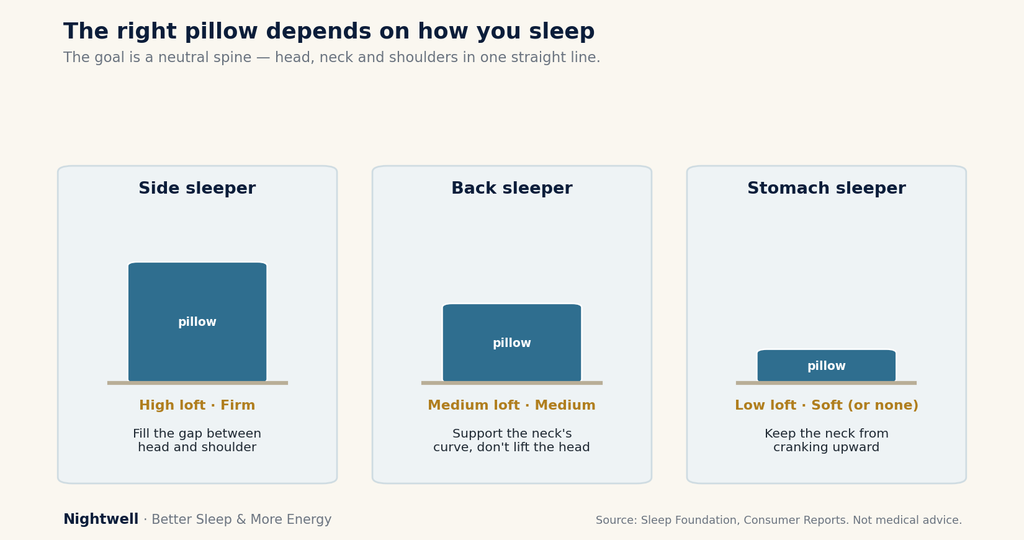
Match the pillow to your position
Side sleepers — high and firm
If you sleep on your side, there’s a real gap between your head and the mattress — the width of your shoulder. Your pillow has to fill it, or your head drops and your neck bends all night. So side sleepers need a high-loft, firm pillow, roughly 3–5 inches thick, enough to keep your neck level with your spine. A firmer memory foam or latex pillow holds that height without collapsing. Bonus tip: a pillow between your knees keeps your hips aligned too.
Back sleepers — medium support
On your back, you need balance: enough support to cradle the natural curve of your neck, but not so much that your head is shoved forward. That means a medium-loft, medium-firm pillow. The most common back-sleeper mistake is a pillow that’s too thick, which tips the chin toward the chest. A pillow with a slight contour under the neck works well here.
Stomach sleepers — thin, or none at all
Stomach sleeping is the hardest position on your neck, because your head is turned to the side all night. The fix is to add as little height as possible: a thin, soft pillow — or genuinely no pillow at all. A thick pillow here cranks your neck upward and is a classic cause of morning stiffness.
What about combination sleepers?
Most people move around. Choose based on the position you spend the most time in — usually the one you wake up in. If you switch a lot, an adjustable pillow (one where you can add or remove fill) is the flexible answer, letting you dial in the loft that keeps your neck neutral in your main position.
Fill and temperature
Beyond height, two things matter:
- Fill. Memory foam and latex hold their shape and support all night; down and feather feel plush but compress and lose loft, which can leave you unsupported by morning. Adjustable shredded-foam pillows offer a middle ground.
- Temperature. Solid memory foam tends to sleep hot. If you run warm or wake up sweaty, look for ventilated foam, latex, or a breathable cover — it works hand in hand with keeping the bedroom cool.
Signs your pillow is the problem
Your pillow may be wrong (or worn out) if you regularly wake with neck or shoulder pain, morning headaches, or you’re constantly punching and folding it to get comfortable. Pillows also lose their loft over time, so even the right one needs replacing every couple of years. If you keep waking up tired and achy despite a full night in bed, something as simple as the wrong pillow height can be quietly fragmenting your sleep.
Our pick if neck pain is the issue: the Luxe neck-support pillow
When the issue is specifically waking with a stiff neck or shoulders, an ergonomic contoured pillow is often the simplest thing to try — it’s built to hold your head in exactly the neutral line this article is about. The one we’d point people to is Luxe’s neck-support pillow, which suits back and side sleepers in particular. It won’t fix a pillow that’s simply the wrong height for your position, so get the loft right first — but if height isn’t the problem and the ache persists, it’s a sensible next step. (Luxe is a UK brand, so check delivery to your area before ordering.)
The bottom line
Don’t shop for a pillow by price or popularity — shop by how you sleep. Side sleepers want it high and firm, back sleepers want medium, stomach sleepers want it thin or absent, and the target for everyone is a neck that stays in line with the spine. It’s one of the cheapest upgrades you can make to your sleep, and for a lot of people with unexplained morning aches, it’s the missing piece.
This article is for general information and education and isn’t medical advice. If you have persistent neck, shoulder, or back pain, please talk to a qualified healthcare professional.
Sources: Sleep Foundation — Best Pillows for Neck Pain; Consumer Reports — How to Choose a Pillow
Comments on “The Best Pillow for How You Sleep”