
Late 1980s, Rome. A university student called Francesco Cirillo is failing to get through his reading. He’s distracted, he’s putting it off, and he’s frustrated with himself. So he sets himself a tiny challenge: could he study properly for just ten minutes? He grabs the kitchen timer to keep himself honest. It happens to be shaped like a tomato — a pomodoro in Italian.
That small bet with himself became one of the most widely used focus methods in the world. Which raises the obvious question: does it actually work, or is it just a nice story?
Short version: yes, for most people — but not for the reason most people think. The 25 minutes aren’t special. What works is the combination underneath: one task at a time, and a real break before you’re worn out. The timer is just a simple way to make both happen.
What it is, in thirty seconds
Work on a single task for 25 minutes with no interruptions. That’s one “pomodoro.” Take a 5-minute break. After four of those, take a longer break of 15 to 30 minutes. If something pops into your head mid-sprint — an email to send, a thing to buy — write it down and get back to the task. That’s genuinely the whole method.
What the research does (and doesn’t) say
We’ll be honest: the Pomodoro Technique itself hasn’t been tested in lots of large, rigorous trials. It’s a productivity method, and those rarely get studied like medicines.
What has been studied are its ingredients, and there the picture is encouraging. A 2025 scoping review found that structured, Pomodoro-style work intervals were generally linked with better focus and less mental fatigue. And a study of students comparing break strategies found that people taking scheduled breaks reported better concentration and motivation than those who simply stopped whenever they felt like it.
That last finding is the interesting one. Left to ourselves, we tend to take breaks at bad moments — usually right when a task gets slightly hard. A timer makes that decision for you.
Why a timer beats willpower
The first reason is that it forces single-tasking. Switching between tasks has a real mental cost, even when it feels like you’re being efficient — the American Psychological Association has a good summary of the research, and we dig into it in why multitasking hurts your focus. A pomodoro gives you permission to ignore everything else for a set time.
The second is that it makes starting easier. “Finish the report” is daunting. “Work on the report until the timer rings” isn’t. If you tend to freeze when faced with a long list, that lower barrier matters a lot — it’s the same idea behind our guide to beating to-do-list overwhelm.
The third is that you rest before you’re drained, not after. Concentration fades gradually across a long stretch, and most people don’t notice until they’re already reading the same paragraph three times. Regular breaks keep you from hitting that wall.
Pick your own rhythm
This is where most people give up too early. They try 25/5, it feels wrong, and they decide the method isn’t for them. But 25 minutes was one student’s starting point in the 1980s, not a rule. Adjust it.
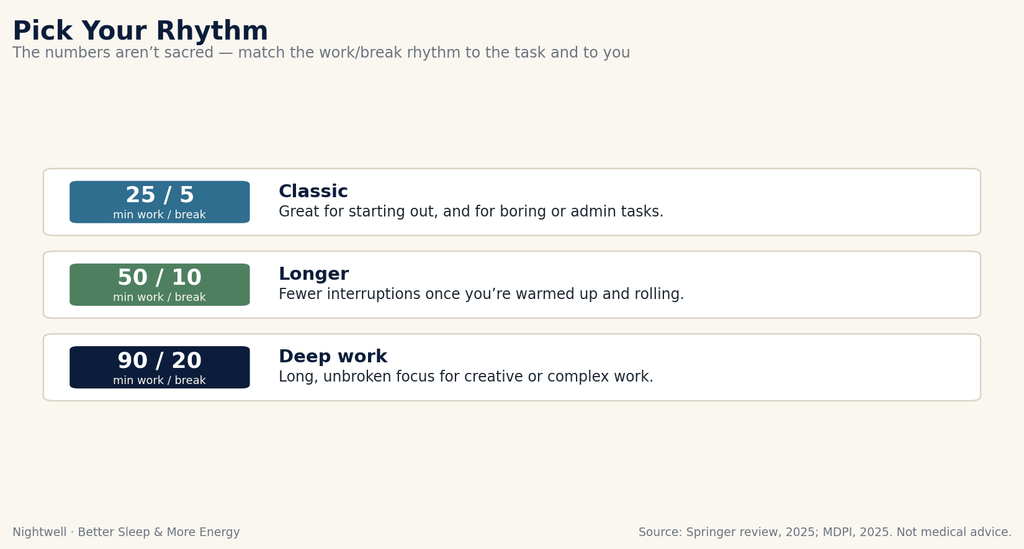
A rough guide from our side: if you’re struggling to start at all, or the task is dull, go shorter. If you’re constantly cut off just as you get going, go longer. Many people end up with 25/5 for admin and email, and something closer to 50/10 or longer for their real work. More ideas for building focus in general are in our guide to improving focus and concentration.
When to ignore the timer
The biggest complaint about Pomodoro is fair: it can interrupt flow — that absorbed, time-disappears state where you do your best work. Flow usually takes a while to reach, and a timer ringing at minute 25 can pull you straight back out of it.
Our advice is simple. If you’re deep in something and it’s going well, let it run. Take the break when you naturally surface. The timer is there to help you start and to stop you burning out, not to police you when things are working.
Try it tomorrow morning
- Choose one concrete task. Not “work on the presentation,” but “write the three opening slides.”
- Remove the obvious distractions. Phone in another room or face-down and silenced, unrelated tabs closed.
- Start the timer and keep a notepad nearby for anything that pops into your head. Write it down, don’t act on it.
- Stop when it rings — even mid-sentence. Leaving something half-finished actually makes it easier to restart.
- After three or four rounds, look back. How long did the task really take? Where did your attention slip? That’s useful information in itself.
Two mistakes trip up almost everyone in the first week. One is checking a message “just for a second” in the middle of a sprint — that second usually turns into five minutes and the block is gone. The other is skipping breaks because things are going well and it feels like wasted time. The breaks aren’t the slack in the system. They’re the reason you’re still sharp in the afternoon.
Five minutes that actually rest you
This is the part people get wrong most often. Scrolling your phone for five minutes isn’t a break for your brain — it’s just a different screen asking for your attention. You come back no fresher.
What works better is boring: stand up, stretch, refill your water, look out of a window at something far away, or step outside. A few minutes of walking is one of the best resets there is — our piece on the benefits of walking explains why. And if you want to go deeper on why proper recovery matters for energy across the whole day, see how to rest properly.
Who it’s really for
It isn’t only for people with short attention spans — that’s a myth. Everyone’s concentration benefits from breaks. But it helps most if you procrastinate, get easily pulled off track, face a huge task that feels impossible to start, or have a lot of repetitive work to get through.
If your work is mostly long, deep, creative stretches, you may need it less, or use a much looser version. That’s fine. The best productivity system is the one you’ll still be using next month — and for a surprising number of people, that turns out to be a cheap kitchen timer.
General information, not medical advice. If you consistently struggle to focus or start tasks and it’s affecting your work or daily life, it’s worth talking to a healthcare professional.