
The short answer
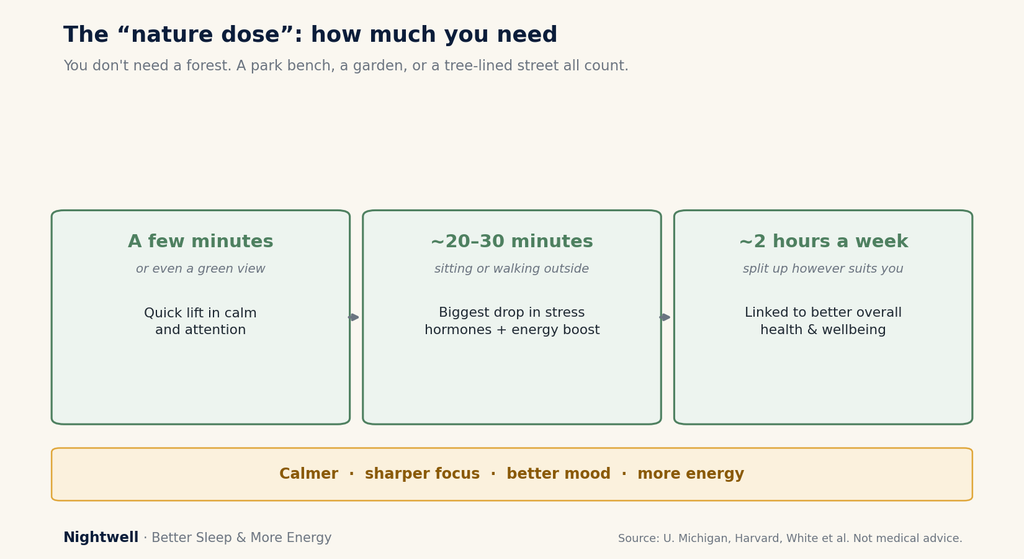
Feeling frazzled and flat? One of the most powerful, best-evidenced ways to recharge costs nothing and is probably a few minutes from your door: time in nature. Being outdoors in a green space lowers your stress hormones, restores your worn-out attention, lifts your mood, and genuinely boosts your energy and vitality. And you don’t need a mountain or a forest — a park bench, a garden, or a tree-lined street all count. The research even points to a rough “dose”: about 20 to 30 minutes for a real stress drop, and around two hours a week for lasting wellbeing.
Why nature recharges you
This isn’t wishful thinking — there are clear mechanisms behind that “reset” feeling you get outdoors.
It restores your attention. Psychologists describe nature as offering “soft fascination”: birdsong, rustling leaves, moving water gently hold your attention without demanding it. That’s the opposite of the hard, effortful focus a screen or a busy city requires. According to Attention Restoration Theory, this soft engagement lets your overworked, directed-attention system rest and recover — which is why a walk in the park clears mental fog and sharpens your thinking afterward. It’s the natural antidote to the drained, fragmented feeling of digital overload.
It lowers stress. Time in nature measurably reduces cortisol, your main stress hormone, calming your nervous system. Since chronic stress is a huge, hidden energy drain (as we cover in stress, burnout and energy), lowering it frees up energy you didn’t know you were spending.
It lifts mood and vitality. Natural settings trigger feel-good brain chemicals and are linked to less anxiety and low mood. And crucially for our purposes, studies find that spending around 20 minutes in nature actually increases people’s sense of energy and vitality — not by stimulating you like caffeine, but by restoring you.
The “nature pill”: how much you need
One of the most useful pieces of research here comes from the University of Michigan, which set out to find the effective “dose” of a nature experience. Participants spent time in an outdoor spot that made them feel connected to nature, several times a week, while their cortisol was measured. The finding: just 20 minutes was enough to significantly lower cortisol, and 20 to 30 minutes of sitting or walking produced the steepest drop. Beyond that, benefits kept accruing, but more slowly. The researchers even started calling it a “nature pill.”
Zoom out to the bigger picture and another landmark study found a threshold of about two hours a week in nature associated with better health and wellbeing — and it didn’t matter whether you got it in one big dose or spread it across the week. Below that, the benefits were smaller. So the practical targets are simple: aim for a 20-to-30-minute green break when you need to de-stress, and roughly two hours a week overall.
An honest word on “fresh air”
We talk about nature “recharging” us and getting “fresh air,” so it’s worth being precise about what’s actually doing the work. It’s probably not extra oxygen — the air outside isn’t meaningfully more oxygen-rich than indoor air. The real benefits come from the package that being outdoors delivers: the restorative, soft-fascination quality of natural surroundings, natural daylight (which sets your body clock, as we cover in morning sunlight), usually some gentle movement, a break from screens, and stepping out of stuffy indoor spaces where stale, carbon-dioxide-heavy air really can make you feel foggy and sluggish. “Fresh air” is shorthand for all of that — and it’s genuinely restorative, just not for the oxygen reason people assume.
How to get your dose — no wilderness required
The best part is how accessible this is. You don’t need to live near a forest or block out half a day. Small, regular doses work:
- Take your lunch break outside — a 20-minute walk or a sit on a park bench ticks the box and breaks up the workday.
- Take phone calls or meetings on foot, outdoors where you can. A walking call is a two-for-one of nature and movement.
- Start the day outdoors, pairing your nature dose with morning daylight for an energising double benefit.
- Find the green near you. A city park, a riverside path, a tree-lined street, or even a quiet garden all count — the study found ordinary green spaces did the job.
- Bring nature indoors when you can’t get out: houseplants, a window seat with a view of trees, or even nature sounds offer a smaller version of the effect.
- Make it screen-free. The restorative effect is strongest when you’re actually present — leave the phone in your pocket and let your attention wander.
Level up: forest bathing and “green exercise”
If you want to get more from your nature time, two approaches stack extra benefits. The first is forest bathing — the Japanese practice of shinrin-yoku, which simply means slowing right down and soaking in a natural setting through all your senses: noticing the light through the leaves, the sounds, the smells, the feel of the air. It’s not a hike with a destination; it’s unhurried, mindful presence. Studies from Japan have found that even short sessions of this kind of immersion reduce stress hormones, and the deliberate, senses-first approach seems to deepen the calming effect compared with a distracted stroll.
The second is green exercise — doing your movement outdoors rather than in a gym. Exercising in nature tends to feel easier and more enjoyable, lifts mood more than the same workout indoors, and combines two powerful energy boosters at once: physical activity and natural surroundings. A brisk walk in the park, a cycle along a river, or an outdoor stretch session all count. You get the circulation and endorphins of movement plus the attention-restoring, stress-lowering effect of the green setting — a genuine two-for-one for your energy.
Where it fits
Time in nature isn’t a standalone miracle — it’s a beautifully simple way to tick several energy boxes at once: it lowers stress, restores focus, lifts mood, and often folds in daylight and movement too. That makes it one of the highest-return, lowest-effort habits in the whole toolkit of getting more energy naturally — and a perfect counterbalance to days spent indoors and online.
The bottom line
Nature is genuine, research-backed medicine for a tired mind and body — it cuts stress hormones, restores frayed attention, brightens your mood, and boosts your vitality, all for free. You don’t need a grand escape into the wilderness; a 20-to-30-minute walk in any green space delivers most of the benefit, and around two hours a week keeps it topped up. So next time you feel drained, foggy, or wound up, resist the urge to push through at your desk or scroll for a lift. Step outside, find something green, and let nature do what it’s quietly excellent at: recharging you.
This article is for general information and education and isn’t medical advice. If you experience persistent low energy or low mood that time outdoors doesn’t help, please talk to a qualified healthcare professional.
Sources: ScienceDaily — Take a 20-Minute “Nature Pill” (U. Michigan study); Harvard Health — A 20-Minute Nature Break Relieves Stress; University of Nebraska — The Power of Nature
Comment on “How Nature and Fresh Air Recharge Your Energy”