
The short answer
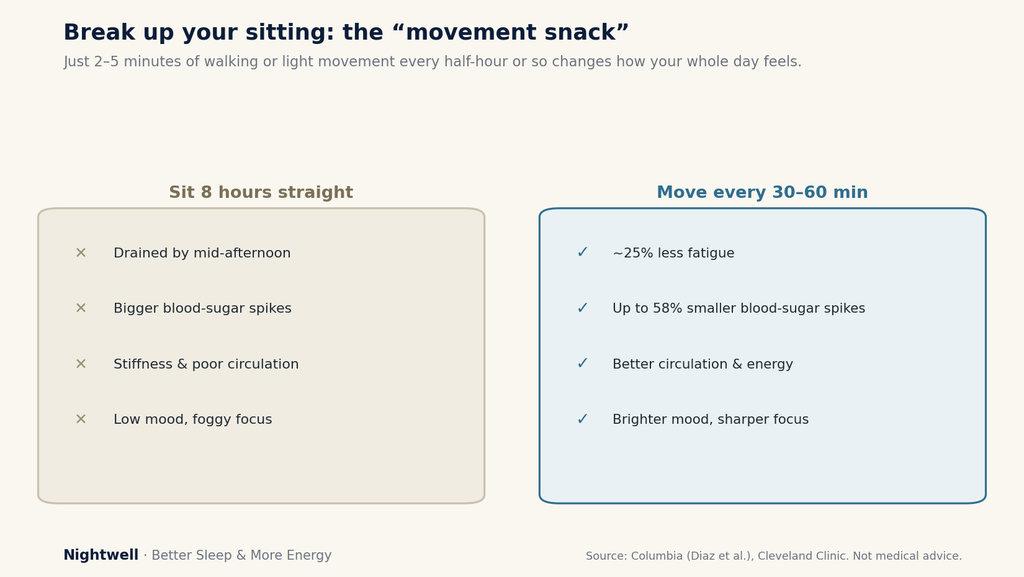
You can sleep eight hours, eat well, and still feel wiped out by mid-afternoon — and the culprit might simply be your chair. Sitting for hours on end quietly drains your energy by slowing your circulation, your metabolism, and your mind. The fix isn’t a punishing workout; it’s surprisingly small. Research shows that breaking up your sitting with short “movement snacks” — just 2 to 5 minutes of walking or light movement every half-hour to hour — can cut fatigue by around a quarter and dramatically steady your blood sugar. You don’t have to sit less overall so much as sit less continuously.
Why sitting drains your energy
It seems backwards — how can doing nothing make you tired? But prolonged sitting works against your body in several ways at once:
- Sluggish circulation. Sitting slows blood flow, especially in your legs, so oxygen and nutrients move around your body less efficiently. You feel this as low energy and heaviness, even after a good night’s sleep.
- A slowed metabolism. Your large leg and postural muscles are among the most metabolically active in your body. When they’re switched off for hours, your metabolism idles and your blood sugar is handled less well — contributing to the post-lunch slump.
- Deconditioning. Over weeks and months of mostly sitting, your baseline fitness quietly drops, so ordinary tasks — stairs, carrying shopping — start to feel harder and more draining. It’s a self-reinforcing loop: the less you move, the less energy you have to move.
- A staler mind. Less blood flow to the brain and hours in one position dull your focus and mood, feeding the kind of brain fog that makes the afternoon drag.
And it’s not a small problem: adults in wealthy countries sit for an average of 11 to 12 hours a day — most of their waking life. Sitting more than about 6 to 8 hours daily, without breaks, is linked to higher cardiometabolic risk, which is why some researchers have (a little dramatically) called sitting “the new smoking.”
The catch: a single gym session won’t fix it
Here’s a surprising and important finding. You might assume that a solid workout cancels out a day of sitting — but the research points to an “active couch potato” effect: someone who exercises for an hour and then sits for the other fifteen still carries much of the risk of prolonged sitting. Continuous sitting appears to be its own problem, separate from whether you exercise. The lesson isn’t that exercise doesn’t matter — it hugely does — but that you also need to break up the sitting itself. Regular workouts plus frequently interrupted sitting is the winning combination.
The fix: movement snacks
The good news is that the antidote is refreshingly manageable. Researchers set out to find the smallest dose of movement that counteracts sitting, and landed on a simple idea: get up and move for a few minutes, roughly every 30 to 60 minutes. These short bouts have picked up the nickname “movement snacks” (or “exercise snacks”).
A well-known Columbia University study tested different patterns and found the standout was 5 minutes of walking for every 30 minutes of sitting. That single habit produced a striking 58% reduction in blood-sugar spikes after meals compared to sitting all day, along with lower blood pressure, less fatigue, and better mood.
And you don’t have to be perfect to benefit. In a real-world version, people managed only four or five movement breaks a day — well short of the hourly ideal — and still saw their fatigue drop by about 25%, with better moods on top. As the lead researcher put it, you’ll feel that difference by the end of the day. So aim for a short move every half-hour to hour, but know that even a handful of breaks pays off.
Movement snack ideas
The intensity matters less than simply moving — walking is ideal, but anything counts:
- A 5-minute walk around the block, the office, or the house
- Climbing a flight or two of stairs
- Standing up to stretch, roll your shoulders, and loosen your back
- A quick set of squats, calf raises, or wall push-ups
- Taking phone calls standing or pacing — or a walking meeting
- Marching in place while the kettle boils
A few tricks make it automatic: set a timer or calendar nudge every 30–60 minutes; take a short walk first thing in the morning to start your system; park farther away or get off a stop early; and — a favourite of the researchers — take a short walk after lunch. Moving after you eat blunts the blood-sugar spike and directly fends off the dreaded afternoon slump.
What about a standing desk?
Standing desks are often sold as the cure for sitting — but the honest answer is more nuanced. Simply swapping “sitting still for eight hours” for “standing still for eight hours” isn’t the win it sounds like: standing motionless for long stretches brings its own problems, from sore feet and legs to back and circulation strain. The benefit of a standing desk isn’t standing itself — it’s that it makes you change posture and move more easily. If a standing desk prompts you to shift, sway, and step away more often, it helps. If you just stand rigidly in place, you’ve traded one static position for another. The real target, with or without special equipment, is the same: regular movement and frequent changes of position, not any single “correct” posture held all day. A cheap timer that gets you walking every half-hour does more than an expensive desk you stand at without moving.
How it fits the bigger picture
Breaking up sitting is one of the purest examples of the “move more” principle that tops the list in how to get more energy naturally — and it pairs with proper exercise rather than replacing it, as we cover in exercise and sleep. It also works alongside eating for steady energy: movement and balanced meals both smooth out the blood-sugar swings that leave you flat. Stack them and the effect compounds.
The bottom line
Sitting still for hours is a quiet, everyday energy thief — it slows your circulation and metabolism, dulls your focus, and, over time, lowers your baseline fitness. But you don’t need to overhaul your life or move to a standing desk to fix it. Just break up the sitting: a few minutes of walking or light movement every half-hour to hour is enough to cut fatigue, steady your blood sugar, and lift your mood. Set a timer, take the stairs, walk after lunch, and get up more often than you think you need to. Your body was built to move — give it small, frequent chances to, and you’ll feel the difference by day’s end.
This article is for general information and education and isn’t medical advice. If you have a health condition, mobility issue, or circulation concern, please talk to a qualified healthcare professional before changing your activity routine.
Sources: TIME — The 5-Minute Movement Snack (Columbia study); Cleveland Clinic — How a Sedentary Lifestyle Impacts Your Health; McGill Office for Science and Society — Is Sitting the New Smoking?
Comment on “Why Sitting All Day Drains You (and What to Do)”