
Vitamin D has become the supplement people reach for when they’re tired and don’t know why. It’s cheap, it’s everywhere, and everyone seems to have a friend who “felt so much better” after starting it. Sometimes that’s real. Often it isn’t. And the gap between the two is where a lot of money — and a lot of time spent not finding the actual cause — disappears.
Our verdict in three lines
✓ If you’re genuinely low in vitamin D, fixing it may help your energy — and your bones, muscles and immune system.
✗ If your levels are fine, more vitamin D won’t make you less tired.
→ You can’t tell which group you’re in from how you feel. A blood test can.
That’s the short version. The longer version is more interesting, because vitamin D is one of the most misunderstood nutrients on the shelf. Here are the beliefs we hear most, and what’s actually true.
“I’m tired, so I’m probably low in vitamin D”
Maybe. But tiredness is one of the vaguest symptoms there is. Low iron, low B12, an underactive thyroid, poor sleep, sleep apnoea, stress and depression can all feel almost exactly the same from the inside.
It’s true that people with fatigue tend, on average, to have lower vitamin D levels. But that’s a link, not proof that one causes the other. A large genetic study designed specifically to test cause and effect found little evidence that low vitamin D actually causes fatigue in the general population. People who spend a lot of time indoors, for instance, may be both tired and low on vitamin D for the same underlying reasons.
None of that means vitamin D doesn’t matter. A real deficiency can cause muscle weakness, aches and low energy, and correcting it is worth doing. It just means “tired” isn’t enough to assume it.
“If I were low, I’d feel it”
Often you wouldn’t. Low vitamin D is frequently silent — plenty of people with low levels have no obvious symptoms at all. When symptoms do show up, they tend to be things like persistent tiredness, muscle weakness or aches, bone or lower back pain, low mood, or picking up infections more often. All easy to put down to something else.
This is exactly why testing is so useful. The blood test is called 25-hydroxyvitamin D, it’s routine, and it answers the question in a way no amount of guessing can.
“I get plenty of sun in summer, so I’m covered”
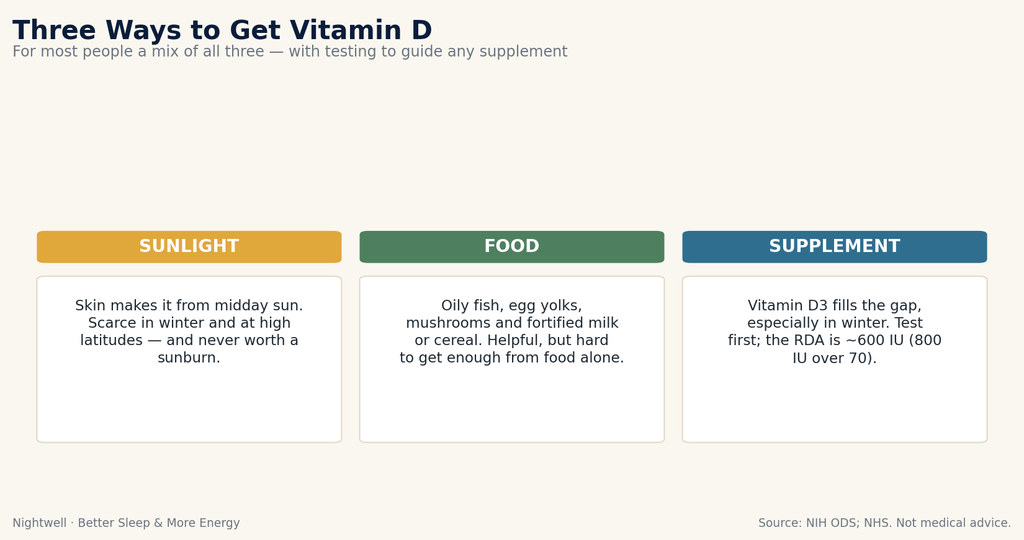
Your skin makes vitamin D from sunlight, and in summer many people make a good amount. But your body doesn’t reliably store enough to carry you through a long, dark winter. In much of Europe and the northern US, the sun is simply too low from roughly October to March for your skin to make much at all — which is why the NHS advises everyone in the UK to consider a daily supplement during those months.
A few things make it harder still: darker skin (more melanin means slower production from the same sunlight), getting older, spending most of the day indoors or working nights, covering most of your skin outdoors, and some health conditions and medications.
“I’ll just eat more of the right foods”
Good idea, but probably not enough on its own. Very few foods are naturally rich in vitamin D. Oily fish like salmon, mackerel and sardines are the best natural sources — a portion of salmon can cover most of a day’s needs. Egg yolks, mushrooms exposed to UV light, and fortified milk, plant milks and cereals help too. But it’s genuinely hard to hit your target reliably from diet alone, especially in winter.
So for most people, the realistic answer is a mix: some sunlight when it’s available, vitamin-D-rich foods where you can, and a supplement when needed.
“If a little is good, more must be better”
This is the one to take seriously. Unlike some vitamins, vitamin D is fat-soluble. Your body stores excess instead of flushing it out, so very high doses can build up over time and raise calcium in your blood to harmful levels. Ironically, the symptoms of too much can include tiredness, weakness, nausea and confusion.
According to the NIH Office of Dietary Supplements, the recommended amount for most adults is about 600 IU (15 micrograms) a day, or 800 IU over the age of 70. The upper limit for adults is 4,000 IU a day. Going above that should only happen under medical supervision — for example, when a doctor is correcting a confirmed deficiency and plans to recheck your levels.
“It’s basically a multivitamin thing — one pill fixes everything”
It’s the same story as with multivitamins in general: supplements fix gaps, they don’t hand out extra energy to people who already have enough. If you’re low, a supplement can make a real difference. If you’re not, you’re paying for peace of mind.
What we’d actually do
If you’re persistently tired: see your doctor and ask for a check-up that covers the usual suspects, not just vitamin D. That often means vitamin D, iron and ferritin, B12, thyroid function and a full blood count. Our guides on iron and energy and vitamin B12 and energy explain why those two in particular are worth ruling out. And if your blood tests come back normal, look hard at your sleep — being tired even after eight hours has plenty of causes that have nothing to do with vitamins.
If you’re in a higher-risk group and it’s winter: a standard daily supplement at the usual recommended amount is a reasonable, low-risk choice for many people, and is exactly what public health bodies like the NHS suggest. Take it with a meal, since it’s absorbed better with some fat.
If you’ve been told you’re deficient: follow your doctor’s dose, and get retested when they suggest it. Higher treatment doses are usually meant to be temporary.
In all cases: don’t stack products. Vitamin D turns up in multivitamins, calcium supplements, fish oils and fortified foods, and it’s easy to end up taking far more than you meant to. If you’re pregnant, have a health condition or take other medications, check with a pharmacist or doctor before starting.
Vitamin D is a genuinely important nutrient that a lot of people are low in — especially in winter. It’s just not the energy switch it’s often sold as. Find out where you stand, fix a real shortfall if there is one, and keep looking if there isn’t.
General information only, not medical advice. If you’re persistently tired, please see a healthcare professional rather than self-diagnosing, and don’t take high-dose vitamin D without medical guidance.