
The short answer
Sugar isn’t poison, and you don’t have to give it up entirely to feel better — but most people eat two to three times more added sugar than the recommended limit, mostly without realising it, and it’s a major driver of energy crashes, cravings, and long-term health problems. The good news: cutting back doesn’t have to mean misery or willpower battles. The trick is to target added sugar (not the natural sugar in fruit), spot where it hides, and reduce it gradually so your palate adjusts. Do that and you get steadier energy, fewer cravings, and a genuinely more satisfying diet — without feeling deprived.
Added sugar vs natural sugar — an important difference
Not all sugar is the problem, and this distinction matters. Natural sugars — the kind in whole fruit, vegetables, and milk — come packaged with fibre, water, vitamins, and minerals that slow their absorption and nourish you. Nutritionists broadly agree these aren’t a concern; you don’t need to fear an apple. Added sugars are the ones stirred into food and drink during processing to boost taste or shelf life, and they deliver calories with essentially no nutrition. When health guidance talks about “cutting back on sugar,” it means added sugar — so this isn’t about eating less fruit.
How much is too much?
The limits are lower than most people expect. The American Heart Association recommends capping added sugar at about 6 teaspoons (25 grams) a day for women and 9 teaspoons (36 grams) for men. The World Health Organization suggests keeping added sugars under 10% of your calories, and ideally below 5% — roughly 25 grams on a typical diet. For children it’s around 6 teaspoons, and none at all under age two.
Now the reality: the average adult consumes around 17 to 22 teaspoons a day — two to three times the ceiling. The single biggest source is sugary drinks. And that’s the heart of the problem, because it’s remarkably easy to blow through your entire daily budget without touching an obvious dessert.
Where sugar hides
You’d expect sugar in cola or a cupcake. What catches people out is how much lurks in foods that don’t taste especially sweet, or that are marketed as healthy.
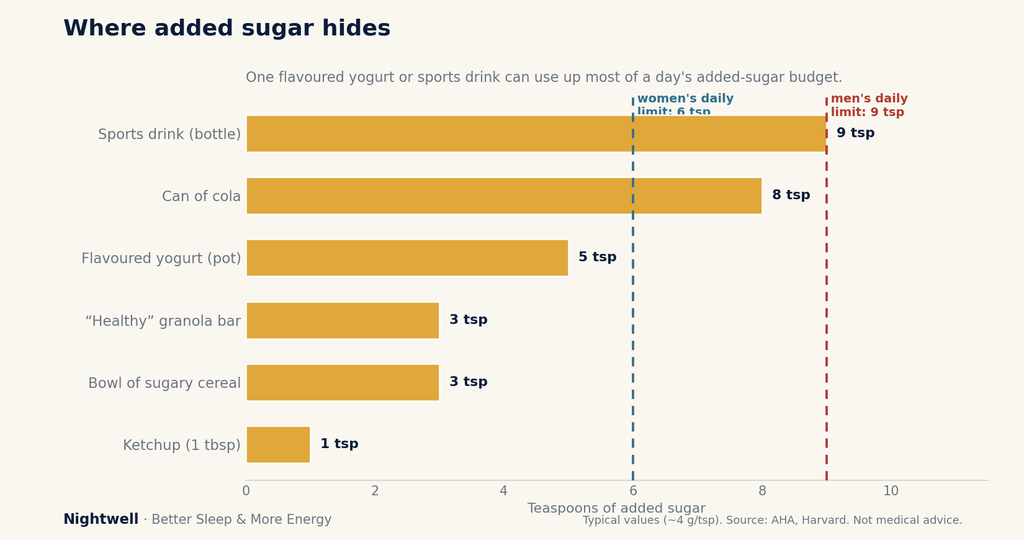
A single pot of flavoured yogurt can contain around 5 teaspoons — nearly a woman’s entire daily allowance. A sports drink or a can of cola can hit or exceed the limit on its own. And sugar shows up in savoury foods you’d never suspect: pasta sauces, ketchup (about a teaspoon per tablespoon), salad dressings, bread, crackers, and “healthy” granola bars and cereals. Even fat-free and diet foods often add sugar to compensate for lost flavour.
Making it harder, added sugar wears many disguises on ingredient lists: corn syrup, high-fructose corn syrup, fruit juice concentrate, dextrose, maltose, molasses, and dozens more. If a sweetener sits near the top of the ingredients list, the product is largely sugar. The one genuinely helpful tool is the nutrition label’s “Added Sugars” line, which now separates added from natural — learning to glance at it is the fastest way to see what you’re really getting.
Why cutting back steadies your energy
This is where sugar connects directly to how you feel each day. A hit of added sugar — especially in a drink, with no fibre, protein, or fat to slow it — spikes your blood sugar fast, then drops it just as fast into a crash: renewed tiredness, poor focus, and a craving for more sugar to climb back out. That’s the loop that powers the mid-afternoon slump and the 4 p.m. vending-machine run. It’s the same blood-sugar rollercoaster we cover in eating for steady energy, and cutting added sugar is one of the most direct ways to flatten it.
There’s a craving cycle at work too. Sugar is genuinely moreish, and the spike-and-crash pattern keeps you reaching for the next hit. Break the cycle and most people find their cravings quieten within a couple of weeks — and foods they used to find “normal” start tasting cloyingly sweet.
How to cut back — without the misery
The reason sugar reduction so often fails is that people try to quit cold turkey, feel deprived and irritable, and give up. A gentler, smarter approach sticks:
- Go gradual. Cut your added sugar by roughly a quarter every week or two rather than all at once. Your palate genuinely adapts — give it time and less sugar starts to taste right.
- Start with drinks. Sugary beverages are the biggest source and the easiest win. Downsize your order, dilute juice with water, switch cola for sparkling water with lemon or lime, and have black coffee or unsweetened tea for a sugar-free caffeine hit — far better than the sugar bombs in many energy drinks.
- Tame, don’t ban, your cereal and yogurt. Mix a sugary cereal half-and-half with a plain high-fibre one, and buy plain yogurt you sweeten yourself with fruit. You cut the sugar without cutting the food you like.
- Cook a bit more at home. Packaged and restaurant foods reliably carry more added sugar. Cooking — even simply — puts you in control of what goes in.
- Read one label a day. You don’t need to audit everything at once. Check the “Added Sugars” line on the products you buy most, and swap the worst offenders.
- Let fruit handle your sweet tooth. Whole fruit satisfies a sweet craving with fibre and nutrients attached — the natural sugar isn’t the enemy, and it’s a genuinely useful tool for cutting the added kind.
- Anchor to protein and fat. When you do have something sweet, pairing it with protein or fat (fruit with nuts, for instance) softens the spike — the same no-crash snack principle that keeps energy steady.
An honest word on sweeteners and exercise
Two nuances worth knowing. First, artificial and non-nutritive sweeteners can help you cut sugar and calories, and swapping a sugary drink for a diet one is generally a step in the right direction — though many people find they’d rather retrain their taste toward less sweetness overall than lean on intense sweeteners. Second, sugar isn’t always the villain: during long or intense exercise (roughly 60 minutes or more), some fast carbohydrate genuinely helps performance and recovery. Context matters — 40 grams of sugar mid-marathon is doing a job; 40 grams from a soda at your desk is not.
What to realistically expect
You may notice a few days of stronger cravings, or even mild irritability, as you cut back — that passes. Within a couple of weeks most people report steadier energy, fewer afternoon crashes, better mood stability, and a recalibrated palate where they no longer need things so sweet. You don’t have to hit zero; even getting from 20 teaspoons down toward the single-digit guideline is a large, worthwhile win. The goal is a sustainable dial-down, not a joyless ban.
The bottom line
Most of us eat far more added sugar than we think, hidden in drinks and everyday foods rather than obvious desserts — and it’s a quiet engine of energy crashes and cravings. But you don’t have to declare war on sugar to benefit. Focus on added sugar rather than fruit, learn where it hides, tackle sugary drinks first, and reduce gradually so your taste buds come along willingly. Do that and you trade the daily sugar rollercoaster for something better: steadier energy, calmer cravings, and food that still tastes good — just no longer drowned in sweetness.
This article is for general information and education and isn’t medical advice. If you have diabetes or another condition affecting blood sugar, please follow the guidance of a qualified healthcare professional or registered dietitian.
Sources: American Heart Association — Added Sugars; Harvard T.H. Chan School of Public Health — Added Sugar in the Diet