
The short answer
No — you don’t need exactly 10,000 steps a day, and that number isn’t the science-based target most people assume it is. It came from a 1960s Japanese pedometer marketing campaign, not from research, and studies show most of walking’s health benefits arrive well before you hit 10,000. Meaningful gains start around 4,000 steps, and roughly 7,000–8,000 a day is the well-supported sweet spot for most adults, after which the added benefit levels off. The single most important number isn’t 10,000 — it’s simply more than you take now. Don’t let an arbitrary goal convince you that anything less doesn’t count.
Where 10,000 actually came from
The origin story is genuinely surprising. In 1965, a Japanese company launched a pedometer called manpo-kei — literally “10,000-step meter.” The number was a marketing choice, helped along by the fact that the Japanese character for 10,000 (万) looks a little like a walking person. It was memorable and round, and it stuck. Over the decades it spread into fitness trackers, smartphone apps, and corporate wellness programmes until nearly everyone came to believe it was an official health guideline.
It never was. As Harvard’s I-Min Lee, a leading researcher on physical activity, has put it plainly: the 10,000 figure “was not a scientific study.” For a long time nobody had actually tested whether 10,000 was the right target — and when researchers finally did, over the last several years, the results told a more encouraging story.
What the science actually says
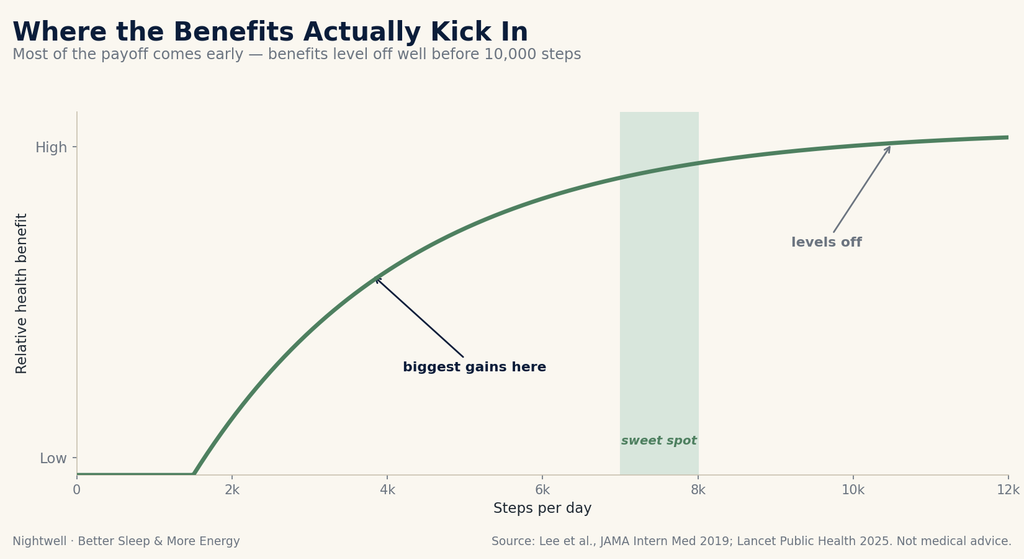
The evidence now points clearly to a graded, “more is better up to a point” relationship — with the biggest returns coming early and a plateau well below 10,000.
- Benefits start low. In a landmark 2019 study of around 17,000 older women, walking about 4,400 steps a day was linked to a 41% lower risk of death compared with roughly 2,700 steps — and the risk kept falling with more steps until it plateaued at about 7,500.
- Around 7,000 is a strong target. A large 2025 review pooling dozens of studies found that about 7,000 steps a day was associated with a roughly 47% lower risk of early death compared with 2,000, along with sizeable reductions in heart disease, dementia, and falls. Beyond 7,000, improvements kept coming but slowed markedly.
- More still helps — with diminishing returns. Other research in younger adults found benefits continuing toward 8,000–10,000 and beyond, but each extra thousand steps adds less than the one before. Older adults tend to see their benefits plateau at the lower end, around 6,000–8,000.
In short: walking is unambiguously good for you, and you get most of the payoff long before the 10,000 mark.
The most important message: move off zero
If there’s one thing to take from all this, it’s that the biggest health gains come from going from barely moving to moderately active — not from squeezing out the last thousand steps. Going from 2,000 to 5,000 steps a day does far more for your health than going from 9,000 to 10,000. Even very modest amounts help: some analyses find measurable benefits from as few as roughly 2,500 steps a day compared with near-total inactivity.
This matters because the 10,000 target quietly breeds an all-or-nothing mindset. People who can’t hit five digits often conclude their effort “doesn’t count,” get discouraged, and give up entirely — ending up worse off than if they’d never fixated on the number. The truth is the opposite: every step is doing something, and the walk you’ll actually take beats the perfect target you won’t.
So what should you aim for?
Rather than chasing a universal magic number, aim for a realistic target that’s a step up from where you are now.
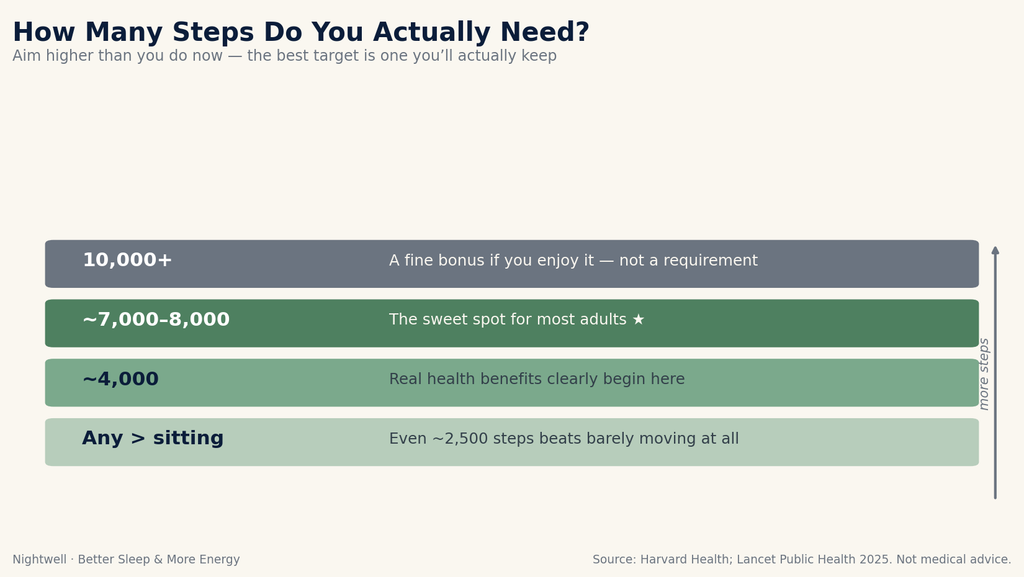
For most healthy adults, somewhere around 7,000–8,000 steps a day is a sensible, evidence-backed goal. If you’re older or just starting out, you’ll see real benefits at lower counts, so there’s no need to feel that 10,000 is the bar. And if you’re currently sedentary, don’t leap for a huge target — Dr. Lee’s own advice is refreshingly simple: try to get about 2,000 more steps than you already do. Build up gradually, adding perhaps 1,000 steps every couple of weeks, and you’ll create a habit that actually lasts.
Does walking pace matter?
You may have heard that a brisk pace matters more than the number of steps. The picture is mixed. There’s some evidence that walking at a moderate-to-vigorous pace adds benefits independent of how many steps you take — but notably, that large study of older women found it was the total number of steps that mattered for longevity, not how fast they were walked. The practical takeaway: don’t stress about speed. Accumulating steps is what counts most, and a brisker pace, when you can manage it, is a nice bonus rather than a requirement.
Can you walk too much?
For almost everyone, no. Walking is low-impact and low-risk, and there’s no clear point at which extra steps suddenly become harmful — the benefits simply plateau rather than reversing. If you love long walks and rack up 12,000 or 15,000 steps because you enjoy them, that’s perfectly fine.
The one real caveat is doing too much too soon. Jumping overnight from a sedentary 2,000 steps to a punishing 15,000 is a recipe for overuse niggles — sore shins, achy knees, tired feet — simply because your body hasn’t adapted yet. That’s an argument for building up gradually, not for holding back. Increase your daily steps in small increments, wear supportive shoes, listen to your body, and ease off if something starts to hurt. Ramp up sensibly and walking stays one of the safest forms of exercise there is.
Why walking is such a good deal
It’s worth stepping back to appreciate why walking earns all this attention. It’s free, gentle on the joints, needs no equipment or gym membership, and counts as genuine moderate aerobic activity — strengthening your heart, improving circulation, and helping with blood pressure, blood sugar, and weight. It’s also one of the most reliable mood and energy boosters going, and it fits the ordinary rhythms of daily life in a way that few other forms of exercise do. Our guide on the benefits of walking covers the full picture, and if you’re carrying a lot of stress, the exercise-and-mood connection is especially worth knowing about. A daytime walk can even improve how well you sleep, which pays you back in next-day energy — see our piece on exercise and sleep.
Easy ways to add more steps
You don’t need to carve out a dedicated hour to move more. The most sustainable approach is to weave extra steps into things you already do.
- Walk while you talk. Take phone calls on your feet, or turn a catch-up into a walking meeting.
- Take the small detours. Park a little farther away, take the stairs, get off a stop early.
- Add a post-meal stroll. A short walk after eating nudges up your step count and helps steady your blood sugar.
- Break up long sitting. Standing and moving for a few minutes each hour adds up — and counters the downsides of sitting all day. These little bursts, sometimes called exercise snacks, are a genuinely effective way in.
Steps aren’t the whole story
One last piece of perspective: a step count only measures walking. It says nothing about the cycling, swimming, gardening, or strength work you might do — all of which are valuable and barely register on a tracker. So don’t let the number become the only scoreboard, or let a great swim feel like it “didn’t count” because your steps stayed low.
It’s also worth remembering that official activity guidelines aren’t written in steps at all — the usual benchmark is around 150 minutes of moderate activity a week, plus muscle-strengthening exercise on two days. Walking is superb aerobic exercise, but it doesn’t build much strength, and strength matters enormously for staying capable as you age. The ideal is to treat your daily steps as the foundation and add some resistance work on top; our guides on how much exercise you need and strength training for beginners show how the pieces fit together.
The bottom line
Ten thousand steps is a fine goal if you enjoy it, but it’s a marketing number, not a medical one — and treating it as a pass/fail test does more harm than good. The research is clear and freeing: most of walking’s benefits arrive by around 7,000–8,000 steps, real gains start well below that, and the jump that matters most is simply moving more than you do today. So forget the magic figure. Find a target you’ll actually keep, add a bit to it over time, and enjoy the walk. That’s what your health responds to.
This article is for general information and isn’t medical advice. If you have a heart condition, mobility issues, or any concern about starting or increasing activity, please check with a qualified healthcare professional first.
Sources: Harvard Health – 10,000 Steps a Day, or Fewer? · Harvard T.H. Chan School of Public Health – Daily Steps and Early Death Risk · BBC Science Focus – The Truth Behind the 10,000-Step Myth (Lancet Public Health review)