
The short answer
Both wake you up, but they do it very differently. Coffee delivers a big, fast jolt of energy; tea gives a gentler, steadier lift with far less of the jittery spike and crash — because it carries less caffeine plus a calming compound coffee doesn’t have. There’s no universal winner. If you want maximum alertness quickly, coffee wins. If you want smooth, sustained focus without the wired feeling, tea has the edge. The best choice comes down to how big a hit you actually want and how your body handles caffeine.
It starts with caffeine — but doesn’t end there
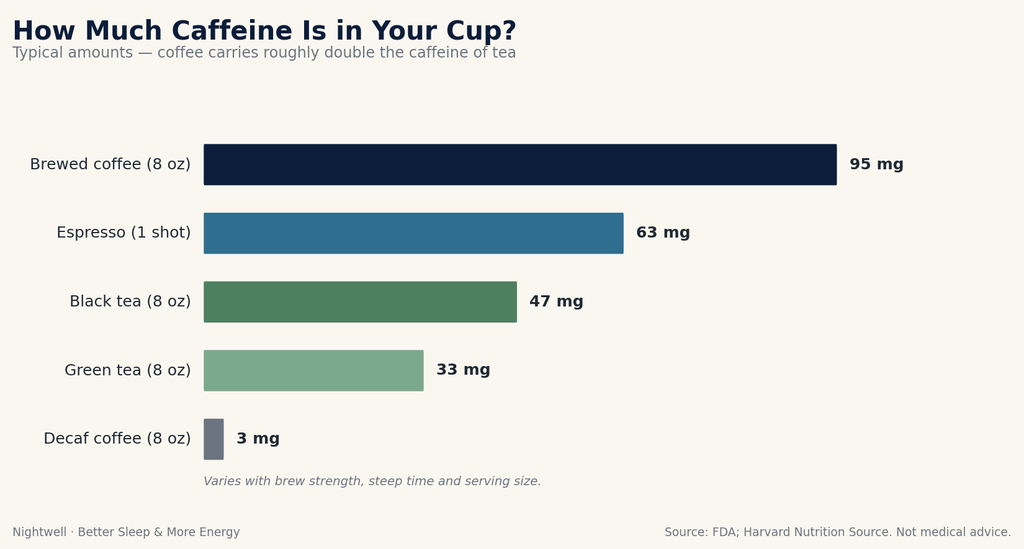
Both drinks run on the same engine: caffeine, which works by blocking adenosine, the brain chemical that builds up through the day to make you feel sleepy. Block it, and alertness rises. The difference starts with dose. A standard cup of coffee carries roughly 80–100 mg of caffeine, while a cup of tea typically ranges from about 25 mg for green tea to 70 mg for a strong black tea — often close to half of coffee’s load. Coffee is also absorbed quickly, so it produces a sharper, faster rise in alertness.
But the amount of caffeine is only half the story. How that caffeine behaves once it’s in you — how fast it lands, how steadily it holds, and what else comes along for the ride — is what makes coffee and tea feel so different. And that’s where tea has a trick coffee can’t match.
Tea’s secret ingredient: L-theanine
Tea contains L-theanine, an amino acid found almost exclusively in the tea plant (Camellia sinensis) — so it’s in white, green, oolong, and black teas, but not in coffee, and not in caffeine-free herbal “teas.” L-theanine is associated with a state of calm, focused alertness, and it appears to buffer caffeine: slowing how sharply it lands and softening the edges. The result is the “relaxed but alert” feeling many people describe from tea, rather than the wired buzz coffee can produce.
This isn’t just folklore. Controlled studies have found that L-theanine and caffeine taken together can improve attention — for example on demanding task-switching — and reduce the jitteriness that caffeine alone can bring. It’s a genuinely different neurochemical package: coffee is pure stimulation, while tea pairs a smaller caffeine dose with a compound that smooths it out. That combination is why a strong cup of tea can leave you sharp and steady instead of buzzy and anxious.
Coffee vs. tea, head to head
Putting the two side by side makes the trade-offs clear. Neither column is “better” — they’re suited to different situations and different people.
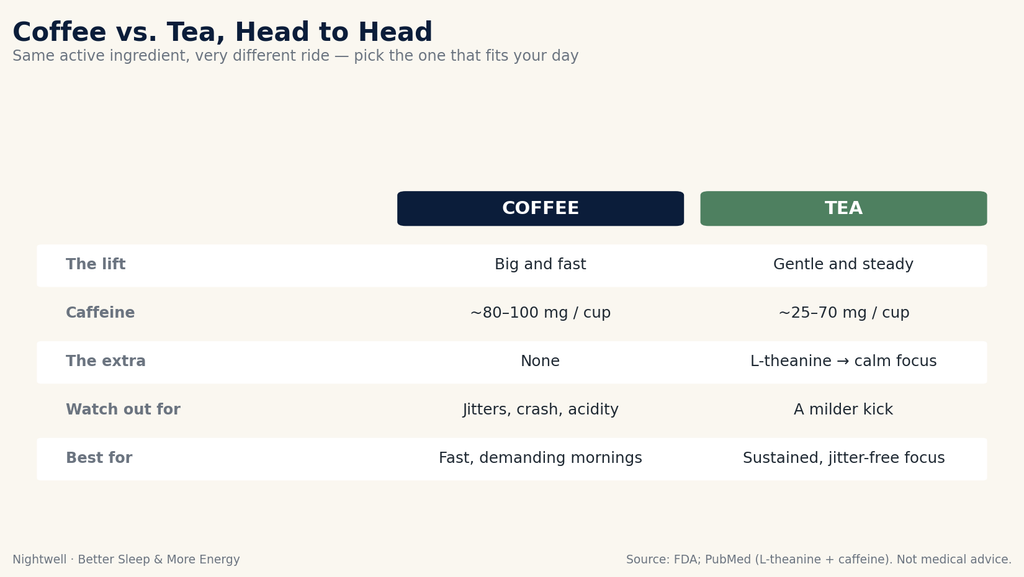
In short: coffee is a sprint, tea is more of a steady walk that quietly gets you just as far. Coffee’s bigger, faster dose is exactly what you want on a heavy morning or before a burst of demanding work. Tea’s lower dose plus L-theanine is better when you want energy that holds through the afternoon without a hard landing — or when coffee tends to leave you anxious or queasy.
The crash — and who feels it
The dreaded mid-morning or afternoon “crash” is largely a story about dose and speed. A big, fast hit of caffeine produces a higher peak, and what goes up tends to come down: as the caffeine wears off, the adenosine it was blocking floods back, and you can feel flatter than before. Coffee, with its larger, quicker dose, is more prone to this spike-and-drop pattern. Tea’s smaller dose and slower release produce a flatter, longer curve, so the comedown is gentler.
Two things make crashes worse regardless of your drink. The first is sensitivity: some people are simply wired to feel caffeine’s jitters and slumps more strongly, and for them tea is often the more comfortable daily option. The second is what you add. Sugary syrups and sweetened coffee drinks stack a blood-sugar spike on top of the caffeine, and that sugar crash is frequently blamed on the caffeine. If your afternoons regularly fall off a cliff, our guide on the afternoon slump and our tips on cutting back on sugar are worth a look — and if you want the full picture of how the stimulant itself works, see how caffeine works.
One more thing shapes how much of a lift you feel: tolerance. Drink caffeine every day and your body adapts, so a good part of that morning cup is really just returning you to your normal baseline rather than pushing you above it. That’s not a reason to quit — it simply means the dramatic buzz fades with regular use, and an occasional lower-caffeine day, or a switch to tea, can help keep caffeine working when you genuinely need it.
So which should you choose?
Rather than crowning a winner, match the drink to the moment:
- Reach for coffee when you need maximum alertness fast — an early start, a heavy morning, or a block of intense focus where a strong kick helps.
- Reach for tea when you want calm, sustained focus, when coffee makes you anxious or jittery, when your stomach finds coffee harsh, or for afternoon work where you don’t want to disturb the night’s sleep.
- Consider both. Plenty of people use coffee on demanding days and tea on calmer ones. You don’t have to pick a side.
- If you’re switching from coffee to tea, start with a bold black tea or chai, which feels closest to coffee, then ease toward green tea or matcha if you want something gentler. Matcha, where you consume the whole powdered leaf, gives a notably calm-but-strong “focused energy.”
This kind of steady, clean focus is exactly what most people are chasing when they reach for a cup — our guide on improving focus and concentration covers the non-caffeine side of the same goal.
More than a caffeine delivery system
Both drinks bring more to the cup than caffeine. Coffee and tea are among the richest everyday sources of polyphenols — plant antioxidants such as the chlorogenic acids in coffee and the catechins (including EGCG) in tea, especially green tea. In moderation, both beverages have been linked in large observational studies to a range of favourable health associations. It’s worth keeping that in perspective — these are associations, not proof that your morning cup is a health tonic — but the reassuring headline is that neither drink is something to feel guilty about at sensible amounts.
Two practical points follow. First, the hydration worry is overblown: while caffeine has a mild diuretic effect, moderate coffee and tea still contribute to your daily fluids rather than dehydrating you. Second, and more importantly, what you add can quietly undo the upside. A cup of black coffee or plain tea is close to calorie-free; a large sweetened, syrup-laden coffee drink is effectively a dessert. If you’re drinking either for the health halo, the fewer add-ons the better.
Timing matters more than the mug
Here’s the thing that outweighs the coffee-versus-tea debate entirely: when you drink it. Caffeine has a half-life of roughly five to six hours, meaning a sizeable chunk is still in your system that long after your last cup. A late-afternoon coffee — or a strong late tea — can quietly wreck your sleep even if you fall asleep fine, which then makes you more tired the next day and more dependent on caffeine. It’s a loop worth breaking. A good rule is to stop caffeine by early-to-mid afternoon; our guide on what time to stop drinking coffee gets specific.
Amount matters too. Health authorities generally consider up to about 400 mg of caffeine a day — roughly four cups of coffee — safe for most healthy adults. If you’re pregnant, guidance is stricter, typically under 200 mg a day, and tea and coffee count the same. And if caffeine reliably makes you anxious, jittery, or wrecks your sleep, that’s your body telling you to cut back or lean toward the gentler cup, whichever drink you prefer.
The bottom line
Coffee and tea both work, and both can be part of a healthy routine. Coffee is the stronger, faster stimulant — ideal when you need a serious jolt. Tea offers less caffeine paired with L-theanine, for a calmer, more sustained focus with fewer jitters and a softer crash. Neither is objectively better; the right pick depends on the energy you want and how caffeine treats you. Whichever mug you reach for, keep the added sugar low, mind your total intake, and above all watch the timing — because a well-timed cup of either beats a badly-timed cup of the “best” one.
This article is for general information and isn’t medical advice. If caffeine consistently makes you anxious, disrupts your sleep, or affects your heart, or if you’re pregnant, consider cutting back and speak with a qualified healthcare professional about what’s right for you.
Sources: FDA – Spilling the Beans: How Much Caffeine Is Too Much? · Harvard T.H. Chan Nutrition Source – Coffee · Giesbrecht et al., PubMed – L-theanine and Caffeine Improve Attention