
The short answer
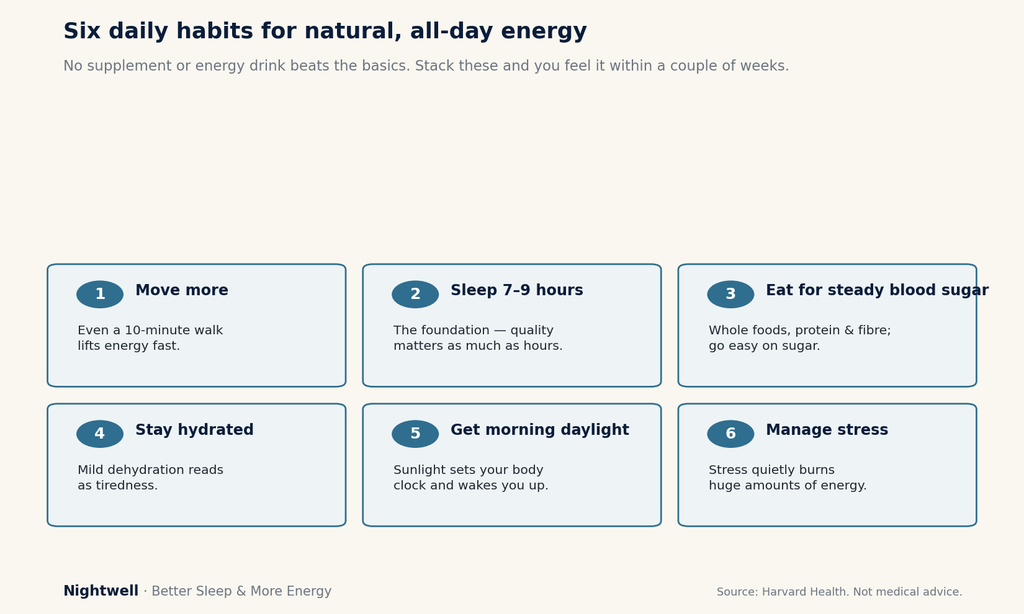
If you’re chasing energy with coffee, sugar, and the occasional energy drink, you’re borrowing against tomorrow rather than building real vitality. Genuine, lasting energy isn’t something you buy in a can — it’s the natural output of a handful of daily habits. The good news, according to decades of research from places like Harvard Health, is that the levers are simple, free, and within your control: move your body, sleep enough, eat for steady blood sugar, stay hydrated, get morning daylight, and manage your stress. Stack these and most people feel a real difference within two to four weeks — no supplements required.
First, a mindset shift: energy is an output, not a product
We’re sold the idea that energy is something you consume — a drink, a pill, a shot. But your body makes its own energy continuously, and how much you have is really a reflection of how well you’re looking after the systems that produce it. That’s why there’s no magic bullet, and why the “quick fixes” so often backfire: caffeine and sugar mask tiredness or spike you briefly, then leave you flatter than before. The reliable path is less exciting but far more effective — tune the basics, and steady energy follows. Let’s walk through the six that matter most.
1. Move more — the fastest lever of all
It feels backwards: when you’re tired, exercise is the last thing you want to do. But movement is arguably the quickest, most powerful natural energiser there is. Harvard’s experts put it plainly — perhaps the fastest, most important way to boost your energy is to move more. Physical activity circulates oxygen, gives your cells more fuel to burn, raises mood-lifting dopamine, and helps you sleep more soundly at night. You don’t need a punishing workout, either: even a brisk 10-minute walk can shift your energy, and short bursts through the day keep it up. If you sit for a living, standing up and moving every hour is one of the simplest changes you can make. Exercise also happens to be one of the best things for your sleep, a link we explore in exercise and sleep.
2. Sleep enough — the foundation everything sits on
No habit can outrun a sleep debt. Adults who regularly get under seven hours are far more likely to feel fatigued during the day, and sleep is when your body and brain actually recharge. Aim for seven to nine hours — though the right number shifts with age, as we cover in how much sleep you really need by age. And remember it’s not just hours but quality: you can spend eight hours in bed and still wake drained if your sleep is fragmented, which is exactly why some people feel tired even after a full night in bed. Protect your sleep and you’ve built the platform every other energy habit stands on.
3. Eat for steady blood sugar
Food is fuel, but the type and timing decide whether it gives you an even burn or a spike and crash. The pattern that keeps energy level is built on whole foods with a low glycaemic index — whole grains, vegetables, beans, nuts, healthy fats — combined with protein, and light on added sugar and refined starch. That combination releases energy slowly instead of dumping it all at once. This whole principle is the heart of eating for steady energy, and it starts with breakfast: a balanced first meal sets the tone for the entire day. Skip the sugary quick fixes that leave you flatter an hour later.
4. Stay hydrated
This one is almost too simple, which is why it’s so overlooked. Water is involved in nearly every process your body runs, and even mild dehydration registers as fatigue, poor concentration, and low mood. Most people don’t drink enough, then mistake thirst for tiredness and reach for coffee — when a glass of water would do more. You don’t need to count litres; drink to thirst, keep water within reach, and check the simple signals, as we explain in how much water you really need. It’s one of the cheapest energy boosts available.
5. Get morning daylight
Here’s a free, fast habit most people have never tried on purpose. Light is the master signal for your body clock. Getting outside into natural daylight soon after waking — ideally within about 30 minutes, even on a cloudy day — shuts down the sleep hormone melatonin and tells your brain to switch firmly into “awake” mode. It sharpens your morning alertness and, by anchoring your circadian rhythm, helps you sleep better that night too. It costs nothing and takes five minutes: step outside with your coffee, walk to work the long way, or just sit by a bright window. Few habits give so much for so little effort.
6. Manage your stress
Stress is an enormous, invisible energy drain. As Harvard notes, stress-induced emotions consume huge amounts of energy — the mental churn of worry and pressure is exhausting even when you’ve barely moved. Two things help. First, reduce the load where you can: overwork, in all its forms, is one of the leading causes of fatigue, so streamline your must-dos, prioritise ruthlessly, and ask for help. Second, actively down-regulate: slow breathing, meditation, yoga, tai chi, time in nature, and simply talking to someone all take you out of the energy-burning “fight or flight” state. Protecting your energy is as much about how you spend it as how you generate it.
What about caffeine and supplements?
Two honest caveats. Caffeine genuinely increases alertness and, used judiciously, is a fine tool — but it doesn’t create energy, it borrows it, and using it late or in large amounts wrecks your sleep and deepens the fatigue cycle (more in how caffeine really works). And supplements? For most people, they don’t boost energy unless you have a genuine deficiency — a whole-food diet is the more effective, evidence-backed route. Save your money unless a test shows a real gap.
When to see a doctor
These habits resolve the everyday tiredness most of us experience. But if you’re doing the basics well and still feel persistently, unusually exhausted, that’s worth investigating rather than pushing through. Ongoing fatigue can signal an underlying issue — from iron or B12 deficiency to thyroid problems, sleep apnea, or low mood — all of which are treatable once identified. Lifestyle fixes a lifestyle problem; a medical cause needs a professional.
The bottom line
Real energy isn’t a product you buy — it’s what your body produces when you look after it. Move your body (the fastest lever), protect seven to nine hours of quality sleep, eat for steady blood sugar, drink enough water, get daylight early, and keep stress in check. None of it is glamorous, and none of it works overnight — but give these habits a couple of weeks and you’ll notice steadier, more dependable energy than any drink or supplement could deliver. Start with the one that feels easiest, build from there, and let the basics do what quick fixes never can.
This article is for general information and education and isn’t medical advice. If you have persistent or unexplained fatigue despite healthy habits, please talk to a qualified healthcare professional.
Sources: Harvard Health — 9 Tips to Boost Your Energy Naturally; Harvard Health — Ways to Maximize Your Energy