
The short answer
Multitasking feels efficient, but for anything that actually requires thought, it’s an illusion. Your brain can’t truly do two attention-demanding tasks at once — it just switches rapidly between them, and every switch costs you time, accuracy, and mental energy. Research suggests that constant task-switching can waste up to 40% of your productive time, while making you slower, more error-prone, and more mentally drained. The fix isn’t to get better at multitasking. It’s to stop trying, and do one thing at a time.
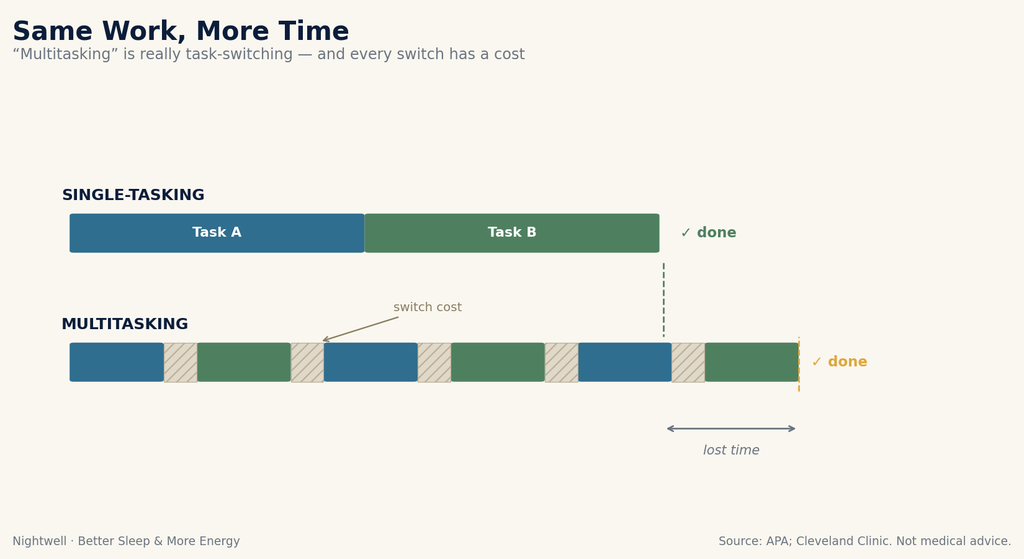
Your brain doesn’t multitask — it switches
The word “multitasking” was actually borrowed from computers, and that’s a big part of the confusion. A computer can genuinely run several processes at once; your brain can’t, at least not for tasks that need focused attention. As neuropsychologists put it, we’re wired to be monotaskers. What feels like doing two things simultaneously is really your brain flipping back and forth between them very quickly — a process called task-switching.
That distinction is the whole story. When you write an email while half-listening to a meeting and glancing at chat notifications, you’re not processing all three in parallel. You’re rapidly reallocating your attention, paying a small toll each time. Those tolls are invisible in the moment, which is exactly why multitasking fools us into thinking it works.
The hidden cost of every switch
Psychologists call it the “switch cost.” Each time you change tasks, your brain has to disengage from the old goal, load up the rules for the new one, and reorient — and that takes time and effort. Individually the costs are tiny. Added up across a day of constant switching, they’re enormous: studies summarised by the American Psychological Association find task-switching can eat up to 40% of your productive time.
It gets worse. There’s a phenomenon called attention residue: when you switch away from a task, part of your mind stays stuck on it, degrading your performance on whatever you do next. And once you’re genuinely interrupted, research suggests it can take over 20 minutes to return to full focus on the original task. So a “quick glance” at your phone doesn’t cost you thirty seconds — it can cost you the next stretch of deep concentration. Heavy media multitaskers, studies find, actually perform worse on tests of memory and attention, not better.
Why it quietly drains your energy
Here’s the part that matters most for how you feel: multitasking isn’t just a focus problem, it’s an energy leak. Every switch raises your cognitive load, and juggling several unfinished tasks keeps your brain working overtime in the background. That’s why a day of frantic switching can leave you feeling utterly drained yet unable to point to much you actually finished — that exhaustion is the residue of fragmented attention. Over time it feeds decision fatigue, irritability, and that foggy, scattered feeling that lingers even after you’ve stopped working. If that sounds familiar, our guides on beating brain fog and on stress, burnout, and energy are worth a read, and steadying your energy through food helps too.
Where multitasking bites hardest
The costs aren’t spread evenly — they land hardest exactly where you can least afford them.
- Learning and memory. Switching while you study or read scrambles how your brain encodes information, so you retain noticeably less. Multitasking through learning is self-defeating: you spend the time but keep little of it.
- Safety. The clearest, most dangerous example is driving while texting. Splitting attention between the road and a screen measurably worsens reaction time — which is exactly why laws restrict phone use behind the wheel.
- Quality and creativity. Deep, original thinking needs sustained, uninterrupted focus. Chop it into fragments and the work comes out shallower, with more small mistakes slipping through.
- Conversations and relationships. Half-listening while you scroll means missed cues and the other person feeling unheard — a quiet cost that doesn’t show up on any productivity chart but matters just as much.
In every case the pattern is the same: the more a task genuinely matters, the more multitasking undermines it.
Why it feels so productive (the trap)
If multitasking is so costly, why does it feel great? Because it delivers a steady drip of small wins. Every time you fire off a reply, check a box, or clear a notification, your brain gets a little hit of reward chemistry, and you feel busy and valuable. But busy isn’t the same as effective. That reward loop is precisely what makes multitasking so seductive — and so hard to quit. Worse, the constant switching trains your brain to expect and crave stimulation, so genuine deep focus starts to feel uncomfortable and even boring. The always-on pull of devices makes this far harder; our guide on digital overload and mental energy digs into that side.
The exception: when it’s actually fine
To be fair, not all “multitasking” is a problem. You can happily fold laundry while watching TV, or listen to a podcast on a walk, because one of those tasks is automatic — it runs on autopilot and doesn’t compete for your focused attention. The simple test is this: does each task require conscious thought? If only one does, you’re fine. If both do — writing and listening, driving and texting, analysing and conversing — you can’t truly do them at once, and trying will cost you on both.
Single-tasking: the real upgrade
The solution is refreshingly old-fashioned: do one thing at a time, with full attention, until it’s finished or you reach a natural stopping point. This isn’t just more efficient — it produces better, more creative work, and, counterintuitively, it usually feels less stressful than the scattered churn of constant switching. A few habits make single-tasking stick.
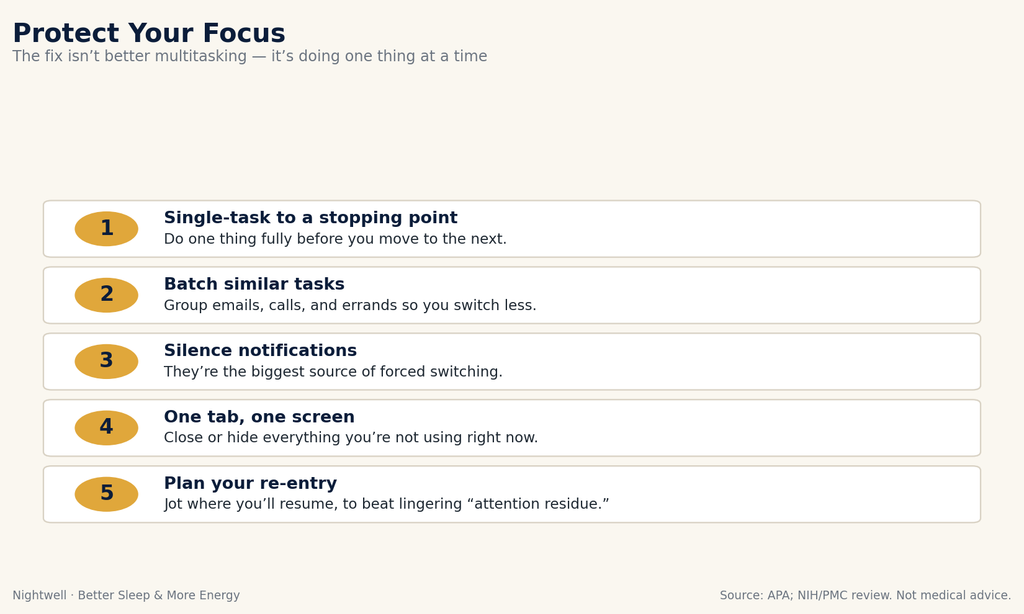
The biggest lever is removing the triggers that force you to switch in the first place — chiefly notifications, which are engineered to yank your attention away on someone else’s schedule. Batching similar tasks (answering all your emails in one block rather than reactively all day) cuts the number of switches dramatically. And when you must step away, jotting a quick note about where you’ll resume helps clear the attention residue so you can pick up cleanly. For a broader toolkit, see our guide on improving focus and concentration.
Catch yourself in the act
Much of the switching we do is invisible — a reflex, not a decision. The single most useful habit is simply noticing the pull. When you feel the urge to flick to your inbox, glance at your phone, or open “just one more” tab mid-task, pause for a beat and name it: that’s the switch reflex. Then choose to stay. You won’t catch every one, and that’s fine; even catching half of them meaningfully protects your focus. A helpful cue is to keep only what you’re working on visible — one screen, one document, phone out of sight — so that switching takes a deliberate action rather than a twitch. Make the distraction the thing that requires effort, and single-tasking quietly becomes your default.
Focus is a skill you can rebuild
If deep concentration feels harder than it used to, that’s not a permanent state — it’s the result of training your brain to expect constant switching, and it can be retrained the other way. Attention behaves a bit like a muscle: neglect it and it weakens, exercise it and it strengthens. The way back is gradual and forgiving.
Start small. Pick one task and give it your undivided attention for a short, defined stretch — even fifteen or twenty minutes — then build from there as it gets easier. Expect the first few sessions to feel oddly uncomfortable, even boring; that restlessness is essentially withdrawal from constant stimulation, and it fades with practice. Protect a daily block for your most important work and guard it like an appointment, notifications off and other tabs closed. Over time, two things happen: single-tasking stops feeling like effort, and the calm focus of doing one thing well becomes its own quiet reward — a welcome relief from the scattered churn you used to call productivity.
The bottom line
Multitasking is one of the most persistent productivity myths going. What you’re really doing is task-switching, and each switch quietly taxes your speed, your accuracy, your memory, and your energy — which is why juggling everything leaves you drained but strangely unproductive. The good news is that the alternative is simple and immediately effective: pick one thing, give it your whole attention, silence the pings, and see it through before moving on. You’ll do better work, remember more of it, and end the day with more in the tank — not less.
This article is for general information and isn’t medical advice. If you consistently struggle to focus, feel persistently mentally foggy, or suspect an attention-related condition, please speak with a qualified healthcare professional.
Sources: American Psychological Association – Multitasking: Switching Costs · Cleveland Clinic – Why Multitasking Doesn’t Work · Digital Multitasking and Brain Health (NIH/PMC)
Comments on “Why Multitasking Hurts Your Focus (And What to Do Instead)”