
The short answer
Strength training is the most skipped — and arguably most important — part of staying healthy as you age, and you can start it today with no gym, no equipment, and no experience. Your own bodyweight is enough to begin. Aim for two sessions a week that work all your major muscle groups, keep the moves simple, focus on good form over difficulty, and make each week a touch harder than the last. Do that and you’ll protect your muscle, bones, metabolism, and independence for decades — and you’ll notice you feel stronger within a month or two.
Why strength training matters so much
Walking and cardio are wonderful for your heart, but they don’t build much muscle or bone — and that’s a problem, because both quietly decline with age. From around 30, adults lose roughly 3–8% of their muscle mass per decade, a process called sarcopenia that accelerates after 50. Strength training is the single most effective way to fight it — in fact, resistance training is the only intervention proven to reverse this muscle loss, and it works even in your 60s, 70s, and 80s.
The benefits go far beyond looking toned:
- Functional independence: every time you climb stairs, carry shopping, or get out of a chair, you’re using strength. Maintaining it keeps you capable and independent as you age.
- Bone density: loading your bones stimulates them to stay dense, cutting the risk of osteoporosis and fractures — especially important for women after menopause, when bone loss speeds up.
- Metabolism and blood sugar: muscle is metabolically active tissue that helps your body handle blood sugar and keeps your metabolism healthier.
- Joint stability and fewer injuries: stronger muscles, tendons, and ligaments make your joints more resilient.
- Balance and fall prevention, plus better mood and long-term health.
It also pairs perfectly with the rest of your movement: walking and cardio as your aerobic base, strength training as the muscle-and-bone protector, together making up the full picture in how much movement you actually need.
You really don’t need a gym
The biggest barrier is usually the idea that strength training means crowded gyms and heavy barbells. It doesn’t. Bodyweight training — using your own body as resistance — is free, accessible, and genuinely effective, especially for beginners. Your muscles don’t care whether the resistance comes from a barbell or your own body; they only respond to being challenged. A set of inexpensive resistance bands adds variety and makes exercises like rows easy to do at home, but you can begin with nothing but your body and a bit of floor space.
A simple starter routine
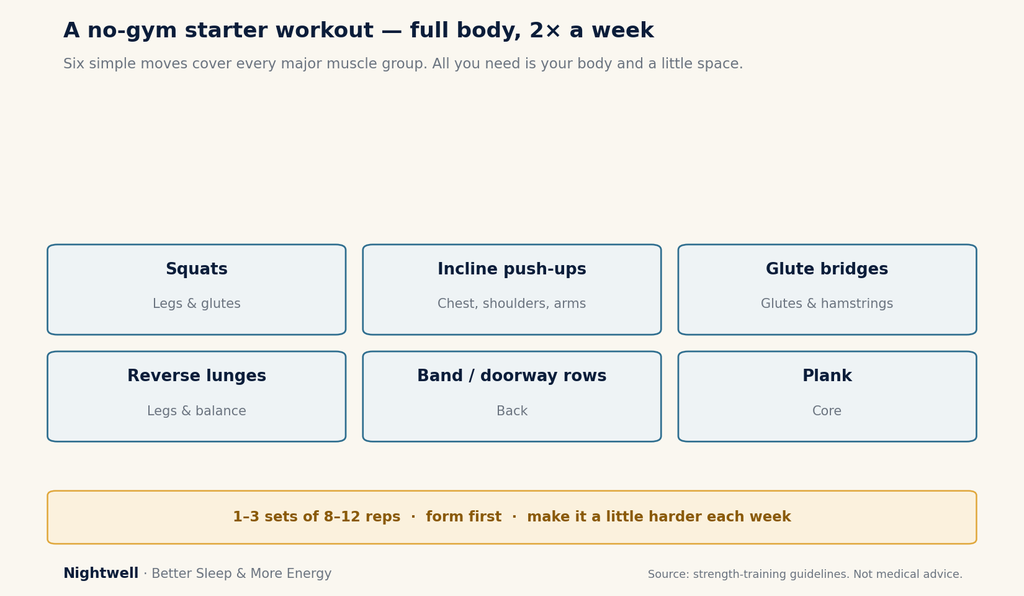
The graphic above shows a full-body beginner workout built from six moves that between them cover every major muscle group:
- Squats — legs and glutes. Sit back as if lowering into a chair, keeping your chest up.
- Incline push-ups — chest, shoulders, and arms. Hands on a wall, counter, or sturdy table makes them beginner-friendly; lower the surface over time to increase difficulty.
- Glute bridges — glutes and hamstrings. Lie on your back, knees bent, and lift your hips.
- Reverse lunges — legs and balance. Step back into a lunge, alternating legs.
- Band or doorway rows — the back muscles most other bodyweight moves miss. Pull a resistance band (or a towel around a sturdy anchor) toward you.
- Plank — core. Hold a straight line from head to heels for as long as your form stays solid.
Do this twice a week, on non-consecutive days so your muscles get around 48 hours to recover and rebuild.
Sets, reps, and how hard to go
Keep the numbers simple. For each exercise, aim for 1 to 3 sets of 8 to 12 repetitions, resting about 60 to 120 seconds between sets. That rep range is the beginner sweet spot. The guiding rule for effort: the last couple of reps of each set should feel challenging but doable with good form. If you can breeze through 15 reps easily, it’s time to make the move harder.
And form comes before everything. A shallow, well-controlled squat beats a deep, sloppy one every time — good technique is what builds strength safely and keeps you injury-free. Slow down, control the movement, and never sacrifice form to do more.
The one principle that drives all progress
If you remember nothing else, remember this: progressive overload. Your body only gets stronger when you gradually ask a little more of it. Do the same easy workout for a year and you’ll stay exactly where you are. The good news is that early on, progress comes fast — the “newbie gains” phase — and you can often make a small step up every week.
With bodyweight training you can’t just “add weight,” so you create overload in other ways:
- Do more reps or an extra set.
- Slow the tempo — take three seconds to lower into each squat — or add a pause at the bottom.
- Increase the range of motion — squat a little deeper, lower your push-up surface.
- Progress to a harder variation — wall push-ups → counter → floor; two-leg → single-leg.
- Shorten your rest between sets.
Each tiny increase keeps your muscles adapting. Strength gains often show up within 4 to 8 weeks as your nervous system sharpens, with visible muscle changes following over the months.
Feed your muscles — and clear up a myth
Two quick but important points. First, strength training and protein work as a team: to build and repair muscle, your body needs enough protein spread through the day, which we cover in protein 101. Training without enough protein leaves gains on the table.
Second, a persistent myth: many women avoid lifting for fear of getting “bulky.” It doesn’t happen from a sensible routine — building large amounts of muscle takes years of dedicated, heavy training and specific eating. What strength training does give women is a stronger, more toned, more capable body and, crucially, protection against the bone loss that accelerates after menopause. It’s one of the best things women can do for lifelong health.
Starting safely
Strength training is safe for almost everyone, but ease in sensibly. Start with the easier variations and light effort, nail your form before adding difficulty, and increase gradually rather than in big jumps. If you have a heart condition, osteoporosis, a recent joint replacement, or another health concern, check with your doctor or a qualified trainer before starting, so your routine fits your situation. A little professional guidance early on is a great investment in doing it right.
The bottom line
Strength training isn’t just for athletes or gym-goers — it’s essential maintenance for every body, and it’s the key defence against the muscle and bone loss that come with age. Best of all, you can start right now with nothing but your bodyweight: two full-body sessions a week, simple moves covering all your major muscles, 8–12 reps with good form, and a small increase in challenge each week. Add enough protein, ditch the “bulky” myth, build up gradually — and give your future self the gift of a strong, capable body that keeps you independent for decades.
This article is for general information and education and isn’t medical advice. If you have a health condition, injury, osteoporosis, or a recent surgery, please talk to a qualified healthcare professional or trainer before starting strength training.
Sources: Building Strength Safely: A Beginner’s Resistance Training Guide; Beginner Strength Training: The Complete Starter Guide; Resistance Training for Sarcopenia: The Evidence
Comment on “Strength Training for Beginners (No Gym Needed)”