
The short answer
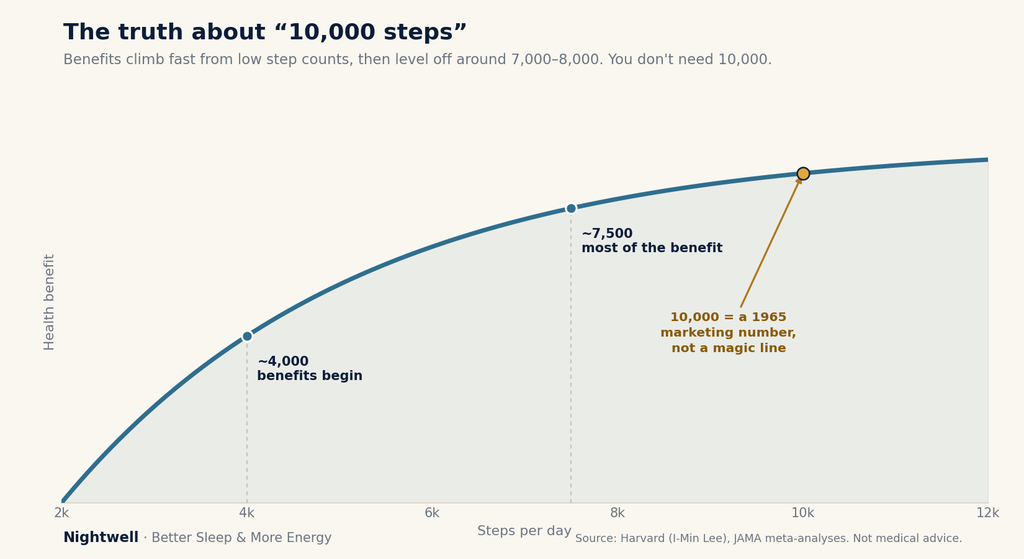
Of all the ways to get healthier, walking is the most underrated — it’s free, requires no equipment or skill, is gentle on your joints, and delivers a huge range of benefits. And here’s the liberating part: you don’t need 10,000 steps a day. That famous number came from a 1965 marketing campaign, not science. The research shows the biggest health gains come from simply moving from very few steps to a moderate amount, with benefits climbing fast and then levelling off around 7,000 to 8,000 steps a day. Even 4,000 helps. So the real message is: walk more than you do now — whatever that number is.
Where “10,000 steps” really came from
The 10,000-step goal feels official — it’s the default on every fitness tracker — but its origin is pure marketing. In 1965, a Japanese company launched a pedometer called the “manpo-kei,” which translates as “10,000-step meter.” The round number was catchy and stuck. As Harvard’s Dr I-Min Lee, who researches this exact question, puts it: that really is the origin, and it was not a scientific study. Decades later, that arbitrary figure became a worldwide benchmark — one that leaves many people feeling like failures when they don’t hit it.
What the science actually says
When researchers went looking for the real numbers, they found something far more encouraging. The benefits of walking begin at surprisingly low step counts and rise steeply before plateauing:
- Even around 2,500–4,000 steps a day reduces the risk of early death compared with being very sedentary. In one study of older women, about 4,400 steps was linked to a 41% lower mortality risk than 2,700.
- Around 7,000 steps a day is the sweet spot: a large 2025 review found people hitting roughly 7,000 steps had close to half the risk of dying from any cause, along with lower rates of heart disease, dementia, depression, type 2 diabetes, and falls.
- Beyond about 7,000–9,000 steps, the benefits keep improving but the gains slow markedly — and going all the way to 10,000 offers little extra for mortality over the 7,000–9,000 range.
In other words, there’s no magic cliff at 10,000. The curve above tells the story: the most valuable steps are the ones that take you from inactive to moderately active. If 10,000 feels out of reach, aiming for 7,000 — or, as Dr Lee suggests, simply 2,000 more than you currently do — is a realistic, science-backed target that still delivers most of the reward.
Does pace matter?
Yes and no, and it’s worth understanding the nuance. For longevity and disease risk, total steps matter more than speed — studies find 8,000 slow steps and 8,000 brisk steps give broadly similar mortality benefits. So if your main goal is health, just get your steps in at whatever pace you can manage.
But for cardiovascular fitness, pace does count. Brisk walking — fast enough that your breathing deepens but you can still talk — pushes you into the moderate-intensity zone that strengthens your heart and lungs, and some research links a brisker cadence to a little extra risk reduction on top. So a good rule of thumb: rack up steps at any pace for general health, and add some brisk walking when you want a fitness boost. A brisk 30-minute walk also counts toward the weekly activity target we cover in how much movement you actually need — in fact, 150 minutes a week works out to roughly 5,000–6,000 steps a day.
Why walking punches above its weight
For something so simple, walking delivers a remarkable list of benefits:
- Heart health: it lowers blood pressure and cuts the risk of heart disease and stroke.
- Mood: it releases feel-good endorphins and reduces stress and anxiety — one of the easiest ways to lift a low mood.
- Energy: a brisk walk is a genuine, caffeine-free energy boost, and it’s a top fix for the afternoon slump.
- Blood sugar: a short walk after meals blunts the post-meal blood-sugar spike — a simple habit with an outsized payoff.
- Weight: a brisk 30-minute walk burns roughly 100–300 calories, and it adds up over time.
- Joints: it’s low-impact and gentle, making it ideal if high-intensity exercise isn’t for you.
- Brain and sleep: regular walking sharpens focus and helps you sleep better, especially when done outdoors in daylight.
Walking is also the perfect way to combine benefits: do it outside and you add the mood-and-focus lift of nature and daylight; do it to break up your workday and you counter the harm of sitting too long.
How to walk more without trying too hard
The beauty of walking is that it slips into daily life — you rarely need to schedule a “workout”:
- Walk for transport: to the shops, to work, part of the commute. It counts every bit as much as gym time.
- Take the stairs and park further away.
- Have walking meetings or phone calls instead of sitting.
- Take a short walk after meals — great for digestion and blood sugar.
- Break it up: three 10-minute walks count the same as one 30-minute one, so you don’t need a big block of time.
- Add gradually: if you’re at 4,000 steps now, aim for 6,000, not 10,000. Small, sustainable increases stick.
- Make it enjoyable: a podcast, a friend, a nice route, or a dog turns “exercise” into something you look forward to.
Is walking on its own enough?
For general health and longevity, walking regularly gets you remarkably far — it’s genuinely enough to capture most of the big benefits, and for someone coming from a sedentary start it’s the single best place to begin. But to be fully honest: walking is mostly aerobic and gentle, so it doesn’t build much muscle or bone strength on its own. As we age especially, we lose muscle, and that needs resistance to counter it. So the ideal isn’t walking instead of everything else — it’s walking as your reliable daily base, with a couple of simple strength sessions added each week (weights, bands, or bodyweight moves) and the odd brisker or steeper walk for cardio fitness. Think of walking as the foundation that makes everything else easier, not the whole house. If all you ever do is walk more, you’ll still be far healthier for it; adding a little strength work just rounds out the picture.
The bottom line
Walking may be the closest thing there is to a perfect exercise: free, easy, low-impact, and packed with benefits for your heart, mood, energy, blood sugar, and lifespan. And you can let go of the pressure of 10,000 steps — that’s a marketing relic, not a health law. The science is clear and kind: the biggest gains come from simply walking more than you do now, with most of the benefit banked by around 7,000 steps. So don’t overthink it. Put on your shoes, pick a number a little above your current one, walk at a pace you enjoy (with some brisk stretches for fitness), and let the most underrated exercise there is quietly transform your health.
This article is for general information and education and isn’t medical advice. If you have a heart condition, a mobility issue, or have been inactive for a long time, please talk to a qualified healthcare professional before significantly increasing your activity.
Sources: JAMA — How Many Steps a Day for Health?; Harvard’s Dr I-Min Lee — The 10,000-Step Myth; BBC Science Focus — 7,000 Steps a Day
Comment on “Walking: The Most Underrated Exercise There Is”