
The short answer
If you’re waiting until you feel motivated to get things done, you’ll be waiting a long time — because motivation is a fickle, fleeting feeling that vanishes exactly when you’re tired and need it most. The people who consistently follow through aren’t more motivated than you; they’ve simply stopped depending on motivation. They rely on discipline — which, done right, isn’t gritted-teeth willpower but smart systems that make action almost automatic. And the biggest mind-shift of all: motivation usually follows action, not the other way round. You don’t need to feel like it to start. You just need to start.
Why motivation lets you down
Motivation feels wonderful — the surge of excitement when you set a new goal, the fire to change your life. The problem is that it’s an emotional state, and like all emotions it rises and falls with your mood, sleep, stress, energy, and even the weather. That’s what makes it so unreliable. Some mornings you wake up ready to conquer the world; others you feel flat and can’t be bothered. If your action depends on the feeling, you’ll only ever act “when you feel like it” — and be honest: how often do you truly feel like doing the hard thing, especially at the end of a long, draining day?
This is why so many good intentions die young. People start a new habit on a wave of motivation, then quit the moment the excitement fades and real life — a busy week, a bad night’s sleep, a setback — gets in the way. It isn’t laziness or weakness. It’s the predictable result of building on a foundation that was always going to crumble.
What discipline actually is
“Discipline” sounds grim — images of 5 a.m. cold starts and superhuman self-control. But that’s a misunderstanding, and it’s why people think they “don’t have any.” Real discipline isn’t about forcing yourself to work harder through sheer will. As James Clear puts it in Atomic Habits, disciplined people are simply better at structuring their lives so they don’t need heroic willpower. Discipline is about self-leadership and design: creating systems that make the right choice the easy, default one, and the wrong choice inconvenient.
In practice, discipline often looks unimpressive: putting a recurring workout on your calendar, deciding in advance that “Tuesday is when I do the accounts,” making a template instead of reinventing the same task each time. It’s less about trying harder and more about deciding once so you don’t have to decide — and re-decide — every single day. That’s exactly why habits and routines are such energy-savers, as we cover in habits and routines: they turn effortful choices into automatic ones.
The big reversal: action creates motivation
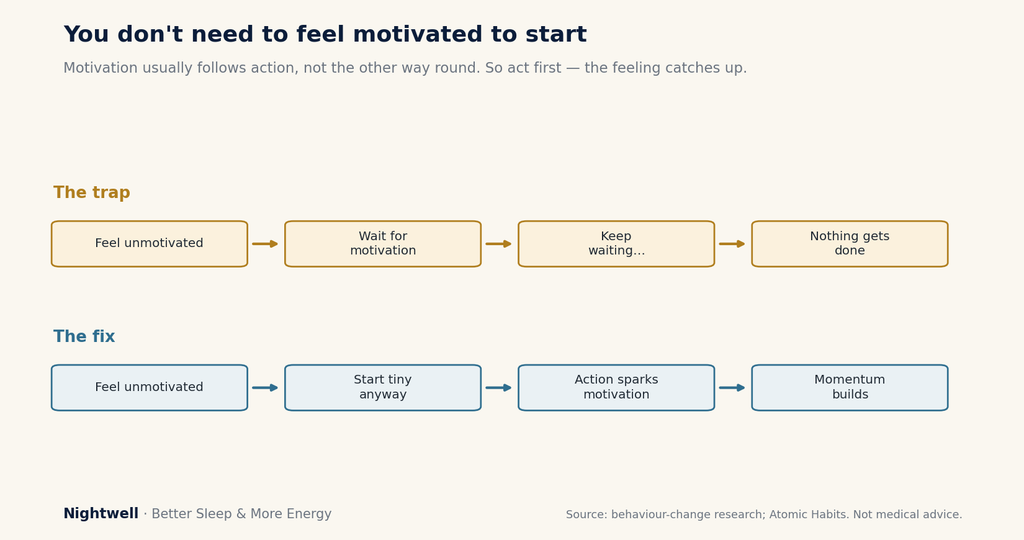
Here’s the single most useful idea in this whole article. We assume the sequence is: feel motivated → take action → get results. So when the motivation isn’t there, we wait for it. But the arrow very often points the other way: action comes first, and motivation follows. Once you start — even reluctantly — momentum builds, small progress feels good, and the motivation you were waiting for shows up because you began.
The graphic above captures the two paths. Wait to feel motivated, and you stall indefinitely. Take a tiny action despite feeling flat, and that action sparks motivation, which fuels more action. So the move when you’re unmotivated isn’t to summon a feeling — it’s to lower the bar and just begin.
How to get things done when you’re drained
These are the practical tactics disciplined people use — none of which require willpower heroics:
- Make the first step tiny. Don’t commit to “write the report” — commit to “open the document and write one sentence,” or “put on my running shoes.” Shrinking the start past the point of resistance is how you beat the inertia, and once you’ve begun you’ll usually keep going. It’s the same “make it small” principle behind building any habit.
- Decide in advance. Every in-the-moment decision is a chance to talk yourself out of it, and your tired, end-of-day self makes poor choices. So remove the decision: schedule it, make it a fixed part of your week, and pre-commit. This is the discipline version of turning a vague to-do into a clear, scheduled next step.
- Design your environment. Make good choices inevitable and bad ones inconvenient. Lay out your gym clothes; keep the guitar on its stand, not in its case; charge your phone in another room. Your future self won’t have willpower — so let your present self remove the decision entirely.
- Use your energy peaks. Discipline is easier when you’re not fighting your own biology. Tackle your most important task at your natural high point rather than grinding against your afternoon slump.
- Track it, and get accountability. A simple habit tracker, a journal, or a friend expecting you to show up all make the effort visible and reinforce the behaviour. Seeing a streak you don’t want to break is a surprisingly strong pull.
- Be kind to yourself when you slip. Discipline isn’t perfection. Missing a day isn’t failure — quitting after missing a day is. Self-flagellation drains the very energy you need; a calm “start again tomorrow” keeps you in the game.
You still need motivation — for direction
None of this means motivation is useless. It has a real job: it supplies the why. Motivation connects you to the deeper reason behind a goal — to feel healthier, to support your family, to create something — and that meaning is what makes discipline feel worthwhile rather than a joyless grind. So the ideal is both working together: motivation gives you direction and the initial spark; discipline provides the structure that carries you when the spark fades. And here’s the encouraging part — they feed each other. Showing up through discipline produces progress, and progress rekindles motivation, creating a self-reinforcing loop. Connecting your daily systems to a genuine “why” is part of the whole-picture approach in getting more energy naturally.
The bottom line
Stop waiting to feel motivated — that feeling is unreliable and always deserts you when you’re tired. Instead, build discipline the smart way: not through brute willpower, but through systems that make good action the path of least resistance. Shrink the first step until you can’t say no, decide in advance, design your environment, and lean on the truth that motivation follows action rather than preceding it. Keep a motivating “why” in view for direction, then let discipline do the daily work. Do that and getting things done stops depending on how you feel — which is exactly what makes it dependable.
This article is for general information and education. If low motivation is persistent, all-consuming, or paired with low mood, it can be a sign of something more than a productivity problem — consider talking to a qualified professional.
Sources: Motivation vs Discipline: Which One Do You Need?; The Truth About Discipline vs Motivation (Atomic Habits); Discipline vs Motivation: What Really Drives Progress