
The short answer
Ever taken a whole day off, slept in, and still felt oddly flat afterward? You’re not broken — you’re just resting the wrong way. Most of us treat rest as a single thing: sleep, or slumping on the sofa. But according to research popularised by physician Dr Saundra Dalton-Smith, there are actually seven different types of rest, and you can be well-topped-up in one while running on empty in the others. That’s why sleep alone, or a Netflix binge, so often fails to recharge you. The fix is to figure out which kind of rest you’re short on — and top up that one.
Why sleep isn’t the same as rest
Here’s the insight that reframes everything: sleep and rest are not synonyms. Sleep is one crucial component of physical rest, and nothing replaces it — but as a Harvard sleep-medicine expert who reviewed this framework points out, if you’re already getting seven to nine hours of good sleep and still feel depleted, getting even more sleep isn’t the cure. You’re likely deficient in one of the other rest domains that sleep simply doesn’t touch. It explains a puzzle many people feel: how you can sleep for days and remain burned out, yet an afternoon spent volunteering on your feet can leave you feeling more restored than a nap. Different tiredness needs different rest.
The seven types of rest
Each type targets a different kind of depletion. As you read, notice which ones ring true — that’s where your deficit likely is.
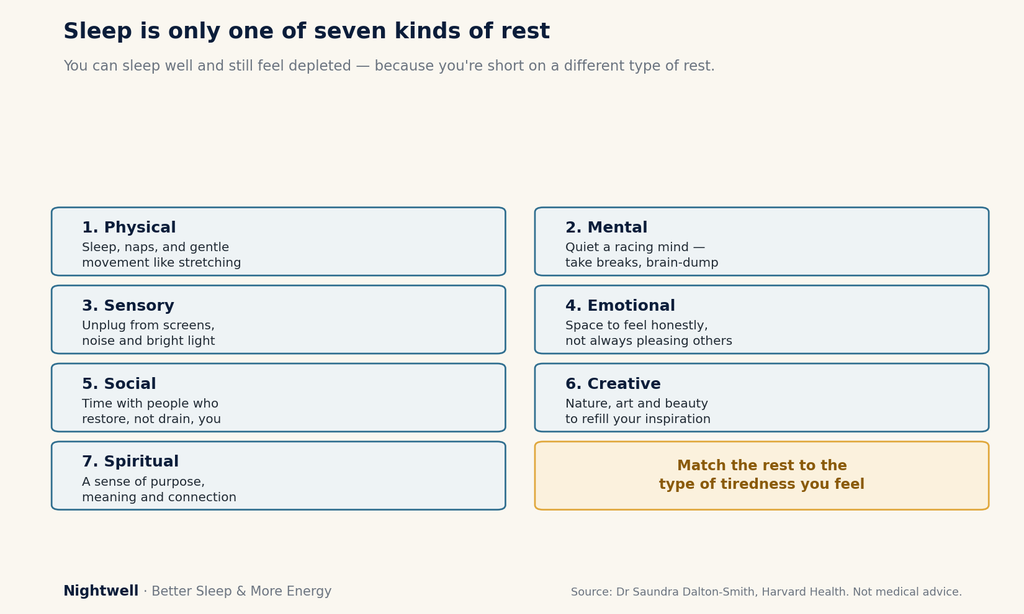
1. Physical rest. This has two halves. Passive physical rest is sleep and napping. Active physical rest is restorative movement — stretching, gentle yoga, a leisurely walk, massage — that eases tension and boosts circulation. If you sit all day, you can be physically tired from too little movement, not too much, which is why breaking up sitting matters so much.
2. Mental rest. The relief a racing, over-thinking mind needs. If you lie awake replaying the day or can’t concentrate, you’re likely mentally under-rested. The fix isn’t a two-week holiday — it’s short, regular pauses through the day to let your brain idle, and offloading the mental clutter, as we cover in why your to-do list exhausts you.
3. Sensory rest. Modern life bombards your senses — screens, notifications, bright light, background noise. Sensory overload leaves you frazzled and irritable. The antidote is deliberately unplugging: a few minutes with your eyes closed, dimming the lights, and stepping away from devices, which is exactly the relief that fighting digital overload provides.
4. Emotional rest. The freedom to feel and express your emotions honestly, rather than constantly performing, people-pleasing, or holding it all in. An emotional-rest deficit shows up as feeling drained by having to “be okay” for everyone. It’s restored by honest conversations and giving yourself permission to be authentic.
5. Social rest. Not all company is created equal. Social rest comes from distinguishing the relationships that revive you from those that drain you — and choosing more of the former. It might mean time with people who ask nothing of you, or, for many, simply time alone to recover from social demands.
6. Creative rest. This one refills your capacity for ideas and problem-solving. You don’t have to be an artist — you use creativity whenever you brainstorm or think around a problem. It’s replenished by taking in beauty and inspiration: time in nature, art, music, or anything that reminds you the world is more than your to-do list.
7. Spiritual rest. The sense of purpose, meaning, belonging, and connection to something larger than yourself. When it’s missing, even a comfortable life can feel empty. It’s restored through whatever gives you meaning — community, contribution, reflection, faith, or connection to your values.
Why your days off don’t recharge you
With that framework, the mystery solves itself. Most “rest days” only ever address passive physical rest — you sleep in, then lie on the couch. But if your real deficit is sensory (you spend the day scrolling), mental (your mind keeps churning about work), or emotional (you spend it managing everyone else’s needs), you finish the day just as depleted. Worse, common “rest” activities aren’t restful at all: scrolling your phone is more sensory and mental input, not less; a day of social obligations you didn’t want isn’t social rest. You went through the motions of relaxing without ever refilling the bucket that was actually empty.
How to rest properly
- Diagnose your deficit. When you feel wiped out despite sleeping, pause and ask what kind of tired you are. Wired and over-thinking? That’s mental. Frazzled by noise and screens? Sensory. Drained by people? Social. The label points you to the right remedy.
- Match the rest to the tiredness. This is the whole game. Mental fatigue needs quiet and fewer inputs, not another podcast. Sensory overload needs a dark, silent few minutes, not more content. Give the depleted bucket what it actually needs.
- Think small and daily, not one big holiday. Dalton-Smith’s key point is that the antidote to burnout isn’t a three-month sabbatical — it’s small, doable top-ups woven through your week, so no single bucket ever runs dry. Five quiet minutes, a screen-free walk, a real conversation, a moment of purpose.
- Make some “rest” genuinely restful. Swap passive scrolling for something that actually restores — a walk in nature, sitting quietly, a creative hobby, time with someone who lights you up.
When rest isn’t enough
These strategies address ordinary depletion. But if you’re doing all the right kinds of rest and still feel persistently, deeply exhausted — if nothing recharges you and it’s dragging on for weeks — that’s worth taking seriously rather than resting harder. Relentless exhaustion can be a sign of burnout that needs bigger changes, or of an underlying medical issue, both of which we touch on in stress, burnout and energy and tired even after 8 hours. When rest alone doesn’t refill the tank, it’s time to talk to a professional.
The bottom line
Rest isn’t one thing, and that’s why your days off sometimes leave you as tired as before. You have seven buckets to keep filled — physical, mental, sensory, emotional, social, creative, and spiritual — and sleep only tops up one of them. The skill is noticing which kind of tired you are and giving yourself that specific kind of rest, in small doses, every week. Do that and rest stops being a hopeful nap that doesn’t quite work, and becomes what it’s meant to be: the thing that genuinely refills you.
This article is for general information and education and isn’t medical advice. If you feel persistently exhausted despite adequate rest, please talk to a qualified healthcare professional.
Sources: Harvard Health — The 7 Types of Rest and Why We Need Them All; Dr Saundra Dalton-Smith — The 7 Types of Rest