
The short answer
If you can’t concentrate the way you used to, you’re not broken and you’re not lazy — you’re living in a world engineered to fragment your attention. The good news is that focus is a skill you can rebuild, and the fastest wins come not from trying harder but from changing your environment and doing one thing at a time. Two ideas do most of the heavy lifting: multitasking is a myth that quietly wrecks your output, and willpower is a terrible way to fight distraction — design beats discipline. Get those right and deep, sustained focus becomes possible again.
The multitasking myth
Let’s start with the belief that’s sabotaging you. You can’t actually do two demanding things at once — your brain doesn’t run tasks in parallel, it switches between them rapidly, and every switch sends you a bill. Cognitive scientists are blunt about it: what we call multitasking is really task-switching, and it can cut your efficiency by up to 40%, increase errors, and slow you down. The word “multitasking” was even coined for computers, not people.
Worse, there’s a hidden tax called attention residue: when you switch away from a task — especially before finishing it — part of your mind stays stuck on the old one, so you’re never fully present on the new one. The lesson is simple and powerful: finish, then switch.
One honest nuance: not all doing-two-things is harmful. You can walk and listen to a podcast, or fold laundry while on a call, because one of those tasks is automatic and doesn’t compete for conscious attention. The damage happens only when two tasks both demand deliberate thought — like writing while monitoring email.
Design beats willpower
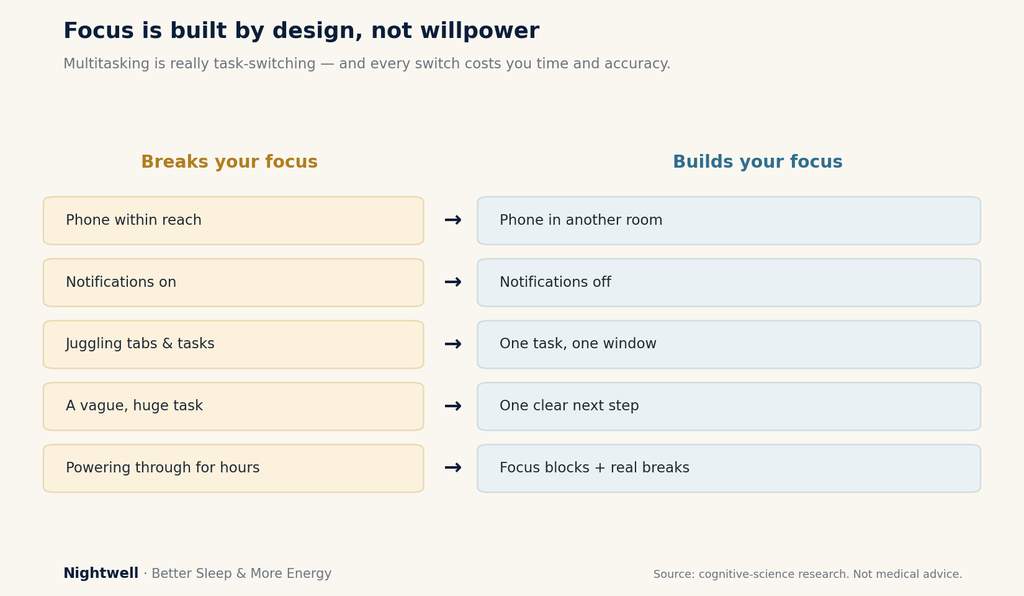
Here’s the mistake almost everyone makes: they try to resist distraction all day through sheer willpower. That fails, because willpower is finite and your phone is engineered to be irresistible. The far more effective approach is to remove the temptation structurally, so there’s no decision to make in the first place.
The single highest-impact move is to put your phone in another room — not face-down on the desk, actually out of sight and reach. Studies consistently show that the mere presence of a phone drains attention, even when it’s off. Then turn off notifications, close every tab and app you don’t need for the task at hand, and if your environment is noisy, use consistent background sound or noise-cancelling headphones. You’re not relying on discipline; you’re removing the things that break concentration before they get the chance.
Work in focused blocks
Your brain can’t concentrate hard indefinitely — peak focus naturally lasts somewhere around 90 to 120 minutes before fatigue sets in, following your body’s ultradian rhythms. So instead of “powering through” for hours (which just degrades into low-quality, distracted work), structure your day into protected sprints of single-tasking.
The most popular version is the Pomodoro Technique: pick one task, set a timer for about 25 minutes, work with zero interruptions until it rings, then take a short break — and after several rounds, take a longer one. It works for a mundane reason: a finite timer makes the task feel bounded and gives your urge to check something a scheduled outlet. You’re not committing to focus forever, just until the timer rings. The 25-minute figure isn’t magic — some people do better with 50-minute blocks. The principle that matters is always the same: one task, a fixed window, no switching.
Make your breaks real
This is the part most productivity advice gets wrong. The break between focus blocks only works if it’s genuine rest — your cognitive recovery happens during actual downtime, not when you “productively” switch to checking email. Scrolling social media on your break isn’t a break; it’s more task-switching, and it leaves you more depleted. Stand up, stretch, look out a window, walk around, get a glass of water, or step outside for some daylight. Protect your break time as fiercely as your focus time.
A few more high-leverage habits
- Batch similar tasks. Answer all your emails in one or two designated windows rather than reactively all day; make your calls back to back. Switching between similar tasks costs far less than leaping between different mental worlds.
- Define one clear next step. A vague, giant task (“work on the report”) invites procrastination and drift. A specific next action (“write the intro paragraph”) is easy to start — and starting is usually the hardest part.
- Do your hardest work at your peak. Most people have a window when they think most clearly — often late morning. Guard it for demanding work and leave admin for the natural dip, an idea we explore in the afternoon slump.
- Train it like a muscle. Attention is trainable. Thanks to neuroplasticity, short, consistent practice at sustained focus strengthens your capacity over time — and every time you give in to task-switching, you reinforce the scattered pattern instead. Start with one honest focus block a day and build.
Focus stands on a physical foundation
No technique will save you if the basics are missing — sleep, movement, and nutrition are the ground every focus method stands on, not optional extras. Sleep deprivation severely impairs concentration, so a good night is the most powerful “focus hack” there is. Blood-sugar crashes scatter your attention, which is why eating for steady energy matters for the mind as much as the body. Movement and daylight sharpen thinking, and when concentration collapses into mush, that’s often plain brain fog with a fixable cause. Caffeine can help in the moment — used wisely, as we cover in how caffeine works — but it can’t substitute for the foundations, and it’s one lever among many in getting more energy naturally.
The bottom line
Deep focus in a distracted world is a genuine competitive advantage, and you build it less by gritting your teeth and more by removing what breaks your concentration and patiently training what sustains it. Do one thing at a time; put the phone in another room and kill notifications; work in timed blocks with real rest between them; batch the small stuff; and protect your foundations of sleep, food, and movement. None of it is complicated, and none of it requires heroic willpower — just a better setup. Reclaim your attention and everything downstream, from your energy to your output, improves with it.
This article is for general information and education and isn’t medical advice. If you have persistent, severe difficulty concentrating, it’s worth discussing with a qualified healthcare professional, as it can have underlying causes.
Sources: Asana / Dr. Sahar Yousef (UC Berkeley) — Why Multitasking Fails; How to Improve Focus and Concentration (research summary); The Multitasking Myth: What Neuroscience Shows