
The short answer
If your energy swings from wired to wiped out over the course of a day, the culprit usually isn’t how much you slept — it’s what and when you ate. Energy comes down to one thing above all: keeping your blood sugar steady. Foods that flood your system with fast sugar give you a quick lift and then drop you into a crash; foods that release their fuel slowly keep you running smoothly for hours. The winning pattern is simple and you can apply it to every meal: build each one around a slow-release carbohydrate, a protein, and a healthy fat, and eat at regular intervals. Do that, and the mid-afternoon slump largely disappears.
Why your energy crashes: the blood-sugar rollercoaster
Every carbohydrate you eat is eventually broken down into glucose — the sugar your cells burn for fuel. The difference between feeling sharp all afternoon and face-planting at 2:30 p.m. comes down to how fast that glucose hits your bloodstream.
When you eat something sugary or made from refined carbs — a pastry, white bread, a soft drink, most breakfast cereals — the glucose arrives almost instantly. Your blood sugar spikes, you feel a brief burst of energy, and your body responds by pumping out a big wave of insulin to shuttle all that sugar out of your blood and into your cells. The problem is that the insulin response often overshoots, so your blood sugar doesn’t just come back down — it drops below where it started. That dip is the crash, and it shows up as exactly the symptoms you know: sudden tiredness, hunger, shakiness, irritability, difficulty concentrating, sometimes a headache. And what do most people reach for to fix it? More sugar or another coffee — which just starts the whole cycle again.
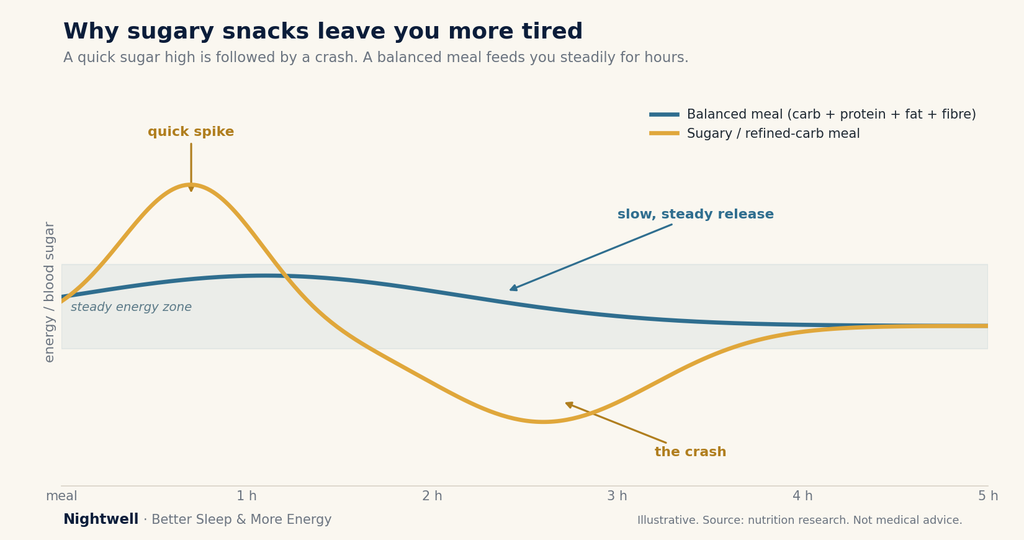
The graph above tells the story: the sugary meal spikes fast and crashes hard, while the balanced meal rises gently and holds you in the “steady energy zone” for hours. That afternoon slump you fight most days? It very often started with what you ate at breakfast.
The Glycemic Index, in plain English
Nutritionists measure how fast a food raises blood sugar using the Glycemic Index (GI) — a scale from 0 to 100. Think of it as a speed gauge for your food. High-GI foods (70 and above) are the fast-release ones: white bread, sugary cereals, pretzels, most sweets. Low-GI foods (55 and below) are the slow-release champions: oats, lentils, beans, sweet potatoes, most whole grains. A high number means a jarring, fast ride for your blood sugar; a low number means a smooth, gentle one with no surprise drops.
The single biggest factor that lowers a food’s GI is fiber. Fiber physically slows how quickly your stomach empties and how fast enzymes can get at the carbohydrates, stretching the release of glucose over a longer window. Oats are a perfect example: they’re rich in a soluble fiber called beta-glucan that forms a gel in your gut and drip-feeds energy instead of dumping it. Most people eat far less fiber than they should — guidelines suggest roughly 25 to 35 grams a day for most adults, and the majority fall well short.
The formula: carb + protein + fat, every time
Here’s the part that makes this genuinely easy to apply. You don’t need a complicated meal plan or to memorize GI tables. You just need to build each meal from three components, because protein and fat both slow digestion even further when eaten alongside carbohydrates. In fact, protein is about three times more effective than fat at blunting a blood-sugar spike when paired with carbs.
So the template is: a slow-release carbohydrate + a protein + a healthy fat, ideally with some fiber and vegetables. A few real examples:
- Oats (carb + fiber) with Greek yogurt (protein) and a spoon of nut butter or a handful of walnuts (fat).
- Two eggs (protein + fat) on whole-grain toast (carb) with half an avocado (fat).
- Quinoa (carb), grilled chicken or chickpeas (protein), roasted vegetables, and a drizzle of olive oil (fat).
- An apple on its own is fine — but an apple with a handful of almonds keeps your blood sugar steady for far longer.
That last example is the whole principle in miniature: never let a naked fast carb ride solo. Pair it with protein or fat and you turn a spike into a slow burn.
The best foods for lasting energy
Stock your kitchen with these and half the battle is won:
- Slow carbs: oats, quinoa, brown rice, whole-grain bread and pasta, sweet potatoes, butternut squash.
- Legumes: lentils, chickpeas, beans — a rare food that packs slow carbs, protein, and fiber all at once.
- Proteins: eggs, Greek yogurt, fish, chicken, tofu, cottage cheese.
- Healthy fats: nuts, seeds, avocado, olive oil, fatty fish like salmon.
- Whole fruit and vegetables: the fiber keeps their natural sugars in check — whole fruit beats fruit juice every time.
What drains you
Just as important is knowing what to keep to a minimum, especially when you need to perform:
- Refined sugar and refined grains — sweets, pastries, white bread, sugary drinks. These are the biggest single cause of energy crashes.
- Ultra-processed snacks, which tend to be engineered around fast carbs and offer little fiber to slow them down.
- Heavy, greasy meals, which divert blood to digestion and leave you sluggish.
- Skipping meals, which lets your blood sugar sag, then drives you to overeat fast carbs when hunger finally hits.
When you eat matters too
Timing is the other half of steady energy. Going five or six hours without eating lets your blood sugar drift down, so aim to eat something balanced every three to five hours. If you notice a dip between meals, a small combined snack — fruit with a few nuts, or yogurt with seeds — smooths it out far better than a chocolate bar. A consistent eating rhythm keeps not just your energy but your mood and focus more stable throughout the day.
The caffeine trap and the water you’re forgetting
One honest word about coffee, since it’s most people’s go-to fix. Caffeine doesn’t actually create energy — it blocks the brain signal that tells you you’re tired. When it wears off, that accumulated tiredness hits all at once, which is a big part of the classic afternoon crash. It’s worth knowing when to stop drinking coffee so it doesn’t wreck your sleep and start the fatigue cycle all over again. And there’s a simpler lever most people ignore: hydration. Even mild dehydration reads as tiredness, and keeping your water intake steady through the day often does more for your baseline energy than another cup of coffee.
It all connects back to sleep
Food and sleep are two sides of the same coin. Eating for steady blood sugar keeps you energized by day, and the same balanced approach — going easy on sugar and heavy meals in the evening — helps you sleep better at night, which is the foundation of next-day energy. If you regularly feel tired even after a full night in bed, your diet may be part of the picture. And when the afternoon dip does hit, a short, well-timed power nap beats a sugary pick-me-up every time. For the evening specifically, it’s worth knowing which foods help and hurt your sleep.
The bottom line
Steady energy isn’t about willpower or expensive supplements — it’s about the shape of your blood-sugar curve, and you control that with simple choices. Build each meal around a slow carbohydrate, a protein, and a healthy fat; lean on whole foods and fiber; go easy on sugar, refined grains, and greasy meals; eat at regular intervals; and keep the water coming. Do that consistently and you trade the daily rollercoaster of spikes and crashes for smooth, dependable energy — the kind that carries you from breakfast to bedtime without a 2:30 slump.
This article is for general information and education and isn’t medical advice. If you experience frequent fatigue, shakiness, or blood-sugar symptoms, please talk to a qualified healthcare professional or a registered dietitian.
Sources: ScienceInsights — What to Eat to Have More Energy; South Dakota State University Extension — Avoiding Sugar Rushes and Crashes; Health Loft — Best Diet for Steady Energy
Comments on “What to Eat for Steady, All-Day Energy”