
The short answer
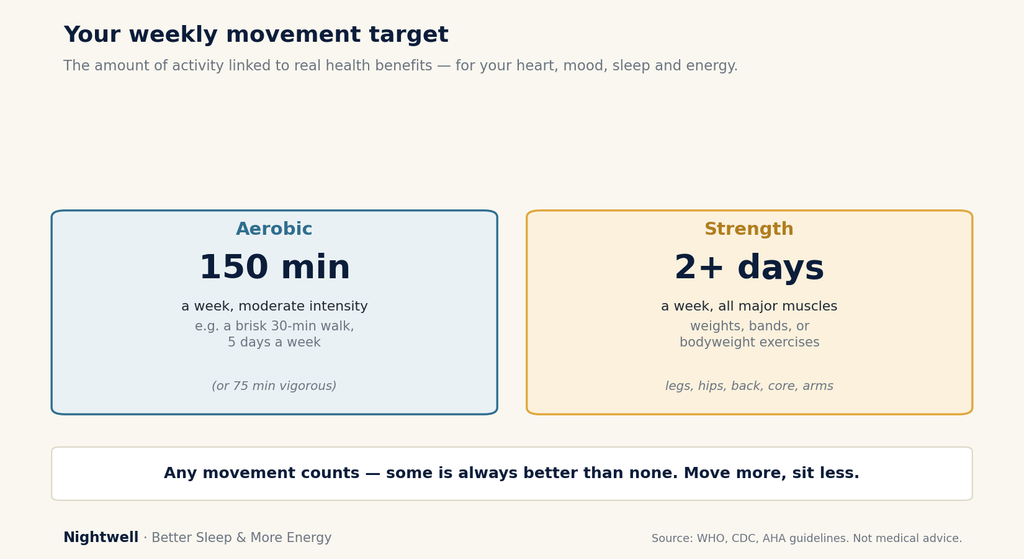
How much exercise do you actually need to be healthy? The official answer is clear and, reassuringly, quite modest: about 150 minutes of moderate activity a week — roughly a brisk 30-minute walk five days a week — plus muscle-strengthening exercise on two or more days. But the single most important message from every health body is even simpler: some is always better than none. You don’t need a gym membership, fancy equipment, or hours of your day. Any movement counts, the benefits start immediately, and even a little makes a real difference.
The guidelines, in plain English
The recommendations from the World Health Organization, the CDC, and the American Heart Association all line up, and they come in two parts.
Aerobic activity: aim for 150 to 300 minutes a week of moderate-intensity movement — anything that gets your heart rate up and leaves you a little breathless but still able to talk, like brisk walking, cycling, or swimming. The classic way to hit 150 minutes is 30 minutes, five days a week. Prefer higher intensity? You get the same benefit from 75 to 150 minutes of vigorous activity (jogging, running, a hard cycle), or any equivalent mix of the two.
Strength: on top of that, do muscle-strengthening activity on at least two days a week, working all the major muscle groups — legs, hips, back, core, chest, shoulders, and arms. This doesn’t mean a bodybuilder’s routine; it can be weights, resistance bands, or simple bodyweight exercises like squats, push-ups, and lunges. Strength training is the part people most often skip, but it’s essential — especially as we age, to protect muscle and bone.
“Some is better than none” — the rule that matters most
If 150 minutes feels daunting, here’s the liberating truth the guidelines now emphasise: you don’t have to hit the target to benefit. Adults who simply sit less and do any amount of moderate-to-vigorous activity gain real health benefits. The health payoff also starts immediately — you don’t have to wait weeks — and the old rule that exercise had to come in blocks of at least 10 minutes has been dropped: even short bursts count now. A brisk walk to the shops, taking the stairs, a few minutes of movement between tasks — it all adds up.
This matters because the biggest health gains come from moving from doing nothing to doing something. If you’re currently inactive, the most valuable step isn’t hitting 150 minutes — it’s simply starting, then building gradually. Every bit is a genuine win.
Why it’s worth it: the benefits
Few things you can do for your health pay off as broadly as regular movement. It:
- strengthens your heart and lowers blood pressure, cutting the risk of heart disease and stroke;
- lifts your mood and eases anxiety and depression — it’s one of the best-evidenced natural mood boosters there is;
- improves your sleep, helping you fall asleep faster and sleep more deeply, which we cover in exercise and sleep;
- boosts your day-to-day energy — counterintuitively, moving more leaves you less tired, which is why it tops the list in how to get more energy naturally;
- sharpens your brain, focus, and memory;
- helps manage weight and blood sugar and lowers the risk of type 2 diabetes and several cancers;
- and is strongly linked to a longer, healthier life.
And the benefits are for everyone — young and old, every fitness level, people who are pregnant or postpartum, and those living with chronic conditions or disabilities. Almost no one is excluded from the payoff of moving more.
How much is too much — and how much is optimal?
More activity brings more benefit, but with diminishing returns: the risk-reduction curve keeps improving up to around 300 minutes a week, then largely plateaus. So somewhere between 150 and 300 minutes of moderate activity a week is the sweet spot for most people — enough to capture the substantial benefits without needing to live at the gym. Going beyond that is fine and can bring extra gains, but you’re no longer chasing big health returns; you’re training for fitness or enjoyment. In other words, you don’t need to do huge amounts to be healthy.
Finding your intensity
You don’t need a heart-rate monitor to gauge intensity — use the “talk test”:
- Moderate intensity: you’re breathing harder and could talk, but not sing. A brisk walk is the classic example.
- Vigorous intensity: you’re breathing hard and can only manage a few words before pausing for breath, like jogging or a hard cycle.
Both count toward your weekly total — vigorous activity just gets you there in half the time.
How to actually fit it in
The guidelines can sound like a chore, but movement fits into real life more easily than you’d think:
- Break it up. You don’t need one long session. Three 10-minute walks a day gets you to 150 minutes over five days without ever “working out.”
- Build it into your day. Walk or cycle for transport, take the stairs, park further away, have walking meetings — this everyday movement counts just as much as a formal workout.
- Break up sitting. Long periods of sitting carry their own risks, so moving little and often through the day matters on top of your workouts — more in why sitting all day drains you.
- Start small and build. If you’re inactive, begin with a reachable goal — a 10-minute daily walk — and increase gradually. Consistency beats intensity, and it’s how you avoid injury and burnout.
- Pick things you enjoy. The best exercise is the one you’ll actually keep doing. Dancing, gardening, sport, swimming — it all counts.
A word on starting safely
Movement is safe and beneficial for the vast majority of people. But if you’re returning from an injury, living with a chronic condition, pregnant, or have been very inactive for a long time, it’s wise to start gently and, if in doubt, check with your doctor about what’s right for you. Build up your time and intensity gradually rather than going all-out on day one — that’s how you make it sustainable and stay injury-free.
The bottom line
You need less exercise than you probably fear to unlock huge health benefits: around 150 minutes of moderate movement a week plus a couple of strength sessions covers it, and more (up to about 300 minutes) adds a bit more. But don’t let the target intimidate you — the most important rule is that any movement beats none, the benefits begin right away, and every walk, stair climb, and stretch counts. Start where you are, choose activities you enjoy, build up gradually, and let movement do what almost nothing else can: protect your heart, lift your mood, deepen your sleep, and give you more energy for everything else.
This article is for general information and education and isn’t medical advice. If you have a health condition, an injury, are pregnant, or have been inactive for a long time, please talk to a qualified healthcare professional before starting a new exercise routine.
Sources: CDC — Physical Activity Guidelines for Adults; American Heart Association — Recommendations for Physical Activity; Physical Activity Guidelines for Americans, 2nd edition
Comments on “How Much Movement Do You Actually Need?”