
The short answer
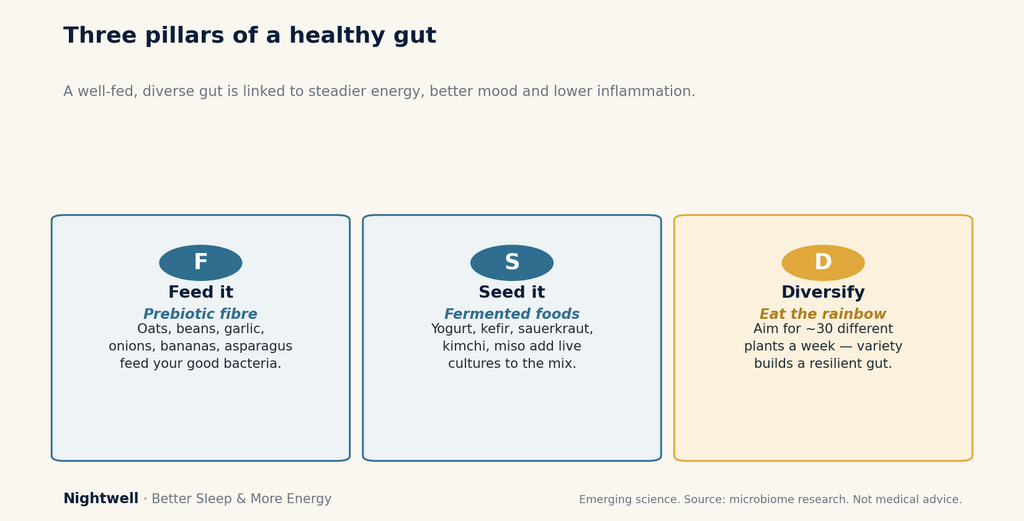
Your gut is home to trillions of bacteria — your microbiome — and a growing body of research links a healthy, diverse gut to steadier energy, better mood, and lower inflammation. The science is genuinely exciting, but it’s also young, so it’s worth being honest: looking after your gut is a smart, low-risk thing to do, but it isn’t a magic switch that fixes fatigue on its own. The practical advice is refreshingly simple and comes down to three things — feed your gut bacteria with fibre, add live cultures from fermented foods, and eat a wide variety of plants.
What the gut microbiome actually is
Your large intestine hosts a vast community of bacteria, along with other microbes, that weigh in total a surprising amount and outnumber your own cells. Far from being passive passengers, they earn their keep: they help digest food your body can’t break down on its own, produce certain vitamins, train your immune system, and manufacture chemical messengers that talk to the rest of your body — including your brain. The health of this community depends heavily on what you feed it, which is why diet is the single biggest lever you have over your gut.
The key concept is diversity. A gut with many different beneficial species tends to be more resilient and is associated with better health, while a narrow, depleted microbiome — the kind encouraged by a diet of ultra-processed food and sugar — is linked to inflammation and a range of problems.
How your gut connects to your energy
Here’s where honesty matters, because this area attracts a lot of overselling. There are several plausible, research-backed ways your gut can influence how energetic you feel:
- Short-chain fatty acids. When gut bacteria ferment fibre, they produce compounds like butyrate that reduce inflammation, strengthen the gut lining, and play a role in energy metabolism. Low production of these is associated with fatigue in some studies.
- The gut barrier. A healthy gut lining keeps things where they belong. When it becomes more permeable, low-grade inflammation can follow — and chronic inflammation is tiring. Researchers are actively investigating this link to fatigue, though it isn’t fully proven.
- The gut-brain axis. Your gut and brain are in constant two-way communication, and gut bacteria influence the production of neurotransmitters that affect mood and alertness. This is one reason gut health, mood, and energy tend to move together.
- Nutrient absorption. A healthy microbiome helps you extract and use nutrients — including some, like folate, that are directly involved in energy metabolism.
But here’s the honest caveat, and a good gut-health article has to include it: much of this evidence is still mechanistic, observational, or from animal studies. There’s no proof that tweaking your microbiome will reliably make you more energetic, and no probiotic is a treatment for chronic fatigue. For everyday energy, the well-established basics — enough sleep, good nutrition, exercise, and hydration — remain more directly important than trying to engineer your gut. A healthy gut supports those foundations; it doesn’t replace them. If you’re constantly tired even after a full night in bed, your gut is one piece of a much bigger picture.
Pillar 1: Feed it — fibre and prebiotics
The most powerful thing you can do for your gut is feed the good bacteria the fibre they thrive on. Prebiotics are simply the types of fibre your bacteria ferment — found in oats, beans and lentils, garlic, onions, leeks, asparagus, bananas, and whole grains. This is exactly why fibre matters so much, and it’s the same fibre that steadies your blood sugar; we go deeper in fibre 101. Since most people eat only about half the fibre they should, feeding your gut better is one of the highest-impact, easiest wins available.
Pillar 2: Seed it — fermented foods
While prebiotic fibre feeds your existing bacteria, fermented foods introduce live cultures directly. Yogurt, kefir, sauerkraut, kimchi, miso, tempeh, and kombucha all contain live microorganisms, and whole fermented foods have a nice advantage over isolated probiotic pills: they deliver a diverse mix of microbes plus beneficial compounds and often prebiotic fibre in the same package, working together. One study in older adults even linked higher intake of live-microbe-containing foods with less fatigue — though, being observational, it shows association rather than proof.
If fermented foods are new to you, start small (a couple of spoonfuls of sauerkraut, a small glass of kefir) and build up, since a sudden large increase can cause temporary bloating as your gut adjusts.
Pillar 3: Diversify — eat the rainbow
The gut principle that surprises people most is that variety matters as much as quantity. Different plants feed different bacteria, so a monotonous diet — even a “healthy” one built on the same few foods — supports a narrower microbiome than a varied one. A widely cited target from microbiome researchers is to aim for around 30 different plant foods a week. That sounds like a lot until you realise it counts fruits, vegetables, whole grains, beans, lentils, nuts, seeds, herbs, and spices — a handful of mixed nuts and a few herbs on your dinner already add several. A diverse, high-fibre plant-based diet has been shown in a randomised trial to improve microbiome composition and even self-reported energy and hunger. It’s a genuinely useful, motivating way to think about eating: not “cut things out,” but “add more variety in.”
What harms your gut
Alongside the things that help, a few habits work against a healthy microbiome:
- A diet high in ultra-processed food and added sugar, which feeds less desirable bacteria and crowds out fibre — another reason to work on cutting back on sugar.
- Very low fibre intake, which starves your beneficial bacteria.
- Unnecessary antibiotics, which wipe out good bacteria along with bad (take them when genuinely needed, but not casually).
- Chronic stress and poor sleep, both of which are linked to less favourable gut profiles — the gut and the rest of your health are deeply intertwined.
What about probiotic supplements?
Probiotic pills are everywhere, and the honest verdict is: the evidence is mixed. Some strains help with specific issues for some people, but there’s no strong case that a general probiotic supplement will boost a healthy person’s energy. For most people, whole fermented foods and a fibre-rich, diverse diet do more — and cost less — than a supplement. Treat probiotics as an optional extra, not the main event, and food-first as the reliable strategy.
The bottom line
A healthy gut is a worthwhile foundation for feeling good — it’s linked to steadier energy, better mood, and lower inflammation — but it works best as part of the whole picture, not as a shortcut around sleep, exercise, and balanced meals. The action plan is simple and low-risk: feed your bacteria with plenty of fibre, seed your gut with fermented foods, and diversify by eating a wide range of plants each week. Do that consistently, go easy on ultra-processed food and sugar, and you give one of your body’s most important systems exactly what it needs — while keeping realistic expectations about what the science can and can’t yet promise.
This article is for general information and education and isn’t medical advice. Persistent fatigue or digestive problems can have medical causes, so if they last or concern you, please talk to a qualified healthcare professional.
Sources: Gut Health and Energy Levels: What Does Science Say?; Gut Health and Fatigue: How Your Microbiome Affects Energy; Fermented Foods and Gut Health (peer-reviewed review)