
The short answer
Weighted blankets can genuinely help some people feel calmer and sleep better — but the science behind the marketing is thinner than the glossy product pages suggest. The honest summary: strongest evidence for people dealing with anxiety or insomnia alongside another condition, much weaker evidence that they do anything measurable for an already-good sleeper. They’re low-risk and, for many, a pleasant “expensive hug.” Just don’t expect a cure.
How they’re supposed to work
A weighted blanket is a regular-looking blanket filled with glass beads or pellets, typically weighing somewhere between about 5 and 30 pounds (2 to 13 kg). The idea is deep pressure stimulation — gentle, even pressure across the body that mimics the feeling of being held or hugged. That sensation is thought to nudge the nervous system out of “fight or flight” and toward “rest and digest,” lowering the physical arousal that keeps a racing mind awake.
What the evidence actually shows
Here’s where honesty matters, because this is a health decision and you deserve the real picture rather than the sales pitch.
For people with clinical conditions, the results are genuinely promising. A number of studies — including a randomized trial in adults with insomnia plus conditions like depression, ADHD, or generalized anxiety — found that weighted blankets reduced insomnia severity and improved sleep and mood. Reviews of the research consistently point to a real calming effect on anxiety, which is often what’s standing between an anxious person and sleep.
For healthy people with no underlying condition, though, the benefits are much harder to prove. Reviewers note that a good chunk of the available studies don’t meet high quality standards, and there’s little strong evidence that a weighted blanket measurably improves sleep for someone who sleeps reasonably well already. In children, the picture is even less clear, and some apparent benefit may come down to a placebo effect — which isn’t nothing, but isn’t what the packaging implies.
So: a weighted blanket is best understood as a comforting sleep aid that helps some people feel more settled at bedtime — not a treatment. If your real problem is chronic insomnia, it shouldn’t be your frontline fix (more on that below).
If you want to try one: how to choose
The most common guideline is to pick a blanket around 10% of your body weight. It’s a rule of thumb, not a precise prescription, but it’s a sensible starting point — heavy enough to feel like reassuring pressure, not so heavy it feels trapping.
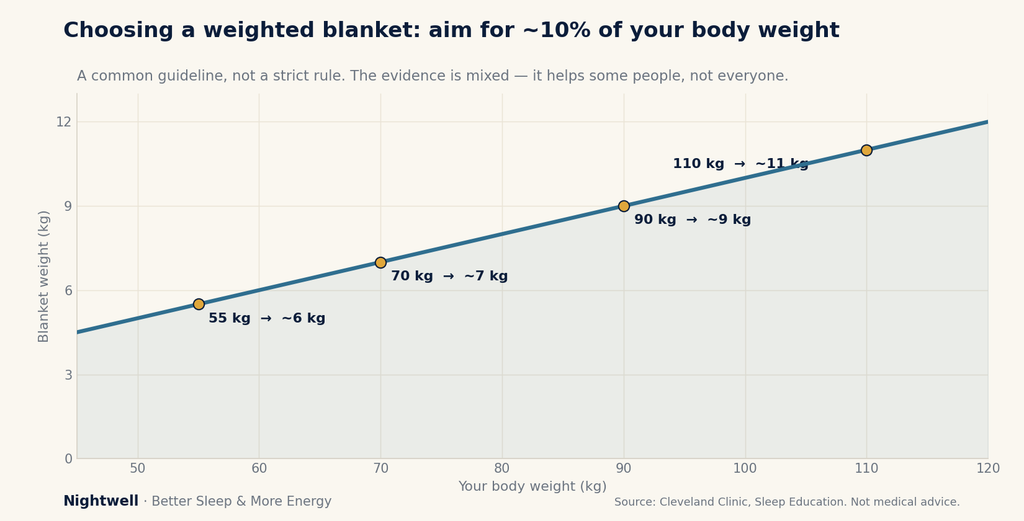
A few practical notes:
- Breathability matters. A dense blanket traps heat, and an overheated bed is its own sleep problem — pair it with a cool bedroom and breathable bedding, or look for a cooling-fabric version.
- Give it a couple of weeks. The first night can feel strange. If it still feels oppressive rather than comforting after a fair trial, it’s simply not for you.
- Not for everyone. Weighted blankets aren’t recommended for infants and young toddlers, or for people with certain respiratory or circulatory conditions. If you’re unsure whether it’s safe for you, check with your doctor first.
When to look past the blanket
If you’re reaching for a weighted blanket because you regularly can’t fall or stay asleep, it’s worth naming what the research keeps pointing to: for ongoing insomnia, the most effective treatment isn’t a product at all, but cognitive behavioral therapy for insomnia (CBT-I). A blanket might make bedtime feel nicer; it won’t fix the underlying habits and thought patterns that drive chronic sleeplessness. And plenty of higher-impact basics cost nothing — a consistent wake time, an evening wind-down routine, and getting enough hours for your age all do more heavy lifting than any single gadget.
The bottom line
Weighted blankets are a reasonable, low-risk thing to try, especially if anxiety is part of what keeps you up — and if the gentle pressure helps you feel calmer, that’s a real benefit worth having. Just go in with clear eyes: it’s a comfort aid, not a proven cure, the honest evidence is mixed, and it works best alongside the fundamentals rather than instead of them.
This article is for general information and education and isn’t medical advice. If you have ongoing sleep problems or a health condition, please talk to a qualified healthcare professional before relying on any sleep aid.
Sources: Cleveland Clinic — Weighted Blanket Benefits; AASM Sleep Education — Do Weighted Blankets Help?; The Conversation — What the Evidence Shows