
Flow is the only kind of hard work that gives you energy back.
Most concentrated effort drains you. An afternoon of emails, meetings and constant switching leaves you tired in a way that has nothing to do with how much you got done. But everyone has had the other kind of session too — the one where you look up, two hours have gone, the work is good, and you feel oddly better than when you started.
That’s flow. Musicians get it, climbers get it, programmers, cooks, gardeners and writers get it. Psychologist Mihály Csíkszentmihályi spent decades studying it and found the experience is remarkably similar whatever people are doing: total absorption, no self-consciousness, a sense of control, and time behaving strangely. The good news is that it isn’t luck. It follows rules, and you can set things up so it happens more often.
The one idea that explains most of it
Csíkszentmihályi’s first book on the topic was called Beyond Boredom and Anxiety, and the title is basically the whole theory. When a task is too easy for your skill, you get bored and drift. When it’s too hard, you get anxious and stall. Flow happens in the band between the two — when the challenge is just a little beyond what feels comfortable.
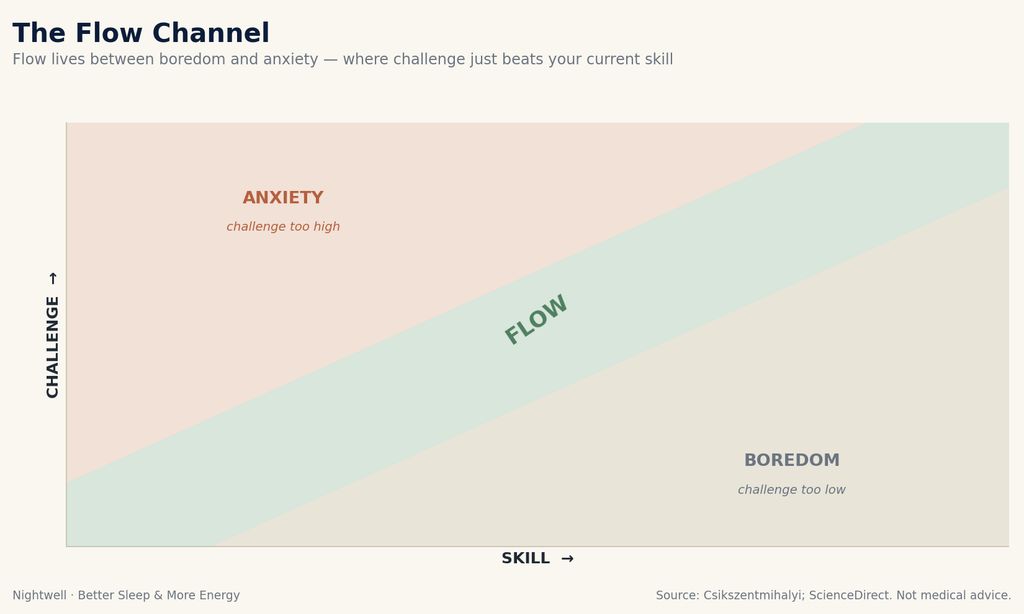
This is more practical than it sounds, because it tells you what to change. If you can’t concentrate, the question isn’t “what’s wrong with me?” It’s “is this too easy or too hard right now?” — and both have fixes. Csíkszentmihályi even found factory workers reaching flow on repetitive assembly-line jobs by turning them into personal challenges: beating their own time, perfecting a movement. You can manufacture challenge.
Flow won’t come? Work out why
When a session isn’t working, it’s almost always one of a handful of problems. Find the one that sounds like you:
| What you notice | What’s usually wrong | What to try |
|---|---|---|
| Restless, bored, keep drifting to your phone | The task is too easy | Add a constraint: a tighter deadline, a higher standard, a personal target to beat |
| Tense, overwhelmed, can’t get started | The task is too hard or too vague | Shrink it: one small, concrete piece you can actually finish in this session |
| You start, then get pulled out every few minutes | Interruptions | Phone in another room, notifications off, one window open, door closed |
| You feel it building, then the session ends | Not enough time | Block 60–90 minutes; don’t book anything right after |
| Foggy, heavy, nothing sticks | You’re tired | No technique fixes this — sleep and rest first |
| You keep checking whether it’s good yet | Self-judgement | Aim for a rough first version; edit later, in a separate session |
Interruptions deserve a special mention. Flow is fragile, and a single notification can knock you out of it completely — then you have to build back up from the start. Doing several things at once is its natural enemy, for reasons we explain in why multitasking hurts your focus.
What a good flow session actually looks like
Before you start (5 minutes). Decide one specific goal for this session. Not “work on the report” — “write the section on costs.” Clear the desk and the screen. Put the phone somewhere you’d have to get up to reach. If you have a small routine that signals “now I’m working” — the same playlist, a coffee, the same seat — use it.
The first 10–15 minutes feel bad. This is the part that makes people give up. It feels effortful, slightly boring, and nothing like “the zone.” That’s normal. It’s the on-ramp, not a sign that flow isn’t coming. Keep bringing your attention back to the task each time it wanders, without scolding yourself for wandering.
Somewhere after that, it tips. You stop noticing yourself working. The next step seems obvious. If you get here, protect it. This is also where strict timers can work against you — a bell after 25 minutes may pull you out just as you’ve arrived. We look at how to handle that in our piece on the Pomodoro Technique. Our view: if it’s going well, let it run.
Stop before you’re empty. Flow can carry you past the point where you’d normally notice being tired. Ending a session while you still know what the next step would be makes the next start far easier.
Flow vs “deep work”
The two terms get mixed up. Deep work is a habit — deliberately scheduling long, undistracted blocks for demanding tasks. Flow is a state of mind that can happen inside those blocks when the conditions are right. Deep work is the runway; flow is the take-off. Plenty of good deep-work sessions never quite reach flow, and that’s fine. Focused effort is valuable on its own. Flow is the bonus. For the wider set of habits that support focus in general, see our guide on improving focus and concentration.
Why you can’t chase it
The strange thing about flow is that the harder you try to get into it, the less likely it becomes. Watching yourself — “am I in flow yet?” — is exactly the self-awareness that flow switches off. So don’t aim for flow. Aim for the conditions, then aim your attention at the work. If flow comes, it comes as a side effect.
This is also why perfectionism is such a flow-killer. If every sentence, line of code or brushstroke has to be judged as you go, you stay in your head. Separating “make it” from “judge it” — a rough draft now, edits later — is one of the simplest ways to get out of your own way.
A tired brain can’t flow
Here’s the part productivity advice tends to skip. Every one of these conditions depends on having enough mental energy to begin with. When you’re short on sleep, focus is harder, frustration comes sooner, and the warm-up period can feel impossible to push through. No technique fixes that.
If flow used to come easily and now it doesn’t, look at your sleep before you look at your methods — starting with how much sleep you actually need. Steady energy across the day helps too; we cover the basics in how to get more energy naturally.
Flow isn’t a productivity hack. It’s closer to a reward for getting the basics right: a rested brain, a clear goal, a task that stretches you, and some time nobody else gets to interrupt. Set that up a few times a week, and you’ll find yourself looking up at the clock surprised far more often.
General information, not medical advice. If you consistently can’t concentrate or engage with tasks and it’s affecting your daily life, it’s worth speaking to a healthcare professional.
Background reading: Positive Psychology on Csíkszentmihályi and flow · ScienceDirect — flow theory overview · NIH/PMC — neurophysiological research on flow