
The short answer
“Cardio or weights?” is one of the most common fitness questions — and it’s the wrong question. The honest answer is both. Cardio and strength training do genuinely different jobs: cardio powers your heart, lungs, and endurance, while strength builds your muscles, bones, and metabolism. Neither replaces the other, and the research is clear that combining them beats doing either alone — for fitness, for fat loss, and even for how long you live. So rather than picking a side, the smart move is to fit a bit of each into your week. Here’s how they differ and how to balance them.
What cardio does best
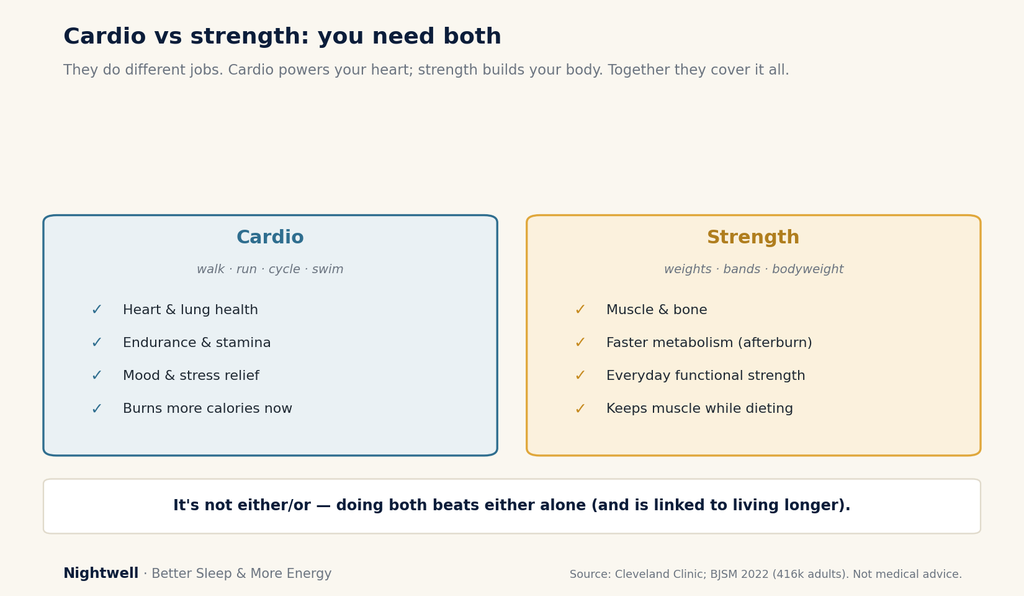
Cardiovascular exercise — walking, running, cycling, swimming, anything that raises your heart rate and keeps it up — trains your heart and lungs. Its standout benefits:
- Heart and lung health: it strengthens your cardiovascular system, improves circulation, and lowers blood pressure and heart-disease risk.
- Endurance and stamina: it makes everyday exertion — stairs, carrying, keeping up with kids — feel easier.
- Mood and energy: it’s a reliable stress-reliever and mood-booster, and a genuine energy lift.
- Calorie burn in the moment: minute for minute, cardio typically burns more calories than basic strength work — a hard run or cycle can top the calorie-burn charts.
Our deep dive on the most accessible form of cardio — walking — shows how much you get from even gentle aerobic activity.
What strength training does best
Strength (resistance) training — weights, bands, or bodyweight moves — works in short, muscle-testing bursts, and it delivers things cardio simply can’t:
- Muscle and bone: it builds and preserves muscle and stimulates your bones to stay dense — the key defence against the muscle and bone loss that come with age.
- A faster metabolism: muscle is metabolically active, and there’s an “afterburn” effect — your metabolism can stay elevated for roughly 36 to 48 hours after an intense strength session, so you keep burning extra calories at rest.
- Functional strength and body shape: it makes you stronger for real life and gives you a leaner, more toned appearance.
- Protecting muscle while losing fat: when you’re eating less to lose weight, strength training tells your body to shed fat rather than muscle.
If you’re new to it, strength training for beginners shows how to start with no gym at all.
The verdict: it’s not either/or
Here’s why the “versus” framing fails. Because cardio and strength target different systems, the best results come from doing both. A large 2022 study of over 400,000 adults found that people who combined cardio and strength training had a lower risk of dying than those who did cardio alone. For fat loss, the combination wins too: cardio burns calories during the workout, while strength preserves the muscle that keeps your metabolism up — so together they build a leaner, stronger body that’s easier to maintain. As one clinic bluntly put it: you can’t go wrong with either, so don’t overthink it — just do some of each.
Which should you emphasise for your goal?
You need both, but you can tilt the balance toward what matters most to you:
- Heart health and stamina: lean a little more into cardio.
- Building muscle, strength, or a toned shape: make strength the priority.
- Losing fat: strength is the foundation (it preserves muscle and metabolism), with cardio added to accelerate the calorie burn — but remember the biggest driver of weight loss is your diet, not either type of exercise. “Cardio equals weight loss” is a myth; you burn calories all day just living.
- Healthy ageing and longevity: do both — and note that strength training becomes especially important for women through perimenopause and menopause, when muscle and bone loss accelerate.
How to balance both in a week
You don’t need to live in the gym. A simple, balanced week that covers the official guidelines (150 minutes of aerobic activity plus two strength sessions, from how much movement you actually need) might look like:
- 2–3 strength sessions a week, covering all major muscle groups, on non-consecutive days.
- 2–3 cardio sessions a week — a mix of moderate (brisk walking) and, if you like, some vigorous (running, cycling).
- Daily walking and general movement woven through your day.
- At least one full rest or active-recovery day — because, as we cover in rest days and recovery, that’s when your body actually adapts.
A classic template: strength on Monday, Wednesday, and Friday; cardio on Tuesday and Saturday; Sunday off. Adjust to fit your life — the best split is the one you’ll actually follow.
Same day or separate? And what order?
Two practical questions come up a lot:
Can I do both on the same day? Yes — just manage your overall intensity and volume so you don’t overdo it. You can also combine them: high-intensity interval training (HIIT) blends cardio and strength into one efficient session, handy when you’re short on time.
Which comes first? Do whichever matches your priority first, while you’re fresh. If your main goal is building strength or losing fat, many experts suggest lifting weights before cardio, so your strength work gets your best energy. And don’t worry about the old fear that cardio “kills” muscle gains — moderate cardio done alongside strength training won’t undermine your results.
Common mistakes to avoid
A few traps catch people trying to balance the two. The first is doing only what you already like — the runner who never lifts, or the lifter who never gets out of breath. It’s natural to gravitate to your favourite, but skipping one type entirely leaves a real gap in your fitness. The second is going all-in on cardio for weight loss while neglecting strength; without resistance training, a lot of the weight you lose can come from muscle, which slows your metabolism and makes the loss harder to keep off. The third is overtraining — cramming in daily hard cardio and heavy lifting with no rest, which leads to fatigue and injury rather than faster results. And finally, women often avoid weights fearing they’ll get “bulky” — a myth, since building large amounts of muscle takes years of dedicated training; what strength work actually gives most women is a leaner, stronger, more defined body and vital protection for their bones. Sidestep these, keep both types in your week, and you’ll get far more from your effort.
The bottom line
Stop treating cardio and strength as rivals — they’re partners. Cardio looks after your heart, lungs, endurance, and mood and burns calories in the moment; strength builds muscle and bone, revs your metabolism, and keeps you strong and capable for life. The evidence is emphatic that combining them delivers the best results, from fat loss to longevity. So aim for a couple of strength sessions and a couple of cardio sessions each week, keep walking daily, take your rest days, and tilt the mix toward whatever goal matters most to you. Don’t overthink it — the winning strategy is simply to do both, consistently.
This article is for general information and education and isn’t medical advice. If you have a health condition or have been inactive for a long time, please talk to a qualified healthcare professional before starting a new exercise programme.
Sources: Cleveland Clinic — Cardio vs Strength Training; Nike — Benefits of Cardio vs Strength Training (BJSM 2022 study); Sharp HealthCare — Cardio vs Strength Training