
Advertising disclosure: This article contains affiliate links. If you buy through one, Nightwell may earn a small commission at no extra cost to you. We only link to products we believe genuinely fit the advice on this page.
The short answer
If you’re clocking a full eight hours and still waking up exhausted, the problem usually isn’t how long you slept — it’s how well. Sleep quality matters as much as quantity, and eight fragmented, shallow hours can leave you more tired than six solid ones. The good news is that a lot of what wrecks sleep quality is fixable. The important part is knowing when it’s a habit to change and when it’s a sign to see a doctor.
Hours in bed aren’t hours of rest
You can spend eight hours in bed and get far less genuine, restorative sleep than that number suggests. Every night you cycle through light sleep, deep sleep, and REM — and it’s the deep and REM stages that actually restore you. If your night is repeatedly interrupted, even by brief awakenings you don’t remember, you never bank enough of those restorative stages.
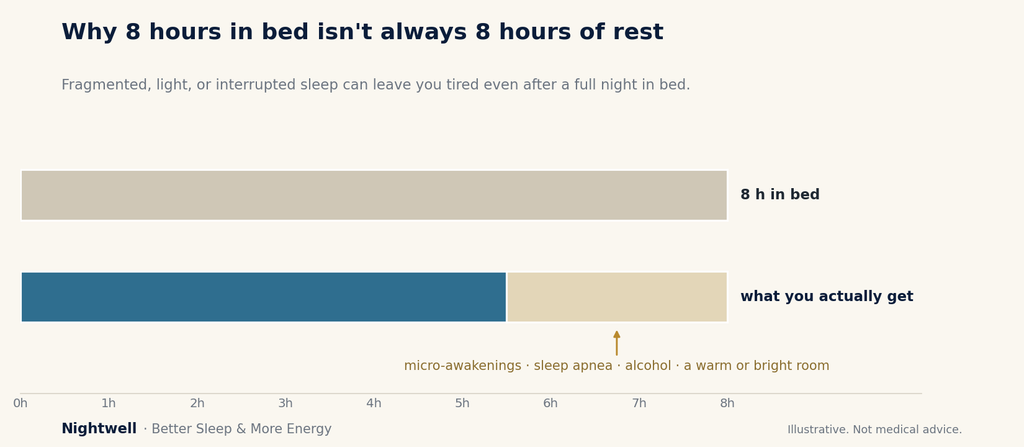
This is called sleep fragmentation, and the tricky part is that it’s often invisible: you can have dozens of “micro-awakenings” an hour without ever consciously waking up. The clock says eight hours; your brain got a fraction of the deep rest it needed.
The fixable causes
Start here, because for many people the answer is a habit or an environment issue, not a medical one:
- Alcohol. A nightcap helps you fall asleep but is a major disruptor of the second half of the night, fragmenting sleep as your body processes it.
- Late caffeine. It lingers for hours and quietly lightens your sleep even when you fall asleep fine — see when to stop drinking coffee.
- A room that’s too warm, bright, or noisy. Each of these nudges you out of deep sleep. Keeping the bedroom cool and truly dark makes a real difference.
- Screens and stress at bedtime. Both keep your brain in a state that resists deep sleep. An evening wind-down routine helps here.
- An irregular schedule. Going to bed and waking at wildly different times — especially catching up on weekends — leaves your body clock confused and your sleep less efficient.
A physical cause worth ruling out: your mattress
The fragmentation this article is about — the tossing, the pressure points, the micro-awakenings you don’t remember — can come straight from a mattress that’s sagging or past its best. No habit fixes a worn-out surface. If yours is years old and you wake sore or restless, a new mattress is one of the few pieces of kit genuinely worth the money; the one we’d point people to is Luxe’s LuxeTherm mattress. But if your mattress is still in good shape, put your effort into the habits above first — they cost nothing.
The sleep-timing trap
Sometimes it’s not your sleep that’s broken, it’s your timing. If you’re sleeping out of sync with your natural rhythm — forcing an early bedtime when your body runs late, or waking mid-cycle to a jarring alarm — you can hit eight hours and still feel foggy. That heavy, groggy feeling right after waking is called sleep inertia, and it’s worse when an alarm pulls you out of deep sleep. Shifting your schedule gradually, by 15–30 minutes at a time, and keeping a consistent wake time can help realign things. And make sure eight hours is even right for you — the amount you need shifts with age.
When it’s time to see a doctor
If you’ve cleaned up the habits and the environment and you’re still exhausted after a fair few weeks, it’s worth getting checked — because persistent, unrefreshing sleep can point to something treatable. Common medical causes include:
- Sleep apnea, where breathing repeatedly pauses and jolts you out of deep sleep, often without you knowing. Loud snoring, or gasping or choking in the night, are classic red flags.
- Iron deficiency or anemia, thyroid problems, or blood-sugar issues, all of which can drain energy regardless of sleep.
- Depression and anxiety, which often show up as exhaustion and unrefreshing sleep rather than obvious low mood.
See a doctor sooner rather than later if your fatigue is paired with loud snoring and gasping, severe daytime sleepiness, morning headaches, unexplained weight changes, or a persistent low mood. These are worth investigating, not pushing through.
The bottom line
Being tired after eight hours is your body telling you the quality of those hours fell short. Most of the time the fix is within reach: cut late alcohol and caffeine, cool and darken the room, wind down properly, and keep a steady wake time. Give those a genuine try — and if the exhaustion won’t budge, treat it as a signal worth taking to a professional rather than a personal failing.
This article is for general information and education and isn’t medical advice. Persistent daytime fatigue can have medical causes, so if it lasts or comes with any of the red flags above, please talk to a qualified healthcare professional.
Sources: Dr. Wendy Troxel (RAND) — quality vs quantity; Sleep Foundation — Sleep Hygiene
Comments on “Why You’re Tired Even After 8 Hours of Sleep”