
The short answer
If high-impact exercise like running or jumping isn’t for you — because of achy joints, an old injury, extra weight, age, or simply preference — you have not lost the ability to get genuinely fit. Low-impact exercise is gentle on your joints while delivering all the cardiovascular, strength, and mood benefits your body needs. And here’s the myth that trips everyone up: “low impact” does not mean “low intensity.” Swimming hard, spinning, or rowing can leave you every bit as breathless and strong as high-impact training — without the pounding. It’s one of the most underrated, sustainable ways to move.
What “low impact” actually means
Low-impact exercise refers to activities that minimise the jarring, shock-like force on your joints — your knees, hips, ankles, and spine. The defining feature is that there’s little or no jumping or hard landing: at least one foot (or a support like water, a machine, or a chair) stays in contact throughout the movement. Contrast that with high-impact activities like running or jumping, where both feet leave the ground and land with force that travels up through your joints. That repeated pounding is what can lead to chronic joint pain and overuse injuries over time — and it’s exactly what low-impact exercise avoids.
The myth: low impact = low intensity
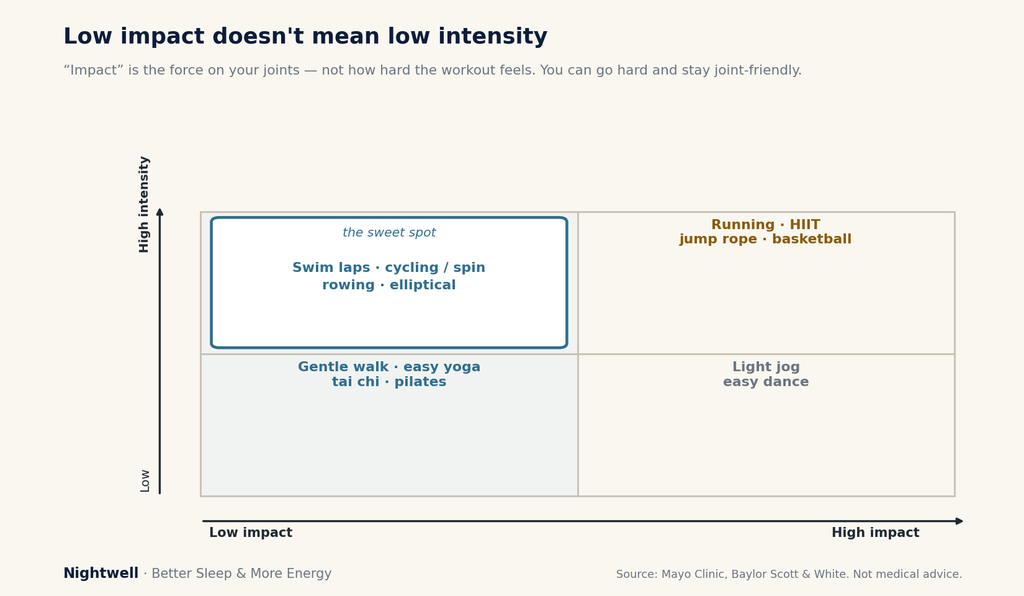
This is the single biggest misconception, so let’s kill it. “Impact” describes the force on your joints, not how hard the workout feels. These are two completely different things. As the matrix above shows, you can absolutely have low-impact and high-intensity at the same time — think of swimming laps until your lungs burn, a hard spin class, or an all-out rowing session. Your heart is pounding, your muscles are working, you’re dripping with sweat — and your joints never take a single jarring blow. Studies confirm that cycling, swimming, and strength training build muscle and cardiovascular fitness just as effectively as higher-impact workouts. So you never have to choose between protecting your joints and getting a serious workout. You can have both.
Why low-impact exercise is so good for you
The benefits go well beyond being kind to your knees:
- Joint protection: it slashes the jarring forces that lead to pain and injury in your knees, hips, ankles, and spine — opening up fitness to people with arthritis, joint replacements, or old injuries.
- Fewer injuries: with less strain on your body, you’re less likely to suffer acute injuries like sprains, strains, and stress fractures.
- Full cardiovascular benefits: it strengthens your heart, lowers blood pressure, improves cholesterol, and builds stamina — just like high-impact cardio.
- Strength and weight management: it builds muscle and burns calories; and because it’s gentler, you can often go for longer, adding up to a significant cumulative burn.
- Mood and mental health: like all exercise, it lifts mood and eases anxiety and depression — with less risk of the burnout that comes from constantly hammering your body.
- Sustainability: perhaps the biggest win. Because it’s comfortable and injury-sparing, it’s far easier to stick with long-term — and consistency is what actually delivers results.
Who is it for?
Almost everyone can benefit, but it’s especially valuable if you’re:
- Managing arthritis or joint pain. It might feel counterintuitive, but movement actually eases arthritis stiffness — the Mayo Clinic notes that strong muscles support and protect your joints, while not exercising weakens them and makes pain worse.
- Older, and wanting to stay active, strong, and balanced without high injury risk.
- Carrying extra weight, where high-impact activity puts more strain on joints.
- Recovering from an injury or returning after a long break, when a gentle on-ramp is exactly what’s needed.
- Pregnant or newly postpartum (with your doctor’s okay).
- A beginner, or simply someone who dislikes the pounding of running.
The best low-impact exercises
- Walking — the simplest of all, free and joint-friendly, and hugely beneficial in its own right, as we cover in walking benefits.
- Swimming and water aerobics — possibly the ultimate low-impact workout. Water supports your body and removes almost all joint stress while its resistance works your muscles — ideal for arthritis and joint replacements.
- Cycling — on a road bike, stationary bike, or in a spin class. It builds the muscles that support your knees and can be as gentle or as brutal as you like.
- Elliptical and rowing machines — full-body cardio with no pounding.
- Yoga and Pilates — build strength, flexibility, core stability, and balance, often from seated or lying positions that limit joint stress.
- Tai chi — “meditation in motion,” excellent for balance, fall prevention, and calm, and especially popular with older adults.
- Strength training — with light weights, bands, or bodyweight, it’s low-impact and builds the muscle that protects your joints.
How to build a low-impact routine
You can meet the standard activity guidelines — around 150 minutes of moderate activity a week plus a couple of strength sessions, from how much movement you actually need — entirely with low-impact exercise. Mix and match to keep it fresh: perhaps a few brisk walks, a swim, and a strength session across the week. Use the “talk test” for intensity — aim for a level where your breathing is harder than usual but you can still talk. And remember the golden rule from arthritis research: consistency matters more than intensity. Even moderate, regular movement eases pain, lifts mood, and improves fitness. Start gently, do a little each day if that’s easier on your joints, and build from there.
The bottom line
Low-impact exercise is proof that you don’t have to punish your joints to get fit. By keeping the jarring forces low while letting the intensity be whatever you choose, it delivers the full package — a healthier heart, stronger muscles, better mood, and easier weight management — in a form that’s kind to your body and easy to sustain for life. Whether you’re managing arthritis, easing back in after time off, or simply prefer not to pound the pavement, activities like swimming, cycling, walking, and yoga have you covered. Don’t mistake “gentle on the joints” for “not a real workout” — go as hard as you like, and let your joints thank you.
This article is for general information and education and isn’t medical advice. If you have arthritis, a joint condition, an injury, are pregnant, or have any health concern, please talk to a qualified healthcare professional before starting a new exercise programme.
Sources: Mayo Clinic — Exercise Helps Ease Arthritis Pain and Stiffness; Baylor Scott & White — 10 Joint-Friendly Low-Impact Workouts; Low Impact vs Low Intensity: The Myth Explained
Comments on “Low-Impact Exercise: Gentle on Joints, Great for You”