
The short answer
If you’ve ever felt clearer, calmer, and lighter after a walk or a workout, that wasn’t your imagination — it’s some of the most robust science in health. Exercise is one of the most powerful, well-evidenced things you can do for your mood: it eases stress and anxiety, lifts low mood, and for mild-to-moderate depression it can be as effective as medication. And you don’t need to punish yourself to get the benefit — even a 10-minute walk shifts your mood, and consistency matters more than intensity. Here’s what’s happening in your brain when you move, and how to use it.
What movement does to your brain
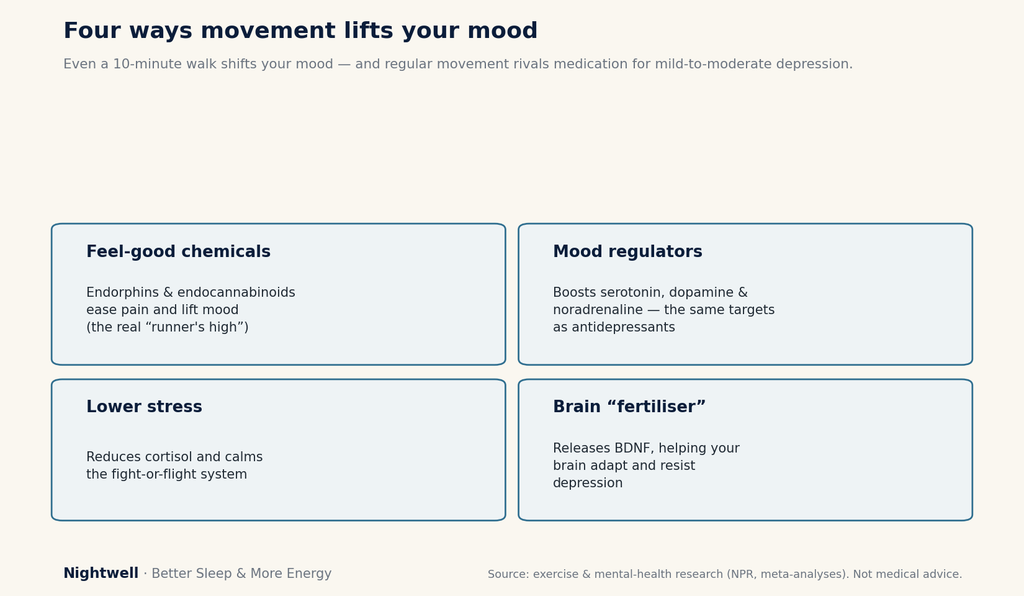
The mood boost from exercise isn’t vague “feel-good” hand-waving — it comes from several concrete changes in your brain chemistry, all happening at once.
Feel-good chemicals. Exercise releases endorphins, your body’s natural mood-lifters and painkillers. And here’s a recent update to the science: the famous “runner’s high” turns out to owe even more to endocannabinoids — your body’s own version of the calming compounds in cannabis — than to endorphins. Reviews of the research consistently find these rise after moderate exercise and are linked to reduced anxiety and a sense of euphoria and ease.
Mood-regulating neurotransmitters. Movement boosts serotonin, dopamine, and noradrenaline — the very same brain chemicals that antidepressant medications target. In other words, exercise nudges your brain chemistry in a similar direction to the drugs used to treat depression.
Lower stress. Exercise dials down cortisol, your main stress hormone, and calms an overactive “fight or flight” system. A 2025 review of dozens of trials confirmed that exercise significantly reduces cortisol in people under psychological distress. That’s why a workout can melt away a stressful day — the same principle behind managing stress and burnout.
Brain growth. Perhaps the most remarkable effect: exercise triggers a protein called BDNF, which one researcher memorably calls “Miracle-Gro for the brain.” Depression is thought to make the brain less adaptable, or “plastic”; BDNF helps it grow new connections and adapt, which may be a core reason exercise works against depression over time.
It’s not just chemistry
Beyond the neurochemistry, exercise lifts mood through everyday psychology too. Meeting even small movement goals builds confidence and self-esteem — a sense of “I can do this.” Group activities and classes add social connection, itself a powerful buffer against low mood. Exercise offers healthy distraction from worries and rumination. And it improves your sleep, which feeds directly back into better mood and energy. All these threads weave together, which is why movement sits at the heart of the energy-and-mood loop: it’s one of the most reliable ways to turn that loop in the right direction.
Just how effective is it?
Very. This isn’t a nice-to-have — the evidence is strong enough that exercise is increasingly recognised as a genuine treatment. Research widely reported in 2026 found exercise can relieve depression about as effectively as antidepressant medication, and it’s a low-cost, accessible option with a long list of side benefits instead of side effects. That’s a genuinely hopeful message: one of the best tools for your mental health is available to almost everyone, for free.
How much do you actually need?
Far less than you might fear. Studies show that as little as 30 minutes of moderate exercise, three times a week, produces significant antidepressant effects. And a single session lifts your mood right away — the acute benefit doesn’t require weeks of training.
The single most important finding, though, is this: consistency beats intensity. Three 20-minute walks a week do more for your mental health than one exhausting session. You don’t need to run marathons — in fact, the mood benefits tend to peak at moderate intensity and level off beyond about 45 to 60 minutes; very extreme, under-recovered training can even raise stress hormones. So the sweet spot is regular, moderate, enjoyable movement, not heroic effort.
Which type is best?
The good news is that almost anything works. Aerobic exercise — brisk walking, cycling, swimming, running — is the most studied for mood, and it’s where the “runner’s high” chemistry is strongest. But strength training helps too, and mind-body practices like yoga are especially good at lowering cortisol. The best type, ultimately, is the one you’ll enjoy and keep doing — because consistency is what delivers the results. Fold it into your week using the balance in how much movement you actually need.
The “I don’t feel like it” problem
Here’s the cruel catch: when your mood is low, exercise is the last thing you want to do — yet it’s exactly what would help. The way through isn’t to wait for motivation, which won’t come; it’s to act first and let the feeling follow. Start absurdly small: a five-minute walk, a few stretches, one song of movement. Do it regardless of how you feel, and notice your mood afterward. This “action before motivation” approach is a recognised, evidence-based strategy for lifting low mood, and even the tiniest movement can begin to turn things around.
An important word on when to get help
Exercise is a genuinely powerful tool for your mental health — but it’s important to be clear about its limits. For everyday stress, low days, and mild-to-moderate symptoms, movement can make a real, measurable difference. For clinical depression or anxiety, exercise works best alongside professional treatment, not as a replacement for it. So if you’re experiencing persistent low mood, hopelessness, loss of interest in life, or anxiety that’s interfering with your daily life, please reach out to a doctor or mental-health professional. Doing so isn’t a failure — it’s the same sensible step you’d take for any persistent health problem, and exercise can then be part of your recovery rather than something you’re expected to fix everything with alone. And if you ever have thoughts of harming yourself, contact a crisis line or emergency services right away.
The bottom line
Movement is medicine for the mind. It floods your brain with feel-good chemicals, boosts the same mood-regulating neurotransmitters as antidepressants, lowers stress hormones, and even helps your brain grow and adapt — and it does all this while building confidence, connection, and better sleep. Best of all, it’s within reach for almost everyone: a few 20-to-30-minute sessions of something you enjoy each week is enough to lift your mood and calm your stress, with consistency mattering far more than intensity. When you’re low, start small and let the action lead. And when it’s more than a rough patch, pair your movement with professional support. Few things you can do for yourself pay off as broadly, or as reliably, as this.
This article is for general information and education and isn’t medical advice. If you’re experiencing persistent low mood, anxiety, or hopelessness, please talk to a qualified healthcare or mental-health professional. If you’re in crisis or thinking of harming yourself, contact your local emergency services or a crisis helpline immediately.
Sources: NPR — Exercise Relieves Depression as Effectively as Medication; The Impact of Exercise on Depression (NIH review); Exercise and Mental Health: How Movement Lifts Your Mood