
The short answer
Ever notice how a fit-looking person can struggle to carry the shopping, or an older relative gets stuck trying to rise from a low chair? That gap is what functional fitness closes. Instead of isolating single muscles on machines, functional training strengthens the movement patterns you actually use in real life — squatting, bending, pushing, pulling, carrying. The payoff isn’t just looking fit; it’s being capable: getting up easily, lifting safely, climbing stairs, hauling groceries, and staying independent for life. And you can build a complete workout from just a handful of these patterns, starting with nothing but your bodyweight.
What “functional” really means
Functional fitness is training that prepares your body for the demands of real life. Rather than asking “which muscle does this work?”, it asks “which movement does this train?” — and it builds exercises around the natural actions your body performs every day: standing up, bending down, reaching, lifting, twisting, and carrying. These are movements hardwired into us; toddlers squat, hinge, push, and pull instinctively, and so do elite athletes.
The key difference from traditional gym training is that functional exercises are compound and multi-joint — they make several muscle groups and joints work together as a coordinated system, exactly as they do in real life. A machine that isolates one muscle can’t do that. There’s a brilliant illustration of why this matters: a seated knee-extension machine and a squat both strengthen your thighs, but standing up from a low sofa isn’t a thigh problem — it’s a coordination problem, with your hips, knees, ankles, and core all working together. The squat trains that coordination; the machine doesn’t. Functional fitness trains you for the sofa, not just for the machine.
The movement patterns of real life
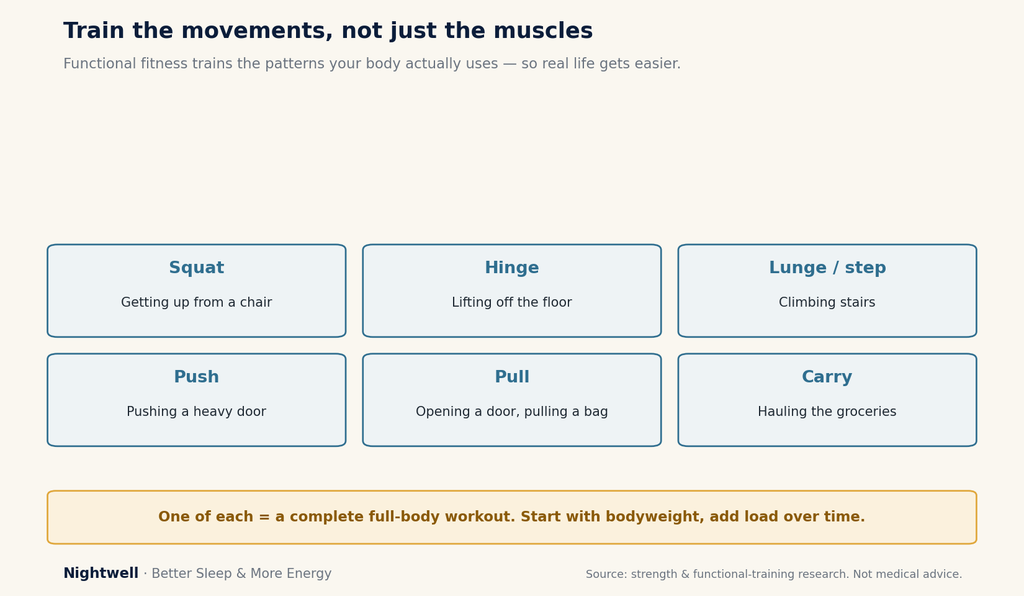
Strip away the fitness-industry noise and almost everything your body does comes down to about six fundamental patterns, each mirroring a daily task — as the graphic above shows:
- Squat — getting up from and down into a chair, using the toilet, picking something up. The most-used pattern of all.
- Hinge — bending at the hips to lift something off the floor, garden, or load luggage. This trains your posterior chain (glutes, hamstrings, lower back) and is one of the most important patterns for protecting your back — strengthening the hinge is a leading intervention for chronic low-back pain.
- Lunge / step — climbing stairs, stepping over things, walking with a full stride.
- Push — pushing a heavy door, getting up off the floor, pressing something overhead.
- Pull — opening a drawer or door, pulling a bag toward you, lifting.
- Carry — hauling the groceries, luggage, or a child. Carries build grip strength, posture, and core stability all at once.
There’s also a bonus pattern — rotation (and anti-rotation) — the twisting and bracing you do reaching across your body or steadying a load. Together, these patterns are the alphabet of human movement.
Why it’s worth training this way
Functional fitness delivers benefits that translate directly into your daily life:
- Everyday tasks get easier. Train the patterns under a little load and everything built on them — standing up, lifting, carrying, climbing — feels lighter and less effortful.
- Fewer injuries. Because you’re training your body to move the way it actually moves, you build resilience for real-world demands, and you learn to lift and bend safely rather than tweaking your back on a badly-lifted box.
- Better balance and coordination. Multi-joint, whole-body movements sharpen the coordination and stability that keep you steady — closely tied to the balance work that protects against falls.
- Independence as you age. This is the big one. The ability to rise from a chair, climb stairs, and carry things unaided is independence. Functional training is one of the best investments you can make in staying capable and self-reliant for decades.
- Efficiency. Because each exercise trains strength, mobility, stability, and coordination at once, you get a lot of benefit from a short, simple workout.
Build a workout from the patterns
Here’s how simple it is: instead of picking exercises from a list of muscles, pick one movement from each pattern, and you have a complete full-body workout in about six exercises. For example:
- Squat — bodyweight squats or chair stands
- Hinge — hip hinges or (with weight) deadlifts
- Lunge — reverse lunges or step-ups
- Push — push-ups (against a wall or the floor)
- Pull — band rows or doorway rows
- Carry / core — a loaded carry (hold something heavy and walk) or a plank
Do this two to three times a week with a rest day between sessions — which conveniently satisfies the strength recommendation in how much movement you actually need. It builds directly on the beginner strength routine: those foundational moves are functional patterns.
How to start — and progress
Start with bodyweight. Learn each pattern empty-handed before adding any load — master a lunge before picking up dumbbells. Poor form under load is where most training injuries start, so nail the movement first. It’s also completely scalable: begin with supported versions (chair stands, wall push-ups) if you need to, and progress from there. Functional training works for everyone, from athletes to older adults with mobility concerns.
Then progress gradually, in this order: harder variations first, then more reps or sets, then added weight. Gear can wait — bodyweight, then a pair of dumbbells, a kettlebell, and some resistance bands cover almost everything. Reassuringly, the functional payoff comes fast: people often report feeling stronger and moving more easily in daily life within the first few weeks, with strength gains typically noticeable in four to six weeks.
One honest note: “functional training” has picked up a slightly silly reputation thanks to influencers performing circus-act balancing tricks. Ignore that. Real functional fitness is the humble, time-tested basics — squat, hinge, push, pull, carry — done well. You don’t need to stand on one leg juggling; you need to squat, hinge, and carry with good form.
The bottom line
Functional fitness is training for the life you actually live. By strengthening the fundamental movement patterns — squat, hinge, lunge, push, pull, and carry — you make every real-world task easier, protect yourself from injury, sharpen your balance, and safeguard the independence that matters most as you age. Best of all, it’s refreshingly simple: pick one exercise per pattern, start with your bodyweight, focus on form, and progress slowly. Do that a couple of times a week and you won’t just look fitter — you’ll be more capable, in every squat, lift, and carry your day throws at you.
This article is for general information and education and isn’t medical advice. If you have an injury, a health condition, or concerns about your movement, please talk to a qualified healthcare professional, physiotherapist, or trainer before starting a new routine.
Sources: The 6 Fundamental Strength Training Movements; SilverSneakers — Functional Movements Everyone Should Be Able to Do; Functional Exercises for Healthy Aging