
The short answer
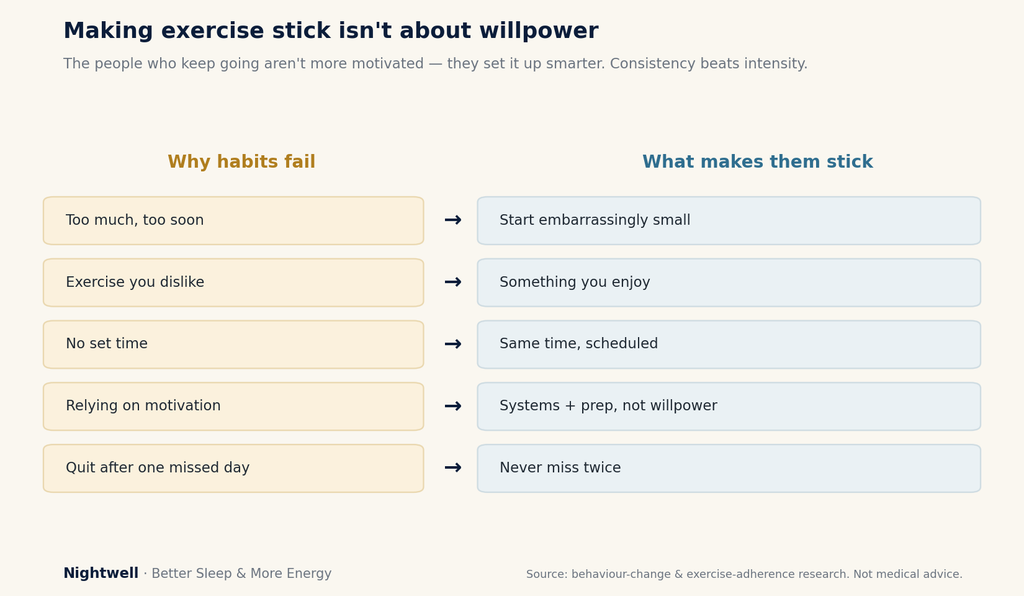
You already know exercise is good for you — the hard part is keeping it going. Most people don’t quit because they’re lazy or lack willpower; they quit because their strategy was wrong. They start too big, pick workouts they hate, rely on fleeting motivation, and give up the moment they miss a day. The fix is to work smarter, not harder: start embarrassingly small, choose movement you enjoy, attach it to a set time, remove friction, and treat one missed day as an accident rather than a failure. Do that and exercise stops being a battle and becomes something you just… do.
Why willpower isn’t the answer
Here’s the reframe that changes everything: the difference between people who exercise consistently and people who don’t isn’t motivation, genetics, or free time — it’s habit strategy. Research is clear that people who rely on motivation quit faster, while those who build a genuine habit stick with it far longer. Motivation is a feeling, and feelings come and go; a habit runs on autopilot with little effort, the same principle we cover in habits and routines. So the goal isn’t to summon more willpower — it’s to design a routine that barely needs any.
1. Start embarrassingly small
The single biggest mistake is starting too big — the classic “I’ll go to the gym for an hour, five days a week” that collapses within a fortnight. Instead, start so small it feels almost silly: a 10-minute walk, five squats, one song of movement. A daily 10-minute walk is a completely legitimate starting point. Your goal for the first month isn’t fitness — it’s simply showing up consistently, so the behaviour becomes automatic. Once the habit is stable, you build intensity gradually. Trying to get fit and build the habit at the same time is what breaks most people; nail the habit first, and the fitness follows.
2. Choose something you actually enjoy
This sounds obvious, yet most people build habits around exercise they dislike because it seems like the “right” thing to do. If you hate running, a running habit is doomed. Enjoyment is one of the strongest predictors of long-term adherence — so pick something at least neutral, ideally fun: walking, dancing, swimming, cycling, hiking, a sport, yoga, lifting. They all count. And here’s a useful truth: most people who say they “hate exercise” actually hate specific formats — boring, painful, or socially uncomfortable ones. Experiment until you find the version that makes you smile. The best workout is the one you’ll actually repeat.
3. Give it a set time and an anchor
Vague plans (“I’ll exercise sometime today”) lose to the day’s demands every time. Instead, tie your movement to a specific time and, ideally, to an existing habit — a technique called habit stacking: “after my morning coffee, I go for my walk.” The established routine becomes the reliable trigger, so you’re not relying on remembering or deciding. As for which time: morning has a slight edge because it happens before the day can derail it, but evening works just as well if that’s when you’ll actually do it. Consistency of timing matters far more than the specific hour.
4. Remove the friction
Every obstacle between you and starting is a reason to skip it. So make starting effortless: lay out your workout clothes the night before, pack your gym bag in advance, keep your trainers by the door, queue up a playlist. These small preparations signal to your brain that exercise is part of the plan — and on low-energy days, the easier it is to begin, the more likely you are to follow through anyway. Design your environment so the healthy choice is the path of least resistance.
5. Track it — and never miss twice
A simple calendar where you tick off each day is surprisingly powerful. Seeing a streak build creates momentum, and you’ll naturally not want to break the chain — a gentle nudge that keeps you going. But streaks also create a trap: people who miss one day often feel they’ve “failed” and quit entirely. So adopt one rule: never miss twice. One missed day is an accident; two in a row is the start of quitting. Missing a session now and then is completely normal — what matters is showing up more often than not. And for genuinely low-energy days, decide your “minimum effort” version in advance (a five-minute walk counts) so you keep the habit alive rather than breaking it.
6. Make it who you are
The most durable habits are tied to identity rather than outcomes. “I’m someone who moves every day” is a far more powerful driver than “I’m trying to lose weight.” Why? Because outcomes can fail to materialise — and when the scale doesn’t budge, outcome-based motivation evaporates. But an identity persists: once you see yourself as an active person, exercising is simply what you do, no negotiation required. Every time you show up, you cast a vote for that identity and it grows a little stronger.
Expect a wobble around week two
Knowing the timeline helps you push through the hard part. The first week or so often rides on novelty and enthusiasm. Then, around week two, the shine wears off — and this is exactly when most people quit. If you can hold your routine through that dip, the odds of it becoming automatic rise dramatically. Habits take time to form — often a couple of months — so expect an effortful early phase before it feels natural. Somewhere in there you’ll notice the shift: missing a workout starts to feel wrong, and you think about exercising without having to force it. That’s the habit taking hold.
A couple of extra boosters
- Add a social element. A workout friend, a class, or a group challenge adds accountability and enjoyment — and it’s much harder to skip when someone’s expecting you.
- Reward yourself. A small treat after a consistent week gives your brain something to look forward to and helps the habit loop lock in.
- Focus on the process, not the outcome. Celebrate showing up, regardless of how you performed. Consistency is the win; results are a by-product.
All of this rests on the same foundation as any behaviour change: action first, feelings later, systems over willpower — the mindset we explore in motivation vs discipline. And it doesn’t much matter what you choose — walking, strength, or anything else from the weekly movement guidelines — as long as you keep doing it. If you’re not sure where to start, a daily walk is about the easiest habit there is.
The bottom line
An exercise habit that sticks isn’t built on motivation or grit — it’s built on smart design. Start so small you can’t say no, pick movement you enjoy, anchor it to a set time, remove every bit of friction, track your streak, and never miss twice. Let it become part of who you are, brace for the week-two wobble, and lean on friends and small rewards to carry you. Do that, and exercise stops being the thing you keep restarting every January — and becomes a permanent, almost effortless part of your life.
This article is for general information and education and isn’t medical advice. If you have a health condition or have been inactive for a long time, please talk to a qualified healthcare professional before starting a new exercise routine.
Sources: How to Build an Exercise Habit That Actually Sticks; Getting Started with Exercise: Building a Sustainable Habit; How to Build a Workout Habit That Actually Sticks